
The best NBA duos of all time are more than famous pairings of talented players. They are partnerships that solved basketball’s hardest problem: how two stars can share control, elevate teammates, and keep winning when defenses devote entire game plans to stopping them. In NBA history, great teams usually begin with one superstar, but dynasties almost always require a second elite force. That is why player comparisons matter. Fans do not only ask who was better in isolation; they ask which combinations translated skill into championships, playoff resilience, and sustained dominance. A true duo is not simply two All-Stars on the same roster. It is a partnership with complementary strengths, defined roles, trust under pressure, and results that hold up across regular seasons and deep postseason runs.
When I evaluate historic NBA partnerships, I use a practical standard shaped by years of studying playoff film, lineup data, and championship contexts. The best duos combine peak performance, longevity together, tactical fit, and title equity. Peak performance asks how unstoppable they were at their best. Longevity matters because one magical run is different from a half decade of contention. Tactical fit examines how their skills meshed: on-ball creation, off-ball gravity, rim protection, perimeter defense, rebounding, tempo control, and late-game shotmaking. Title equity is the clearest test of all. Did the pairing actually win together, or did the idea of the duo remain stronger than the results? This article answers those questions while serving as a hub for player comparisons, because every top partnership also reveals how contrasting archetypes can succeed.
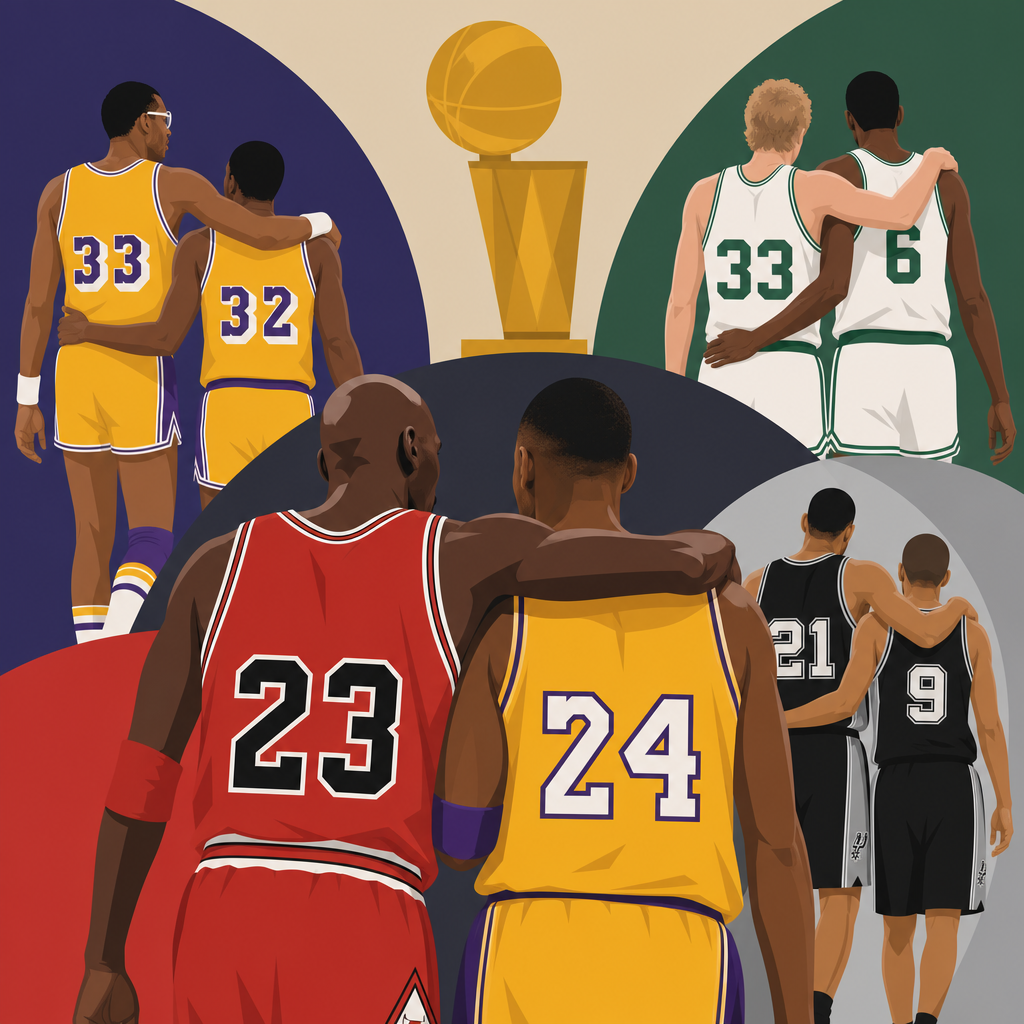
Historic duos also provide a useful framework for comparing players across eras. A dominant center paired with an elite guard creates different pressures than two perimeter scorers or a wing-big combination. Magic Johnson and Kareem Abdul-Jabbar ruled with transition control and half-court precision. Michael Jordan and Scottie Pippen overwhelmed teams with perimeter defense, pace, and relentless scoring pressure. Shaquille O’Neal and Kobe Bryant stressed defenses with interior force plus impossible shotmaking. Stephen Curry and Kevin Durant broke spacing models by forcing opponents to choose between the greatest shooter ever and a seven-foot scorer who could punish any coverage. By studying these pairings, readers can better understand individual value, roster construction, and why some stars amplify one another while others overlap in limiting ways.
This hub covers the best NBA duos of all time with a focus on partnerships that won together at the highest level. It also works as a guide to broader player comparisons within the NBA Players topic. Along the way, I will define what separates iconic duos from short-lived superteams, show how championship environments shaped each pairing, and explain what modern team builders can learn from these examples. The central idea is simple: the greatest duos were not just stacked on paper. They created answers to every major postseason question, and that is why their legacies endure.
What Makes an NBA Duo Truly Great?
An all-time duo needs more than star power. The first requirement is complementary skill. Two elite players can coexist without becoming historically effective if they need the same spaces, touches, and tempos. The best partnerships divide pressure points. One player collapses the defense at the rim, the other punishes help with shooting or playmaking. One handles primary scoring, the other covers defensive versatility, rebounding, or connective passing. This is why Tim Duncan and Tony Parker worked so well. Duncan anchored the paint, screened, scored efficiently on the block, and organized the defense. Parker bent defenses with penetration, early offense, and paint touches from the guard spot. Their strengths overlapped just enough to sustain the offense, but not so much that they reduced each other.
The second requirement is postseason translation. Regular-season brilliance matters, but playoff basketball strips away weak points. Opponents have time to scheme, hunt mismatches, and force stars into their least comfortable decisions. That is where the greatest duos separate themselves. Jordan and Pippen could win ugly defensive games. LeBron James and Dwyane Wade could generate transition points even when the half-court offense bogged down. Shaq and Kobe could survive slow-paced series because no team had a true answer for O’Neal inside while Bryant remained a bailout creator on late-clock possessions. If a duo repeatedly solved multiple playoff styles, its case strengthens dramatically.
The third requirement is durability of partnership. Some pairings flashed elite performance for a year or two, but the all-time list rewards sustained co-leadership. Playing together over several seasons forces adaptation through roster turnover, aging curves, injuries, and evolving league trends. Kareem and Magic won titles in different phases of their partnership and with different supporting casts. Duncan and Manu Ginobili, though less conventional as a marketing duo, remained central to title teams across distinct eras. Longevity proves that success was systemic, not accidental.
Finally, context matters. Championships are team achievements, and no duo wins alone. Comparing eras requires acknowledging league expansion, defensive rules, pace, playoff depth, and organizational stability. The goal is not to flatten history into a single statistic. It is to judge whether a pairing consistently gave its team the highest strategic ceiling in its era and then converted that advantage into banners.
The Gold Standard: Duos That Defined Dynasties
Michael Jordan and Scottie Pippen remain the cleanest model of a championship wing duo. Together they won six titles, reached two separate three-peats, and paired the league’s most feared scorer with the era’s premier perimeter utility defender. Jordan’s profile is obvious: unmatched scoring volume, elite midrange efficiency, playoff poise, and competitive pressure that distorted opponents before tipoff. Pippen supplied point-forward creation, transition handling, weak-side rim support, ball pressure, and matchup flexibility from point guards to power wings. Their real genius was strategic elasticity. Chicago could trap aggressively, play in space, attack through the triangle, or let Jordan isolate when structure broke down. That mix of floor and ceiling is why they sit near the top of almost every serious player comparison discussion.
Magic Johnson and Kareem Abdul-Jabbar built a different but equally historic blueprint. Kareem gave the Lakers a half-court anchor with the skyhook, reliable rim protection, and elite defensive rebounding. Magic transformed the team’s tempo, passing geometry, and emotional tone. In transition, he turned routine rebounds into immediate pressure. In the half court, his size let him see over traps and feed Kareem in deep position. They won five championships together, and their longevity matters because they remained dangerous even as roles shifted with age. Kareem’s scoring burden changed, Magic’s control expanded, yet the partnership still centered title contention.
Tim Duncan and Tony Parker deserve more respect in public debates than they often receive. They won four championships together as primary pillars and reached the playoffs annually during their shared prime. Duncan was the franchise conscience: elite interior defender, dependable low-post scorer, and one of the smartest help defenders the league has seen. Parker, especially from 2005 through 2014, gave San Antonio dribble penetration that many Duncan-led rosters otherwise lacked. Their pick-and-roll chemistry, supported by Gregg Popovich’s spacing adjustments, evolved with the league. Early Spurs teams won with defense and size. Later versions used pace, ball movement, and drive-and-kick principles. A duo that thrives across stylistic transformations has earned all-time status.
Here is a concise comparison of landmark partnerships that won repeatedly:
| Duo | Titles Together | Primary Strength | Why It Worked |
|---|---|---|---|
| Jordan and Pippen | 6 | Two-way wing dominance | Elite scoring, perimeter defense, and adaptable half-court offense |
| Magic and Kareem | 5 | Tempo plus interior control | Transition playmaking balanced by dependable post scoring |
| Duncan and Parker | 4 | Structure and penetration | Paint defense, pick-and-roll pressure, and long-term continuity |
| Shaq and Kobe | 3 | Interior force plus perimeter shot creation | Impossible size matchup inside and elite late-clock scoring outside |
Interior Force and Perimeter Firepower
Some of the best NBA duos of all time paired a dominant big with a superstar guard or wing. Shaquille O’Neal and Kobe Bryant are the defining example. From 2000 to 2002, they won three straight championships and reached a level of postseason inevitability that few teams have matched. Shaq’s value was not just volume scoring. He forced constant double-teams, put opposing frontcourts in foul trouble, controlled the offensive glass, and generated high-efficiency offense in low-possession playoff games. Kobe supplied a completely different stress point. He could attack from the perimeter, create against set defenses, and punish teams that overloaded the paint. Their tension off the court is well documented, but on the court the fit was devastating because each star solved a problem the other could not solve alone.
Kobe Bryant and Pau Gasol deserve separate recognition because they are sometimes overshadowed by the Shaq years. Yet this partnership won back-to-back titles in 2009 and 2010 and made three consecutive Finals. Gasol was not just a skilled secondary scorer. He was a high-post facilitator, screen partner, soft-touch interior finisher, and positional rebounder whose decision-making fit Phil Jackson’s triangle offense. Kobe remained the primary shot creator and defensive tone-setter on the perimeter. This duo illustrates an important lesson in player comparisons: raw star ranking is not the only variable. Sometimes the better partnership comes from cleaner fit, emotional steadiness, and balanced offensive responsibilities rather than higher individual peak prestige.
LeBron James and Anthony Davis belong in this conversation even though their title count together is smaller. At their 2020 peak, they produced one of the league’s most complete modern duos. LeBron orchestrated the offense as a jumbo primary creator, while Davis supplied elite finishing, switchable defense, weak-side shot blocking, and face-up scoring. The reason they rank below the foundational dynastic pairs is availability and duration, not quality of fit. When healthy, they have offered the exact template front offices seek: a ball-dominant initiator plus a defensive anchor who can score without monopolizing every possession.
Elite Wing Pairings and Modern Offensive Geometry
Wing duos are often the easiest to scale in postseason basketball because they can defend across positions, create their own shots, and stay playable in every lineup context. Jordan and Pippen set the standard, but modern examples expanded the spacing dimension. LeBron James and Dwyane Wade reached four straight Finals and won two championships in Miami. At first, skeptics questioned the fit because both preferred the ball and neither was built around high-volume three-point shooting. The partnership succeeded because both attacked the rim relentlessly, defended in space, and generated transition offense at an elite rate. Surrounded by shooting and anchored by Chris Bosh’s willingness to adapt, they became overwhelming in open court situations and terrifying when trapping defensively.
Stephen Curry and Kevin Durant created perhaps the most unguardable offensive duo ever assembled. Their partnership produced two championships and two Finals MVP runs for Durant, but the tactical story is larger than awards. Curry’s off-ball movement and shooting gravity stretched defenses to uncomfortable distances, often beyond standard help principles. Durant then punished compromised matchups with pull-up shooting, rim finishes, and release-point advantages no defender could neutralize. In practical terms, teams had to choose between top-locking Curry and allowing slips, or staying home and letting Durant attack one-on-one. Few duos have ever imposed such mathematically efficient shot profiles on elite defenses.
Larry Bird and Kevin McHale deserve mention as a less conventional wing-big hybrid. Bird operated as a shooting forward with visionary passing and clutch shotmaking. McHale provided low-post efficiency, length, and interior scoring counters that punished single coverage. Their Celtics teams were beautifully balanced, especially when Robert Parish and deep frontcourt support reinforced them. What made Bird and McHale special was how little offensive waste existed between them. Bird could score from anywhere while elevating others; McHale converted possessions with footwork and touch that remain instructional for post players today.
How to Compare Duos Across Eras Without Oversimplifying
Era comparison is where many player debates lose precision. The 1980s Lakers played faster than the grind-heavy late 1990s Bulls. Illegal defense rules, hand-checking standards, three-point volume, sports science, travel conditions, and expansion all changed the environment. A useful method is to compare duos by dominance relative to their competition, not by raw totals alone. Jordan and Pippen ruled a slower, more physical era by controlling both ends. Curry and Durant dominated in a spacing era where skill and efficiency reached new heights. Duncan and Parker thrived during a tactical transition period from bruising half-court basketball to motion-heavy spread concepts.
Another essential factor is support structure. Great duos benefit from coaching clarity, front-office competence, and role-player alignment. That does not diminish them; it explains how winning actually works. Magic and Kareem had Pat Riley and strong roster continuity. Duncan and Parker had Popovich, Manu Ginobili, and a culture of tactical adaptation. Kobe and Gasol had Jackson, Lamar Odom, and elite size. When readers compare duos, the most accurate question is not “Who had more help?” in a simplistic sense. It is “How well did the team ecosystem amplify the duo’s strengths and protect its weaknesses?”
For readers using this page as a hub for player comparisons, that framing is the main takeaway. Compare role fit, playoff scalability, lineup flexibility, and championship proof. Those filters separate memorable names from historic partnerships. If you want to go deeper, use this article as the starting point for related comparisons: Jordan versus LeBron, Kobe versus Wade, Duncan versus Kobe, Shaq versus Hakeem, Curry versus Magic, and the larger question of whether the best team-building model is guard-big, wing-wing, or creator-anchor. The best NBA duos of all time won because they answered those construction questions better than everyone else.
The greatest NBA duos combined individual brilliance with dependable partnership. Jordan and Pippen mastered two-way wing control. Magic and Kareem joined pace, vision, and interior dominance. Duncan and Parker proved that continuity and fit can outlast stylistic change. Shaq and Kobe showed how overwhelming force inside pairs with elite perimeter creation. Curry and Durant demonstrated how modern spacing can become virtually unsolvable when both stars scale perfectly. Across eras, the details differ, but the standard stays the same: complementary skills, postseason reliability, and championships won together.
That is why this topic matters within any serious NBA Players discussion. Player comparisons become more accurate when they account for partnership dynamics rather than treating stars as isolated cases. The best duos reveal how talent translates into banners, how roles sharpen greatness, and how roster construction turns elite players into champions. Use this hub as your foundation for deeper comparisons across positions, eras, and team-building models. Then explore the connected matchups, because understanding the best NBA duos of all time is one of the fastest ways to understand basketball history itself.
Frequently Asked Questions
What makes an NBA duo truly one of the best of all time?
The best NBA duos of all time are defined by much more than name recognition, highlight reels, or individual awards. A truly historic pairing combines elite talent with functional chemistry, postseason success, and the ability to make teammates better while sharing responsibility at the highest level. In other words, greatness as a duo is not just about putting two stars on the floor together; it is about whether their games complement each other in ways that lead to sustained winning.
That usually starts with fit. Some legendary duos balanced perimeter creation with interior dominance, while others paired scoring with defense, playmaking with finishing, or leadership with versatility. The most successful partnerships solved the challenge that many star pairings never fully overcome: deciding when one player should take over and when the other should support, all without disrupting rhythm or ego. The greatest duos made those decisions look natural.
Championships matter heavily in this conversation because the title of “best duo” carries a standard beyond regular-season brilliance. Historic partnerships are remembered because they won when defenses were specifically designed to stop them. They adjusted across playoff rounds, held up under pressure, and delivered in defining moments. Longevity also matters. A duo that wins once can be special, but a duo that contends for years, wins multiple titles, and defines an era enters a different category entirely.
So when fans debate the best NBA duos ever, they are usually weighing a combination of peak dominance, versatility, playoff performance, championships, cultural impact, and staying power. The greatest pairings were not just individually elite players standing next to each other. They were basketball partnerships that consistently produced results.
Why are championships so important when ranking the greatest NBA duos in history?
Championships matter because they are the clearest proof that a duo’s talent translated into team success at the highest possible level. In the NBA, there are plenty of star pairings that looked unstoppable on paper or dominated stretches of the regular season. What separates the all-time great duos is that they turned that talent into championships against elite competition, under playoff pressure, and across long postseason runs where every weakness is exposed.
The playoffs are where a duo’s value is tested most honestly. Opponents have time to study tendencies, build specific game plans, and force stars into uncomfortable situations. A legendary partnership responds by adapting. One player may draw double teams so the other can attack. One may carry the scoring load in one series, while the other anchors defense or controls tempo in the next. Winning a title shows that the duo was not just impressive statistically, but resilient and versatile enough to survive the hardest basketball environment.
That said, championships are not the only factor. Context matters. Some duos faced dynastic opponents, injuries, weak supporting casts, or shorter windows together. A ringless pairing can still rank among the most talented or influential ever. But when the conversation is specifically about the best duos of all time, championships often become the defining separator because they show that the partnership accomplished the ultimate objective together, not just individually.
In short, titles matter because they validate chemistry, sacrifice, and execution. They prove that two stars did more than coexist. They solved the hardest challenge in basketball: sharing greatness in a way that kept producing wins when everything was on the line.
Which legendary NBA duos are most often mentioned in the all-time debate?
Several pairings appear in almost every serious discussion of the greatest NBA duos ever because they combined star power, team success, and long-term impact. Michael Jordan and Scottie Pippen are a standard choice because they led the Chicago Bulls to six championships and defined the modern image of a championship wing duo. Jordan was the league’s most dominant scorer and closer, while Pippen gave the Bulls elite defense, playmaking, versatility, and the ability to thrive in a secondary star role without diminishing the team’s ceiling.
Magic Johnson and Kareem Abdul-Jabbar are another foundational pairing in the debate. Together, they powered the Los Angeles Lakers through one of the NBA’s most successful eras, winning multiple championships with a blend of pace, intelligence, and interior excellence. Magic controlled games with vision and tempo, while Kareem remained one of the most dependable and efficient offensive anchors in league history. Their partnership worked across different stages of their careers, which strengthens their case.
Shaquille O’Neal and Kobe Bryant are almost always included because their peak was overwhelming. At their best, they were one of the most physically and offensively unstoppable combinations the league has ever seen. Three straight championships gave them a résumé that few duos can match, even if their relationship was often complicated behind the scenes. Their success is also a reminder that perfect personal harmony is not required if the basketball fit is dominant enough.
Other frequently cited pairings include Tim Duncan and Tony Parker, whose consistency fueled the Spurs dynasty; Bill Russell and Bob Cousy, who helped define early championship basketball in Boston; and Stephen Curry and Klay Thompson, whose shooting changed the geometry of the sport and powered a modern dynasty. Depending on how broadly people define a duo, LeBron James and Dwyane Wade, Larry Bird and Kevin McHale, and even newer pairings may enter the conversation. The exact ranking varies, but these names appear often because they combined elite individual talent with winning that lasted.
How do fans and analysts compare duos from different NBA eras?
Comparing duos across eras is difficult because the game has changed dramatically in style, pace, rules, spacing, athletic demands, and even the way stars are used. A dominant pairing from the 1960s played in a very different environment than one from the 1990s or 2010s. That is why most thoughtful comparisons focus less on raw statistics alone and more on how much a duo dominated relative to its own era, how consistently it won, and how much it influenced the way basketball was played.
For example, older duos may not have the same scoring efficiency or three-point volume as modern pairings, but they often played in more compressed offensive systems and under different physical standards. Meanwhile, newer duos benefit from spacing and offensive freedom, but they also face more complex defensive schemes and deeper scouting. Era-adjusted thinking helps avoid unfair conclusions. Instead of asking only who had the better box-score numbers, it is smarter to ask who controlled championship races, who forced opponents to change strategy, and who sustained excellence over time.
Analysts also look at role balance and basketball synergy. A duo that fit perfectly within its era can be just as impressive as one with louder individual numbers. Some pairs transformed transition offense, some mastered half-court execution, and others built their value through defense and versatility. The goal is not to pretend every era was identical. It is to identify which partnerships were the most effective and influential within the conditions they actually faced.
That is why all-time duo debates rarely produce universal agreement. They combine measurable success with interpretation. The strongest comparisons usually respect context, value championships, and recognize that dominance can look different depending on the decade. Greatness across eras is best judged by impact, adaptability, and whether the duo became the defining force of its time.
Can a duo be considered all-time great if the players were individually better apart than together?
Yes, but it depends on what kind of greatness is being measured. If the conversation is about the best individual players who happened to share the floor, then separate career value matters a great deal. But if the discussion is about the best NBA duos of all time, what matters most is what the pair accomplished together. A duo can include two all-time players and still fall short historically if the partnership itself did not maximize winning. On the other hand, a pairing can rank extremely high because of chemistry, fit, and championships even if one or both players had stronger individual stretches outside that partnership.
This is an important distinction because basketball history is full of stars whose careers evolved in different contexts. Some players were better statistically before joining a co-star because they had more control over the offense. Others became more efficient or more successful after sacrificing touches for a partnership that raised the team’s ceiling. That sacrifice should not be seen as a weakness. In many cases, it is exactly what makes a duo great. The ability to share spotlight, accept role adjustments, and still dominate is a major part of championship basketball.
There are also pairings where one player was clearly the primary force and the other was the ideal complement. That does not make the second player less important to the duo’s legacy. In fact, some of the greatest partnerships ever worked because the supporting star filled the exact gaps the lead star could not. Elite defense, secondary playmaking, spacing, rebounding, or late-game composure can be just as valuable to a duo’s overall success as headline scoring numbers.
So yes, players can absolutely have larger individual résumés outside the partnership and still be part of an all-time great duo. The key question is not whether both players were always at their personal peak together. It is whether their combination created a level of winning, balance, and postseason success that deserves a place among the most effective partnerships in NBA history.