
Michael Jordan’s baseball years remain one of the most debated chapters in sports history because they combined grief, ambition, celebrity pressure, and a rare willingness from the world’s best basketball player to start over in public. In NBA history, the phrase “Michael Jordan baseball years” usually refers to his retirement from the Chicago Bulls in October 1993, his pursuit of professional baseball in 1994, and the lessons that shaped his return to basketball in 1995. For readers exploring legends and eras, this story matters because it connects the late 1980s Bulls rise, the first three-peat, the culture of superstar branding, and the broader question of how elite athletes respond when identity is disrupted.
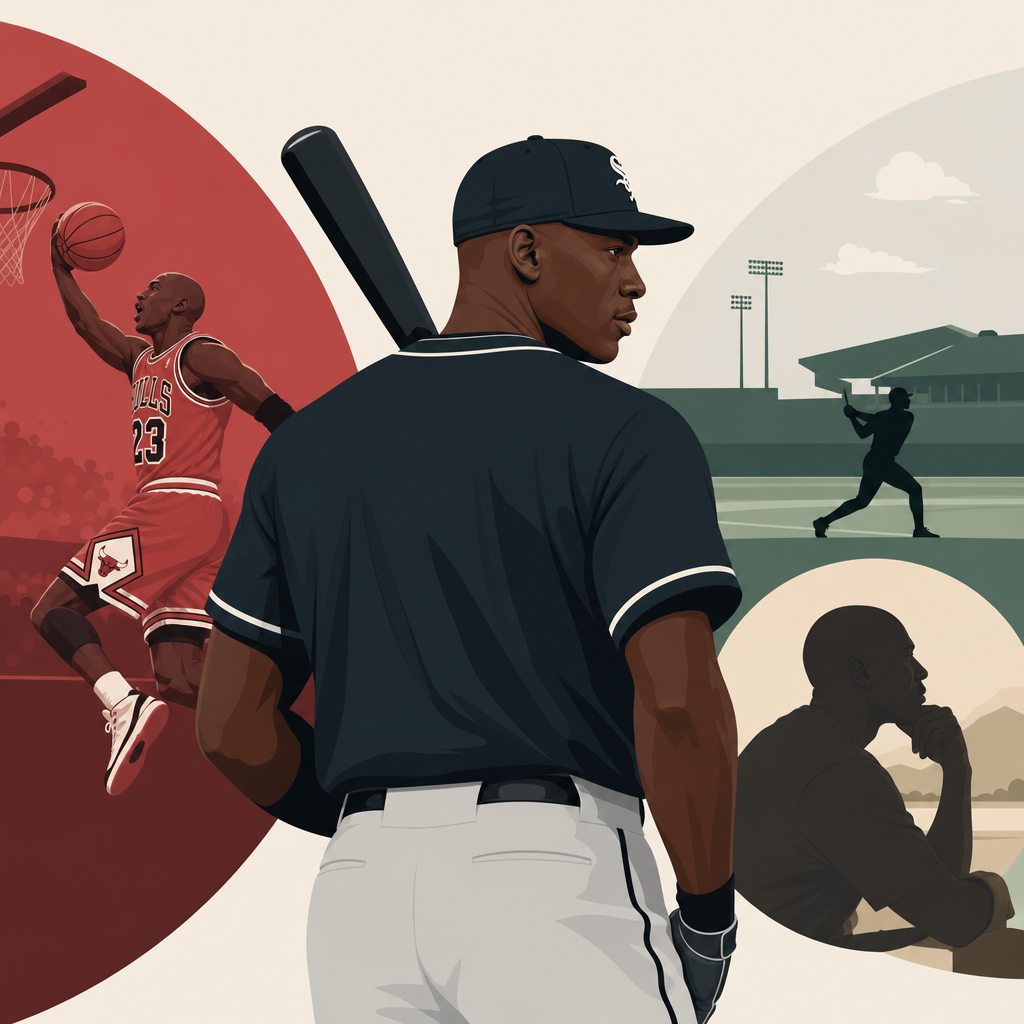
Jordan did not leave basketball because he had stopped dominating. He retired months after winning his third straight NBA championship and his third consecutive Finals MVP award. He was 30 years old, at the peak of his fame, and still the league’s defining figure. The shock came from timing. His father, James Jordan, had been murdered in July 1993, and Jordan later said his father had always imagined him playing baseball. That detail is essential. The move was not a publicity stunt in the usual sense; it was a personal decision made during a period of exhaustion and loss. It also unfolded under intense speculation about gambling, media scrutiny, and whether he would ever return.
As a hub page for legends and eras, this article explains not only why Jordan left and what he learned, but also what the episode reveals about athletic greatness across generations. Basketball history often gets reduced to rings and scoring titles. Jordan’s baseball detour offers a more useful lens: greatness is partly resilience, adaptation, and the ability to fail visibly without losing competitive identity. I have studied this period through game logs, interviews, documentary footage, and the historical record around the Bulls, White Sox, and Birmingham Barons, and one conclusion holds up. Jordan’s baseball years did not weaken his legacy. They made his career easier to understand in full.
Why Michael Jordan Left the NBA in 1993
The direct answer is that multiple pressures converged at once. The most important was his father’s death. Jordan had been exceptionally close to James Jordan, who encouraged both basketball and baseball and remained central to his son’s confidence. When James Jordan was killed, Jordan lost more than a parent; he lost a stabilizing voice at the exact moment his public life had become overwhelming. By the summer of 1993, he had already led the Bulls to three championships, carried global marketing obligations, faced nonstop media attention, and absorbed criticism tied to his gambling habits. None of those issues alone explains retirement. Together, they created a genuine breaking point.
Jordan announced his retirement on October 6, 1993. At the press conference, he emphasized that he had lost the desire to play basketball and no longer felt the same motivation. That statement has often been misunderstood. People sometimes hear “lost the desire” and assume decline, but Jordan was speaking about emotional depletion, not skill erosion. The timing matters in NBA history because the league had never seen its biggest star voluntarily walk away so soon after a title. In practical terms, the retirement froze the Bulls’ first dynasty at three championships and opened a power vacuum that teams such as the Houston Rockets immediately occupied.
There was also another layer: Jordan needed distance from a game that had become inseparable from grief. Every arena, every camera angle, and every postgame question would have pulled him back into the same emotional cycle. Baseball offered a different daily structure, a new clubhouse, and a sport linked to childhood memories and his father’s wishes. That does not mean his NBA departure was inevitable. It means the baseball decision made psychological sense at a moment when normal career logic did not apply. For understanding legends and eras, this is crucial. Historical turning points often come from personal forces that statistics alone cannot capture.
How the Baseball Experiment Actually Worked
In February 1994, Jordan signed a minor league contract with the Chicago White Sox organization, owned by Jerry Reinsdorf, who also owned the Bulls. Jordan reported to spring training and was assigned to the Double-A Birmingham Barons. This is the part casual fans often miss: he did not bypass development and go straight to the majors. He entered a demanding level of professional baseball where pitchers could command breaking balls, exploit timing flaws, and punish hitters who had not seen elite live pitching in years. Jordan had played baseball as a teenager, but he had not devoted himself to the sport full-time since high school.
His 1994 season with Birmingham was respectable in context, though not star caliber by ordinary prospect standards. In 127 games, he batted .202 with 3 home runs, 51 RBIs, 30 stolen bases, and 114 strikeouts. Those numbers look modest until you factor in the gap in experience. Jordan was facing players who had spent years refining swing mechanics, pitch recognition, and situational hitting. Baseball is less forgiving than basketball when an athlete relies only on explosiveness and will. Timing is technical, and failure is routine. Jordan had to learn how to survive a sport where even strong performers fail most of the time.
I think this is where the public conversation often becomes lazy. Many summaries say he “couldn’t play baseball,” but that ignores the developmental reality. Several evaluators, including manager Terry Francona, noted that Jordan improved during the year and was not embarrassing himself. He drew walks, ran the bases aggressively, and handled outfield responsibilities competently. Scouts still doubted his path to the major leagues, especially given his age, but they also saw work ethic. The baseball years are best understood as legitimate professional apprenticeship, not a novelty tour.
| Topic | What Happened | Why It Mattered |
|---|---|---|
| 1993 retirement | Jordan left the Bulls after a third straight title | Ended the first Bulls dynasty phase and shocked the league |
| 1994 baseball season | Played Double-A for the Birmingham Barons | Tested whether elite athleticism could transfer across sports |
| Skill challenge | Faced advanced pitching after years away from baseball | Exposed how specialized baseball development really is |
| Mental reset | Entered a new clubhouse with lower status than in the NBA | Forced humility, routine, and renewed competitive hunger |
| 1995 return | Jordan rejoined the Bulls late in the season | Set up the second three-peat and a new phase of his legend |
What Jordan Learned From Minor League Baseball
The clearest lesson was humility. In basketball, Jordan had complete command of the court. In baseball, he was a learner again. He could not impose his will on every possession because baseball has no possession structure. A hitter may wait several minutes between plate appearances, then get one pitch to drive and miss it by a fraction of an inch. That rhythm demands patience and emotional control. By all accounts, Jordan embraced the grind. He took extra batting practice, worked on footwork and reads in the outfield, and accepted coaching in ways superstars are not always forced to do.
He also learned that athletic greatness is not fully transferable without repetition. Basketball fans often assume elite traits translate automatically: hand-eye coordination, speed, competitiveness, body control. Those help, but baseball punishes any gap in technical refinement. Jordan had to improve pitch recognition, shorten his swing path, handle inside fastballs, and adjust to off-speed sequencing. That education likely sharpened his respect for preparation. When he returned to the NBA, his game reflected renewed discipline, especially in conditioning, mid-post execution, and situational focus. The baseball years did not give him new basketball talent; they deepened his appreciation for precision.
Another lesson was perspective. In Birmingham, Jordan was not protected by championship status. He rode buses, played before smaller crowds, and lived inside the ordinary uncertainties of minor league baseball. That matters because celebrity can distort competition. In the minors, the work itself became central again. Teammates judged whether he prepared, listened, and competed, not whether he sold shoes or led SportsCenter. For a player who had been mythologized by age 30, that reset may have been invaluable. It stripped performance down to effort, adjustment, and routine—the foundations of any long career.
Did Gambling Force Him Out? Separating Fact From Myth
No credible evidence shows that the NBA secretly suspended Jordan and disguised it as retirement. The theory persists because it offers dramatic simplicity, but the historical record does not support it. Jordan’s gambling was real and newsworthy. Reports in the early 1990s detailed high-stakes golf bets, casino activity, and debt allegations linked to convicted individuals. NBA commissioner David Stern investigated concerns around the league’s image, and Jordan himself acknowledged that his gambling could be embarrassing, though he denied it compromised competitive integrity. That distinction matters. Public controversy existed, but controversy is not proof of a hidden punishment.
The stronger explanation remains the one Jordan gave consistently: emotional burnout compounded by his father’s death. From my review of the timeline, that explanation fits both his behavior and the practical consequences. If the league had wanted to quietly remove Jordan, allowing him to join another professional sport under the ownership umbrella of Jerry Reinsdorf would have created fresh attention, not less. It also would have risked long-term reputational damage if exposed. More importantly, Jordan’s eventual return and dominance align with an athlete who needed distance and later recovered motivation, not with one serving an undisclosed penalty.
This does not mean every question around the period is unreasonable. Serious sports history requires acknowledging why speculation took hold. Jordan was too famous for the public to accept an ordinary explanation, and the early 1990s media environment rewarded insinuation. But when weighing evidence, historians should prefer documented motives over conspiracy. The documented motives are grief, fatigue, and a meaningful connection to baseball through his father. That interpretation is both more credible and more human.
How the Baseball Years Changed Jordan’s NBA Return
Jordan returned to the Bulls on March 18, 1995, with the two-word statement “I’m back.” The phrase became iconic, but the basketball reality was messy at first. He was still brilliant, yet not fully conditioned for playoff basketball after time away, and the Bulls were not yet the finished machine of the later second three-peat. Orlando eliminated Chicago in the 1995 playoffs, and Jordan’s rust showed in moments, especially late-game decision-making under playoff pressure. That brief failure is important because it completed the lesson of the baseball years: talent alone was never enough, even for Jordan.
What followed was one of the strongest rebuttals to complacency in sports history. During the 1995–96 season, Jordan returned with a sharper physical base, stronger focus, and a clear sense of purpose. The Bulls won 72 games, at the time the best regular-season record in NBA history, and captured the championship. Jordan then led Chicago to titles again in 1997 and 1998, completing a second three-peat. I have always viewed this stretch as inseparable from the baseball detour. Time away clarified what he wanted, while failure in another arena reignited the obsessive edge that had dulled under grief and exhaustion.
His post-baseball style also matured. Early Jordan overwhelmed teams with relentless athletic attacks. After baseball and into his second championship run, he played with more pacing, footwork, and calculated control. The fadeaway, post seals, and tempo management became even more central. Some of that evolution came naturally with age, but some came from renewed attention to detail. In that sense, baseball taught him not just humility but economy—how to dominate through precision when rhythm, not raw force, decides outcomes.
Why This Story Matters in the History of Legends and Eras
Jordan’s baseball years sit at the center of the legends-and-eras conversation because they reveal how careers become mythology. Every era has stars, but only a few players reshape how an era is remembered. Jordan’s first retirement split the 1990s into alternate timelines: the Bulls dynasty before baseball, the Rockets championship window during his absence, and the Bulls dynasty after his return. That interruption changed legacy debates for Jordan, Hakeem Olajuwon, Scottie Pippen, and the league itself. It also amplified Jordan’s image because absence made his dominance feel even larger when he came back.
For readers using this page as a hub under NBA history, Jordan’s baseball chapter connects naturally to broader subjects: how dynasties rise and pause, how superstar labor and mental strain affect performance, how media narratives shape legacy, and how different eras compare when stars leave or lose time. It belongs alongside discussions of Magic and Bird defining the 1980s, Hakeem’s prime in the mid-1990s, the Bulls’ tactical evolution under Phil Jackson and Tex Winter, and later debates about LeBron James, Kobe Bryant, and modern player empowerment. Jordan’s detour is not a side note. It is a bridge between eras.
The final lesson is simple. Michael Jordan left basketball because he was grieving, exhausted, and drawn toward a dream tied to his father. He learned humility, technical respect, patience, and the value of starting over. When he returned, those lessons helped produce an even more complete champion. If you are building a deeper understanding of NBA history, use this story as a starting point, not an exception. Follow the connections from Jordan to the Bulls, the 1990s title landscape, and the legends who defined each era, because that is where basketball history becomes fully clear.
Frequently Asked Questions
Why did Michael Jordan leave basketball to play baseball in 1993?
Michael Jordan left the NBA in October 1993 because several powerful factors converged at once. The most personal reason was the death of his father, James Jordan Sr., earlier that year. Jordan spoke openly about how deeply that loss affected him, and it changed his perspective on basketball, competition, and life outside the sport. His father had loved baseball and had often imagined Michael pursuing it, so the decision to step away from the Bulls and try baseball carried emotional meaning far beyond a simple career move. It was not just about switching sports. It was also about grief, identity, and honoring a family connection during a painful period.
There were also professional and psychological reasons. By 1993, Jordan had already led the Chicago Bulls to three straight NBA championships and had reached a level of fame and pressure that few athletes in history have experienced. Every season came with enormous expectations, constant media attention, and little room for rest. Even though he was still at the top of the basketball world, he had spent years under intense competitive strain. Stepping away gave him distance from that relentless cycle. For many observers, the baseball decision looked shocking because he was still the best player in basketball, but from Jordan’s perspective it appears to have been a serious effort to pursue something meaningful while resetting mentally and emotionally.
Importantly, his departure should not be reduced to a publicity stunt or a random impulse. He signed with the Chicago White Sox organization and committed himself to learning a difficult sport after years away from it. That willingness to start over, especially in public, is one reason the Michael Jordan baseball years remain so compelling. He was not protecting a legacy in that moment. He was risking it, and that risk says a lot about his mindset.
How good was Michael Jordan at baseball, and did he have a real chance to make the majors?
Michael Jordan was not a major league-caliber player during his baseball run, but he was also not merely a celebrity pretending to compete. In 1994, he played for the Birmingham Barons, the Double-A affiliate of the Chicago White Sox, which placed him against legitimate professional prospects in a highly demanding environment. That level matters because Double-A is where players often face advanced pitching, sharper defensive play, and a faster mental game. Jordan had not played organized baseball seriously in many years, so the gap he needed to close was enormous.
His raw statistics reflected that challenge. He showed flashes of athleticism, work ethic, and base-running ability, but he also struggled with pitch recognition and consistency at the plate, which is common for players trying to adjust to high-level professional pitching. Baseball is a sport built on repetition, timing, and years of development, and Jordan was trying to compress a long learning process into a short window while the entire sports world watched. Scouts and coaches often noted that he improved over time, especially considering how much ground he had to make up. That improvement is important because it suggests the experiment was real and not symbolic.
As for whether he had a real chance to reach Major League Baseball, the honest answer is that it would have been difficult. Jordan was already in his early 30s, and baseball development usually rewards players who have spent years refining mechanics and instincts. Still, people inside the game have said his athletic gifts and dedication were genuine enough that, with more time, he might have continued progressing. That does not mean he was on the verge of becoming a major leaguer. It means he earned respect for competing seriously in a sport where reputation alone could not carry him. His baseball years are remembered less as a near-miss major league story and more as proof of how hard it is to master a second professional sport, even for one of the greatest athletes ever.
Were Michael Jordan’s baseball years connected to burnout and pressure from NBA fame?
Yes, burnout and pressure were almost certainly part of the story, even if they were not the only reasons. By the time Jordan retired in 1993, he had become more than a basketball superstar. He was a global icon whose every move generated headlines, criticism, business attention, and public fascination. The pressure of carrying the Bulls, winning championships, meeting impossible expectations, and living under nonstop scrutiny can wear down even the most driven athlete. Jordan’s competitive fire was legendary, but that does not make him immune to exhaustion. In many ways, the baseball chapter can be understood as both an emotional response to personal loss and an escape from the weight of his basketball life.
It is also important to remember that Jordan had already accomplished what most athletes never approach. Three consecutive NBA titles, multiple MVP-level seasons, and status as the best player in the world created a strange kind of challenge: what comes next when you have already reached the summit? For some athletes, repeating greatness is energizing. For others, the cost of sustaining it becomes overwhelming. Jordan’s baseball decision opened a different kind of test, one where he was no longer guaranteed dominance. That kind of reset may have been psychologically valuable because it replaced the burden of protecting perfection with the freedom to learn again.
The public often treats elite athletes as machines, but Jordan’s baseball years remind readers that motivation changes over time. Grief, fatigue, curiosity, and the desire to reclaim a more personal dream can all exist together. So while it would be too simplistic to say he left only because he was burned out, it is fair to say that the pressure of NBA stardom formed an important backdrop. His temporary exit makes more sense when viewed not as a mystery, but as the human decision of a person carrying an extraordinary amount.
What did Michael Jordan learn from playing baseball, and how did it affect his return to the NBA?
One of the biggest lessons Jordan appears to have gained from baseball was renewed humility. In basketball, he had already mastered nearly every challenge in front of him. In baseball, he had to become a beginner again. That meant dealing with failure in a very different form. Even great baseball players fail regularly at the plate, and Jordan had to adapt to a sport where progress can be slow, confidence can fluctuate, and improvement depends on patience as much as intensity. For someone known for dominance, that experience likely sharpened his mental resilience in new ways.
He also learned the value of process over immediate results. Basketball had made Jordan a symbol of control and inevitability, but baseball forced him into development mode. He had to study mechanics, timing, and situational details without the assurance that hard work would instantly translate into success. That kind of disciplined struggle can deepen an athlete’s perspective. When he returned to the NBA in 1995, he seemed to bring back not only his familiar competitiveness but also a refreshed sense of purpose. He was no longer just defending a legacy. He was reengaging with the sport after stepping away from it, which often gives elite performers a clearer understanding of what they truly love about their craft.
His comeback years support that interpretation. After returning, Jordan helped lead the Bulls into another championship era, including the famous second three-peat. It would be too neat to say baseball alone made that possible, but the time away appears to have reset him emotionally and mentally. The baseball years reminded him what it meant to chase excellence without guarantees, and that perspective likely strengthened the focus, hunger, and appreciation he carried into the next phase of his basketball career. In that sense, baseball was not a detour away from greatness. It was part of the path that reshaped it.
Why are Michael Jordan’s baseball years still so important in sports history?
Michael Jordan’s baseball years matter because they challenge the standard sports narrative that greatness must always be linear, dominant, and uninterrupted. Most legends are celebrated for staying on top, avoiding vulnerability, and protecting their image. Jordan did the opposite. At the peak of his powers, he stepped away from the sport he ruled and entered one where he was inexperienced, imperfect, and heavily scrutinized. That made the episode unusual then, and it makes it historically fascinating now. It revealed a side of athletic greatness that includes risk, grief, reinvention, and public failure.
They are also important because they humanize a figure who is often discussed in mythic terms. Jordan’s basketball career can feel almost too complete, too iconic, to fully grasp on a human level. The baseball chapter interrupts that myth just enough to make it more interesting. Here was the world’s most famous athlete trying to honor his father, manage personal pain, and test himself in a completely different environment. Whether fans viewed the move as courageous, confusing, or both, it exposed the emotional reality behind the brand. That is one reason the story remains so debated: it invites people to ask not just what Jordan did, but why he needed to do it.
Finally, the baseball years endure because they changed the meaning of his return. When Jordan came back to the NBA, it was not just another season. It was a comeback layered with absence, reflection, and unfinished ambition. That made the next stage of his career even more dramatic and memorable. In sports history, the Michael Jordan baseball years are significant not because he became a baseball star, but because the experience expanded the story of what greatness can look like. It showed that even the most dominant champions may need to leave, learn, and begin again before they can rise once more.