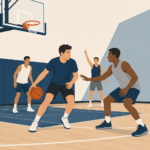

Youth basketball offense works best when it is simple, repeatable, and built for the attention span and skill level of young players. Coaches often inherit ideas from high school or college systems, then wonder why nine- and ten-year-olds forget the reads, bunch together, or stop moving after the first pass. In youth basketball, offense is not about clever diagrams. It is about spacing, timing, decision-making, and confidence. A good youth basketball offense gives kids clear jobs, creates easy passing angles, and teaches habits that still matter when players get older.
That matters because coaching offense is usually where youth teams lose structure. Most young players can learn to guard the ball and hustle back on defense with enough reminders. Offense is harder because it asks five kids to recognize space, understand options, and make choices under pressure. When coaches overload them with terminology or ask them to memorize long sequences, possession quality collapses. The best simple basketball plays for kids reduce thinking without turning players into robots. They teach concepts through a few reliable actions: pass and cut, screen away, dribble handoff, give-and-go, and inside-out play.
When I have coached elementary and middle school teams, the offenses that held up best were the ones players could explain in one sentence. “Pass, cut to the rim, fill out.” “Set a screen and open to the ball.” “If the defense helps, kick it to the corner.” Kids can run simple youth basketball plays when every action has a visible purpose. They struggle when a play depends on perfect timing from all five spots or on skip passes they do not yet have the strength to throw. That is why an effective coaching plan starts with development, not a clipboard.
As a hub for youth basketball coaching, this guide covers the offensive building blocks every coach needs: age-appropriate spacing, simple actions that transfer across levels, a short menu of plays kids can actually execute, common mistakes, and practice methods that make game offense stick. If you coach recreational, travel, school, or church-league teams, the principles are the same. Teach fewer things better. Repeat them until players recognize the pictures on the floor. Then use a handful of simple sets to create layups, open jumpers, and driving lanes without overwhelming your team.
Start with spacing before you install plays
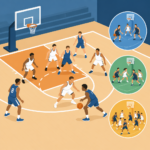
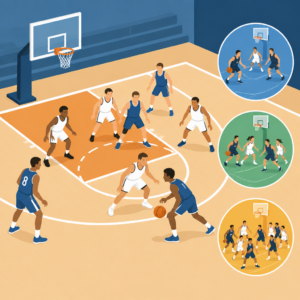
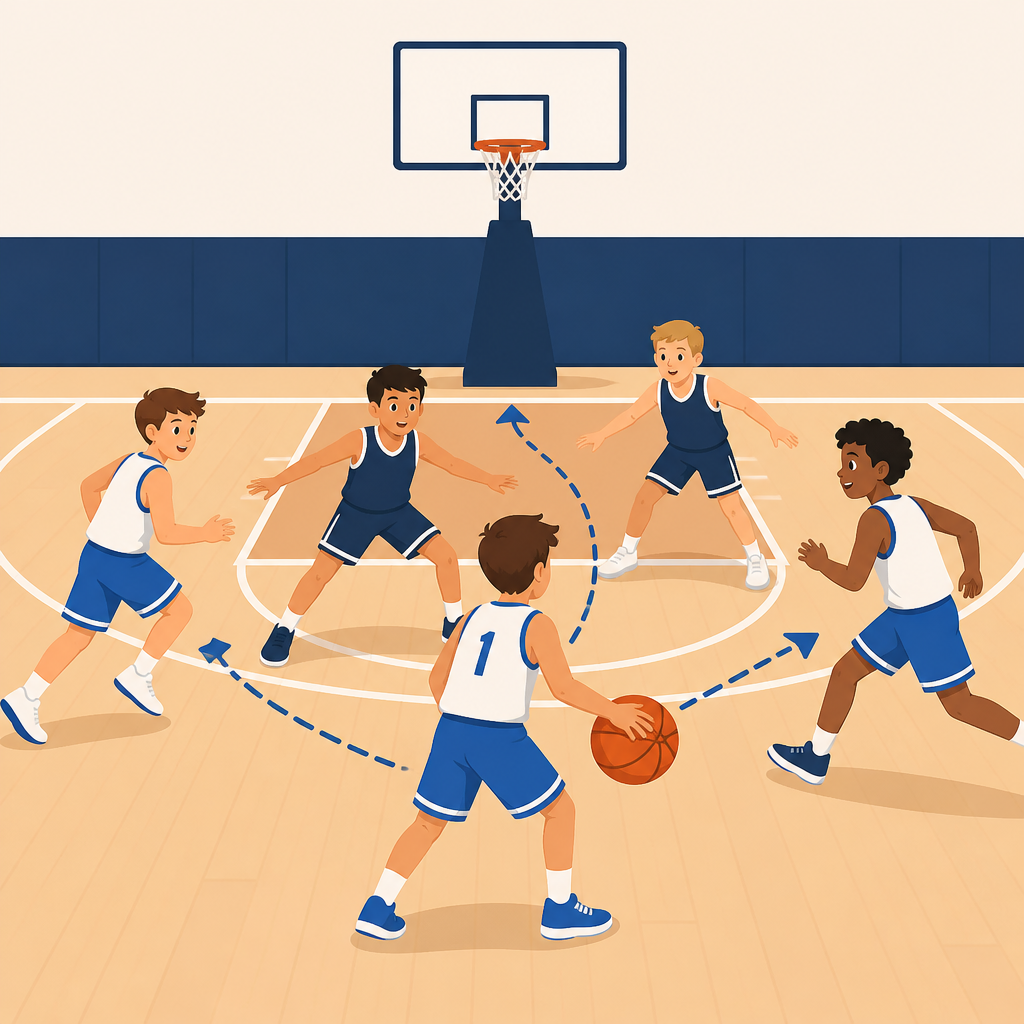
The first rule of youth basketball offense is simple: if spacing is bad, no play works. Young players naturally drift toward the ball because they want to help, receive a pass, or feel involved. The result is a crowded lane, defenders within arm’s reach of multiple attackers, and turnovers on basic passes. Before teaching any set, define five spots players can find quickly. For most youth teams, a 4-out alignment is the easiest starting point: point guard on top, two wings, and two players near the corners or short corners. One player can be inside, or all five can start outside depending on your roster.
Spacing should be taught with landmarks, not abstract language. Tell players to stay “one big step outside the lane line” on the wing, “where the volleyball line meets the sideline” in transition, or “below the free-throw line extended” in the corner. These concrete references are easier for kids than saying “maintain proper spacing.” Good spacing creates passing windows, longer help rotations, and clearer driving gaps. It also improves rebounding balance because players are not all standing under the same defender when the shot goes up.
For younger age groups, I prefer spacing rules that fit on an index card. When the ball is on top, wings are wide, corners are deep, and the post stays opposite the ball. When the ball is on the wing, the nearest corner stays low, the top player slides to the middle, and the weak-side wing lifts for vision. Those adjustments sound basic, but they solve many youth problems before a play even begins. A team that spaces well can score off one reversal and one hard cut without calling anything.
Teach offensive concepts before memorized patterns
Simple plays for kids should come out of a few offensive concepts that repeat every game. The most useful concepts are pass and cut, drive and kick, screen away, and give-and-go. If players understand those four ideas, you can build an offense that looks organized without making children memorize a thick playbook. This is also how you prepare them for future systems. High school offenses still rely on the same foundations, just with more advanced reads and timing.
Pass and cut is the cleanest concept to teach first. After a player passes, that player cuts hard to the basket looking for a return pass. If the cut is not open, the player exits to the weak side and fills an empty spot. This teaches movement after passing, basket pressure, and replacement spacing. Give-and-go is simply the earliest version of that action, and it works especially well against youth defenses that overplay the pass. One sharp pass fake and backdoor cut can produce a layup with no screen required.
Drive and kick is next because it matches how kids naturally play. Most young players want to dribble. Instead of fighting that instinct completely, coaches should give it structure. The rule is straightforward: attack a gap with purpose, keep your eyes up, and if two defenders stop the ball, pass to the open teammate. This concept only works if teammates learn “drift” and “fill” habits. The corner player drifts along the baseline for a vision window, while the top player fills behind the drive as a safety valve. These are simple reads that can be practiced every day.
Screening should be introduced carefully. Young players often slip too early, stand with poor balance, or screen their own teammate’s defender at the wrong angle. Start with away screens rather than complex on-ball screen reads. Away screens are easier to see, safer to teach, and useful against pressure. Once players can set a stationary screen and open to the ball after contact, your half-court offense gets much more reliable.
Three simple youth basketball plays kids can actually run
The best youth basketball plays are short, visible, and flexible. They should create a scoring chance even if the defense blows up the first option. Here are three that consistently work for young teams.
First is Pass-Cut-Fill from a 4-out setup. The point guard passes to the wing and basket cuts. The opposite wing lifts to the top, the corner stays deep, and the post ducks in on the weak side. If the cutter is open, hit the layup. If not, the wing can reverse the ball to the top and repeat the action. This play teaches motion offense without calling it motion. It works against man-to-man and creates enough movement to disturb basic zone principles too.
Second is Wing Give-and-Go. Start with the point guard passing to the wing and then stepping toward the ball as if to receive it back. Instead, the point guard plants and cuts hard to the rim. The wing looks inside first, then attacks if the defender jumps the passing lane. This action is especially effective when defenders turn their heads to the ball. Youth defenders do that often, which is why this simple play produces high-value shots.
Third is Screen Away for the Shooter or Driver. Begin in a 4-out alignment. The point guard passes to a wing, then screens away for the opposite wing. The screened player can curl to the basket, pop to the top, or fade to the corner based on how the defender reacts. The screener then opens to the ball. You do not need all three reads on day one. Start with one: curl if the defender trails. Once that is comfortable, add the pop. The key is that the action creates movement away from the ball, which is easier for young passers to read than a crowded on-ball sequence.
| Play | Starting Alignment | Primary Option | Best Use |
|---|---|---|---|
| Pass-Cut-Fill | 4-out | Layup on basket cut | Teaching motion and spacing |
| Wing Give-and-Go | 2 guard front or 4-out | Return pass to cutter | Beating overplay and ball watching |
| Screen Away | 4-out | Curl to rim or pop for shot | Creating movement against man defense |
How to coach these plays so players remember them under pressure
Young teams do not forget plays because they are undisciplined. They forget because the play was learned as a diagram instead of a set of cues. To improve recall, teach each action with a trigger word and a game picture. For Pass-Cut-Fill, the cue is “pass, rim, replace.” For Give-and-Go, it is “show, plant, cut.” For Screen Away, it is “pass, screen, open.” Short language matters. Under pressure, players will not retrieve a paragraph from memory.
Walk-throughs are useful, but only in short doses. After two or three no-defense reps, add guided defense immediately. Have defenders play at half speed and let the offense call out the read before making it. Then progress to live play from the exact alignment you use in games. Research on skill acquisition consistently shows that athletes retain decision-based skills better when practice includes realistic variability rather than perfect blocked repetition. In plain terms, kids remember offense when they must recognize it, not when they can sleepwalk through it.
One detail many coaches miss is where to stand during teaching. If you are always in the lane pointing and talking, players learn to depend on you as the traffic controller. Step off the floor when possible. Let them find spots, make a wrong cut, and self-correct with one brief prompt. I have found that if players can restate the action to a teammate, they can usually run it in a game. If they can only nod while a coach speaks, the understanding is fragile.
Adjust the offense to age, roster, and defensive rules
Not every youth basketball team should run the same offense. A third-grade recreational team with no shot clock, limited practice time, and wide talent gaps needs a different approach than a seventh-grade travel team. Younger teams benefit from fewer reads and more fixed spacing. Older teams can handle continuity actions where one movement flows into the next. If league rules require man-to-man defense, screening and cutting become especially important. If zones are common, overloads, short-corner touches, and high-post flashes matter more.
Roster makeup also changes what “simple” means. If you have one reliable ball handler and four developing players, use entries that keep the ball in that player’s hands longer without creating isolation habits. A dribble handoff from the top to a wing can be easier than asking two weak passers to reverse the ball under pressure. If you have a strong post player, build around two actions: wing entry and opposite-side cut, or high-low looks from the elbows. If no one can score with back-to-the-basket moves, do not force post touches just because traditional offenses include them.
Simple does not mean static. It means the offense fits what your players can execute at speed. The right system is the one that lets your team get into shape quickly, recognize the first read, and flow into a second action if the first is covered.
Common mistakes that make youth offenses stall
The biggest offensive mistake in youth basketball is crowding the ball. The second is cutting without conviction. The third is passing and then standing still. Those habits kill possessions because they shrink space and make defenders’ jobs easy. Another common error is installing too many inbound plays, quick hitters, and special sets before the core half-court habits are solid. A team does not need eight plays if it cannot complete a reversal, basket cut, and kick-out pass under pressure.
Coaches also overvalue the clipboard and undervalue transition habits. Many of the best scoring chances in youth games happen before the defense is organized. Teach players to run wide lanes, advance the ball with the pass when possible, and attack the paint with numbers. Even a basic secondary break, where the first big runs to the rim and the next perimeter player fills the top, can create easier offense than a carefully drawn half-court set.
Finally, avoid punishing every mistake with immediate substitution. Young players need accountability, but they also need enough game reps to see patterns. If a player misses the read but made the right cut at the right time, coach the finish or the pass. Preserve aggression while correcting detail.
Build a coaching plan that connects practice to games
A strong youth basketball coaching plan ties drills directly to the offense you run on Saturday. If your main action is Pass-Cut-Fill, your practice should include 2-on-0 and 3-on-3 versions, advantage games that reward basket cuts, and shell segments where spacing is graded. Use constraints to teach habits. For example, in small-sided games, award two points for a layup off a cut and one point for a regular basket. Players quickly learn what the offense is trying to produce.
Film helps even at the youth level if it stays short and specific. Show two clips of correct spacing, one clip of a successful give-and-go, and one clip where the lane is clogged. Keep it under five minutes. Children learn faster from seeing themselves than from hearing another speech. Over the season, your offensive identity should become recognizable: wide spacing, hard cuts, one extra pass, and simple actions run with confidence.
The main benefit of a simple youth basketball offense is not just more points. It is better player development. Kids learn how to move without the ball, read defenders, and trust teammates. They gain structure without losing creativity. Start with spacing, teach repeatable concepts, install two or three dependable plays, and practice them in game-like situations. If you coach youth basketball, pick one action your team can own this week and build from there. Simple offense, taught well, wins possessions now and prepares players for every level that comes next.
Frequently Asked Questions
What makes a youth basketball offense effective for younger players?
An effective youth basketball offense is built around simplicity, repetition, and habits that young players can actually remember under game pressure. At younger ages, the goal is not to install a long list of actions or teach a complicated read-based system. The goal is to give players clear responsibilities, enough spacing to operate, and a small number of decisions they can make confidently. When kids know where to stand, when to move, and what to look for after they pass, the offense becomes much more functional.
The best youth offenses also match the physical and mental development of the team. Younger players often struggle with weak passes, limited ballhandling under pressure, and short attention spans during live play. That means an offense should create easy passing angles, reduce congestion, and include simple actions like pass-and-cut, give-and-go, or screen away. These concepts are easier to teach and easier to repeat than multi-step sets with several reads. If players can execute the same few actions over and over, they build confidence, and that confidence usually leads to better pace, better movement, and fewer frozen possessions.
Most importantly, a strong youth offense teaches transferable basketball skills. Instead of relying on one dominant dribbler to create everything, it encourages all five players to space the floor, move after passing, and make basic decisions. That helps kids learn how to play, not just where to run. Over time, those simple offensive habits become the foundation for more advanced team basketball.
What are the easiest offensive plays kids can actually learn and run in games?
The easiest offensive plays for kids are usually the ones that involve only one or two simple actions and can be taught with consistent language. A basic pass-and-cut is often the best starting point. A player passes to a teammate, then cuts to the basket looking for a return pass. If the cutter is not open, they can clear out to an open spot. This teaches movement, timing, and the important habit of not standing still after a pass.
Another strong option is the give-and-go. It is simple, effective, and easy for young players to understand because the sequence is straightforward: pass, cut, receive, finish. Even if the return pass is not there, the action creates movement and helps prevent bunching. A down screen or away screen can also work well if taught gradually. For example, one player passes to the wing and then sets a screen for a teammate on the opposite side. That gives kids a clear job and introduces them to teamwork without overwhelming them with multiple reads.
You can also use a very simple 4-out alignment with one post player or even a 5-out alignment if your team is still learning spacing. In these structures, the “play” does not need to be heavily scripted. Instead, players follow a few simple rules: keep space, pass and cut, replace open spots, and attack open lanes. That approach is often more successful than trying to memorize a long playbook. For young teams, the most effective play is usually the one they can run correctly and repeatedly, not the one that looks the smartest on a whiteboard.
Why do young players bunch together on offense, and how can coaches fix it?
Young players bunch together because the ball naturally attracts attention, and most children have not yet developed an instinct for spacing. They want to help, they want to be involved, and they often believe getting closer to the ball gives them a better chance to score. The result is a crowded offense where defenders can guard multiple players at once, passing lanes disappear, and driving becomes almost impossible. This is one of the most common issues in youth basketball, and it is usually more about teaching than effort.
The best way to fix bunching is to make spacing concrete and visible. Instead of telling players to “spread out” over and over, give them exact landmarks. Use cones, floor spots, or sections of the court to show where players should stand. Teach them that good offense creates wide passing angles and room to move. You can even use simple phrases they will remember, such as “if you can touch your teammate, you are too close” or “fill the open spot, don’t chase the ball.” Kids respond well to clear, repeatable language.
Coaches should also build spacing into every drill, not just talk about it during games. Small-sided games like 3-on-3 or 4-on-4 are excellent for this because they make spacing problems obvious and create more touches for each player. Reward players who stay wide, cut with purpose, and relocate properly after passing. Over time, players begin to understand that spacing is not just where they stand. It is what makes the offense work. Once they see that better spacing leads to easier passes, cleaner drives, and more shots, they start to buy into it naturally.
How many offensive plays should a youth basketball team have?
Most youth basketball teams need far fewer plays than coaches think. In many cases, two to four simple actions are more than enough, especially for younger age groups. Trying to install too many plays often leads to hesitation, confusion, and possessions where players are thinking instead of reacting. Young athletes play best when they have a small menu of reliable options they understand well.
A good approach is to choose a few core actions and teach them thoroughly. For example, a team might have a basic inbounds play, a simple half-court entry, a pass-and-cut motion rule, and one easy screening action. That gives structure without overloading players. The emphasis should be on execution, spacing, and recognition, not variety for the sake of variety. If your team can run one simple action with timing and confidence, it will usually be more effective than five plays they only half remember.
There is also a developmental advantage to keeping the playbook small. When players repeat the same actions, they begin to understand why those actions work. They learn to read defenders, hit cutters, move to open space, and play with better rhythm. That is far more valuable in the long run than memorizing a large set of diagrams. At the youth level, offensive success usually comes from doing basic things well, not from having a complicated system.
Should youth coaches use set plays or a simple motion offense?
For most youth teams, the best answer is a blend of both, with a heavy emphasis on simple motion principles. Set plays can be helpful because they give players structure and help them get organized, especially after timeouts, on sideline or baseline out-of-bounds situations, or when a team is struggling to settle into the half court. A short, easy set can create confidence and give young players a clear starting point.
However, relying only on set plays can limit development if players become dependent on memorized movements and stop learning how to react when the defense disrupts the pattern. That is why simple motion concepts are so important. Teaching kids to pass and cut, fill empty spots, maintain spacing, and move after the ball teaches them how to play when the original action breaks down. Since youth games are often unpredictable, that flexibility matters a lot.
The strongest approach is usually to use one or two basic set plays alongside a simple motion framework. Think of the set play as the entry and the motion as what happens next if the first option is not open. That balance gives kids guidance without making them robotic. It also helps coaches teach real basketball habits while still giving the team something organized and repeatable to run. At the youth level, the offense should not feel like a test of memory. It should feel like a set of simple rules that help players play fast, share the ball, and make good decisions.