
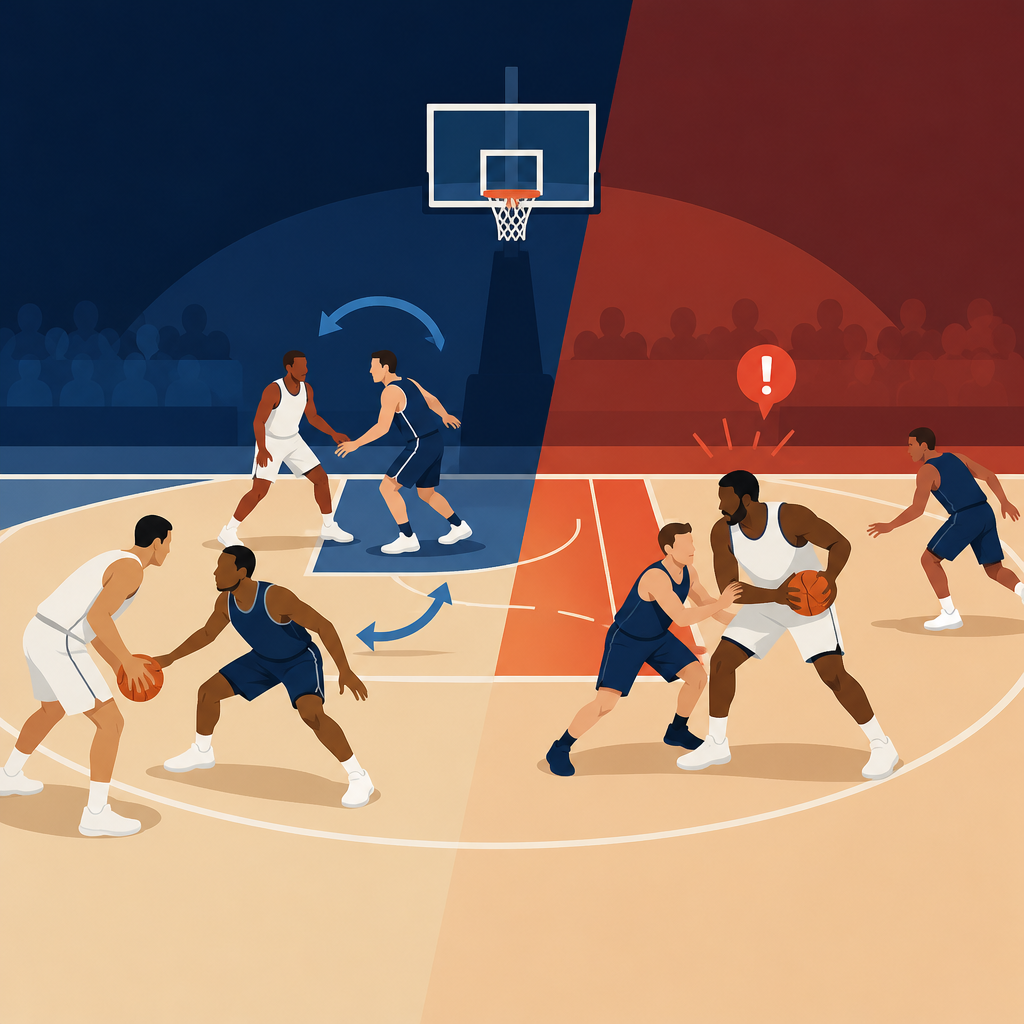
Switching defense in the NBA has moved from a situational tactic to a default coverage because modern offenses are built to hunt weak links, force help, and create efficient shots from three, at the rim, or at the foul line. In simple terms, a switch happens when two defenders exchange assignments during an on-ball screen instead of fighting over, going under, or sending extra help. Teams switch to keep the ball in front, remove the advantage created by the pick, and avoid the chain reactions that produce open corner threes. As someone who has broken down NBA defensive tape for years, I can say the rise of switching is not a trend driven by fashion; it is a practical response to spacing, shooting range, and the league-wide preference for pick-and-roll offense. Understanding why everyone switches now, and when switching defense fails, is essential to understanding modern NBA strategy.
At the strategic level, switching defense is about simplifying decisions without making the defense passive. Instead of asking the screen defender to show, recover, drop, or trap on every possession, a switch can flatten the action immediately. That matters because offenses now run ball screens higher, earlier, and with more shooters spread across the arc than at any previous point in league history. Tracking data from recent seasons consistently shows that teams generate a huge share of half-court offense through pick-and-rolls, handoffs, and second-side screening actions. If a defense cannot manage those exchanges cleanly, it bleeds points through rotations. Switching became popular because it limits the need for long help rotations and because more big men can survive on the perimeter than in past eras. But switching is not a magic solution. It works only when personnel, communication, technique, and game context align.
Why switching became the NBA’s default answer
The main reason switching became so common is that offense evolved faster than traditional coverages could comfortably keep up. Spread pick-and-roll created impossible choices for conservative defenses. If the big dropped too far, elite pull-up shooters like Stephen Curry, Damian Lillard, and Trae Young walked into threes. If the big came up too high and help tagged the roller late, lob threats punished the back line. If weak-side defenders collapsed into the paint, offenses kicked to high-value corner shooters. Switching cut through those dilemmas by meeting the screen with an immediate exchange. The offense still might attack a mismatch, but it no longer receives a built-in downhill advantage simply because two defenders had to navigate a pick.
Rule environment matters too. Illegal defense interpretations are far looser than in the 1990s, spacing is wider, and players are more skilled with the ball at every position. Power forwards now handle like wings, centers pass on the move, and lineups often feature five players who can shoot. That reduced the viability of stationing a traditional rim protector near the basket on every possession. In response, teams built switchable rosters with rangy forwards between 6-foot-5 and 6-foot-9 who can guard multiple spots. The Golden State Warriors used Draymond Green, Andre Iguodala, Harrison Barnes, and later Kevin Durant to turn switching into a championship foundation. The Boston Celtics, Miami Heat, and recent playoff teams across the league followed with their own versions.
Another reason is predictability. Coaches value schemes players can execute under playoff pressure, when opponents spend days hunting coverage mistakes. In a switching system, the reads are clearer: touch the screener, exchange assignments, contain the ball, then scram out of bad matchups if possible. Clear rules reduce hesitation, and hesitation is fatal against elite ball handlers. I have seen this in film sessions repeatedly: the possession breaks not because the scheme was wrong, but because one defender was late deciding whether to switch, peel, or stay. Switching reduces that gray area. It is easier to drill, easier to call on the fly, and easier to scale from regular season to postseason basketball, where opponents ruthlessly isolate any recurring weakness.
How switching defense actually works on the floor
Good switching defense is not random trading of assignments. It is a coordinated system built on stance, angle, communication, and pre-switching. The on-ball defender must influence the ball toward the screener’s defender, buying time for the exchange. The screener’s defender must meet the ball at the level of the screen, chest square, hands active, and feet ready to absorb a drive without opening up. Meanwhile, off-ball defenders shrink the floor, tag slips, and prepare to “x-out” to shooters if the offense forces a rotation. The switch itself is just the start. The real possession begins after the switch, when the defense has to survive the mismatch the offense wanted.
Teams teach different switching families. A one-through-five switching team exchanges every matchup. A one-through-four team keeps its center in another coverage, often drop, while wings and guards switch among themselves. Some teams “red” or “black” side pick-and-rolls to avoid switching into the middle. Others “top-lock” movement shooters and switch handoffs to deny airspace. Late-clock switching is another common variation: a team may play conventional coverage for fifteen seconds, then switch the final action to remove a quick advantage before the shot. The details depend on personnel. Bam Adebayo can switch onto guards in a way few centers can. Brook Lopez, despite elite rim protection, is more effective in drop than in full-time switching. The scheme must fit the players, not the other way around.
Communication terms are central. “Switch,” “stay,” “scram,” and “peel” are not jargon for coaches alone; they are survival language. A scram switch happens when a help defender quickly replaces a smaller defender trapped on a post mismatch, often before the entry pass arrives. A peel switch occurs when the original on-ball defender recovers from behind and takes the driver back, allowing the switched big to release to another threat. The best defenses use these counters instinctively. Watch Boston with Jrue Holiday, Derrick White, Jaylen Brown, Jayson Tatum, and Al Horford: they often switch the initial action, then solve the mismatch one beat later through a scram or peel. That second effort is why some switch-heavy teams look airtight while others give up layups and post seals.
What switching takes from an offense, and what it gives back
Switching defense is designed to remove first-order advantages. It takes away daylight coming off the screen, cuts off easy pocket passes, and keeps weak-side defenders home on shooters. Against teams that thrive on rhythm ball movement, this is a major disruption. The 2018 Rockets, for example, switched aggressively because they wanted to force opponents into isolation rather than let them play with flow. That idea has spread. Many coaches would rather concede a difficult one-on-one against a set defender than a compromised rotation sequence ending in a corner three. The math supports that choice. Corner threes and rim attempts remain the most efficient shots in the sport, so any scheme that reduces those attempts has strategic value.
Still, switching gives something back: matchups the offense can target. If a small guard ends up on a rolling center, or a slower big ends up against a dynamic pull-up scorer, the offense has a clear plan. That is why the quality of the weakest defender matters so much in a switching scheme. One target can unravel the entire structure. Playoff opponents identify that target immediately, bring him into the action repeatedly, and refuse to move on until the defense proves it can hold. Luka Doncic has made a career out of this process, using screens less to get open than to call his preferred defender into the play. Switching prevents one kind of advantage but may invite another.
| Coverage | Main goal | Best against | Common weakness |
|---|---|---|---|
| Switch | Erase screen advantage immediately | Spread pick-and-roll, movement shooting | Mismatches in isolation or post |
| Drop | Protect rim and contain roller | Non-elite pull-up guards | Pull-up threes, floaters, short-roll playmaking |
| Blitz/Trap | Force ball out of star’s hands | High-usage creators with weaker outlets | Four-on-three behind the play |
| Hedge/Show | Delay ball handler, recover to screener | Traditional pick-and-roll teams | Recovery distance and weak-side rotations |
The table shows why switching has become the hub strategy for many defenses. It is the cleanest answer to actions that are designed to produce confusion. But “clean” is not the same as “safe.” If the offense has a dominant post scorer, a guard who can punish bigs with pull-up shooting, or a screener who slips before contact, the switch can still lose. That is why elite defenses mix coverages selectively. Denver may switch certain off-ball actions around Nikola Jokic while avoiding repeated guard-center switches at the point of attack. Minnesota can switch more liberally with Jaden McDaniels, Anthony Edwards, and Naz Reid on the floor than with a traditional double-big alignment. Smart teams know switching is a tool, not an identity by itself.
When switching defense fails
Switching defense fails most often for five reasons: poor personnel, late communication, bad screen navigation, unprotected mismatches, and offensive counters. Personnel comes first. If a center cannot contain two dribbles on the perimeter, or a small guard cannot front, fight, or scram out of the post, the offense will find those cracks. This is why playoff teams shorten their rotation. Every extra minute from a non-switchable player creates a target map for the opponent. Coaches may hide that player during the regular season, but postseason scouting exposes every weak point.
Communication breakdowns are the next major failure point. A switch called late is usually worse than no switch at all because it leaves both defenders in between jobs. One trails the ball, the other hesitates between the screener and the drive, and the offense gets a clean lane or open pop. You can spot these breakdowns instantly on film: two defenders point at each other while the ball handler turns the corner. That is not a talent issue. That is a reps issue. The best switching teams sound loud on tape and move early, not reactively.
Technique also matters more than fans often realize. A defender switched onto a star guard cannot lunge, cross his feet, or overopen his stance. He must concede a contested two before conceding a blow-by. Likewise, a small defender switched onto a big must fight for leverage early, sit on the high side, and make the post catch uncomfortable. If the catch happens too deep, the possession is usually over. Miami under Erik Spoelstra has long excelled here. Even when the initial switch is not ideal, their players battle for angle and timing, which buys enough time for weak-side help or a scram.
Offenses have also developed direct counters. Slip screens punish overeager switching by sending the screener to the rim before contact. Spain pick-and-roll adds a back screen on the big defender, creating indecision in switch rules. Ghost screens, where a shooter feints a pick and pops out immediately, exploit defenses that auto-switch on the call rather than the contact. Then there is simple mismatch hunting. A team may use three consecutive screens not because the first two can score, but because they are searching for the exact defender they want. Once that defender arrives, the floor clears and the isolation begins. Switching can stop actions, but it cannot stop talent forever.
How great teams make switching sustainable
Great switching teams solve these problems before the possession starts. They build lineups with size overlap, so there is less penalty when assignments change. They teach low-man responsibilities in detail, emphasizing early tags without overhelping. They also use selective pre-switching, where defenders exchange matchups before the screen arrives to keep a vulnerable player out of the action. The Celtics have done this well, especially when protecting a smaller guard against a bruising screener. Instead of waiting to be hunted, they rearrange the matchups early and force the offense into a less favorable target.
Conditioning is another hidden factor. Switching demands repeated high-effort closeouts, box-outs against larger players, and isolation possessions against fresh creators. A team can execute the scheme for one quarter and still fail over forty-eight minutes if its legs go. Rebounding is especially important. Many switching possessions are defended well until the shot goes up, then lost because a guard is pinned by a center after the switch. Coaches track these outcomes closely. A stop is not a stop until the rebound is secured.
Film study sharpens the margins. Defenses look for which ball handlers reject screens, which bigs slip early, and which shooters relocate after a switch. Those details determine whether the defense should switch automatically, switch late, top-lock, or bring help from a specific spacer. The value of strategy in today’s NBA lies in these precise adjustments. Switching defense remains popular because it answers the league’s most common offensive problem, but it must be customized possession by possession. For anyone following NBA Analysis and deeper strategy coverage, that is the core lesson: switching is not the end of defensive thinking. It is the starting point for understanding how modern teams balance flexibility, matchup risk, and the relentless geometry of space.
Switching defense now sits at the center of NBA strategy because it addresses the realities of the modern game better than any single alternative. It limits easy advantages from pick-and-rolls, reduces long help rotations, and allows defenses to survive against elite shooting and spacing. That is why so many contenders prioritize wings who can guard up and down the lineup and bigs who can move their feet in space. At its best, switching turns a complex offensive action into a direct one-on-one challenge and forces offenses to score over discipline rather than confusion.
But the scheme fails when teams treat it like a shortcut. Switching without the right personnel, communication, rebounding, and mismatch protection simply trades one problem for another. The best defenses understand the tradeoffs. They switch to control the first action, then use scram switches, peel switches, and selective help to control the second. They know when to stay in switch mode, when to change the coverage, and when a particular opponent demands a different answer. In other words, the success of switching defense is not about ideology. It is about execution.
If you want to understand today’s NBA at a deeper level, start by watching how teams defend the screen, who gets hunted, and how quickly coaches adjust. That is where strategy becomes visible. Study the switches, then study what happens after them, because that is where games are won.
Frequently Asked Questions
What is switching defense in the NBA, and why has it become so common?
Switching defense is a coverage where two defenders simply exchange assignments when an offensive player sets a screen. Instead of the on-ball defender trying to fight over the pick, the screener’s defender stepping up to hedge, or the defense sending extra help, both defenders trade matchups and keep the action in front of them. In the modern NBA, that idea has gone from a situational tool to a core defensive philosophy because it directly attacks what offenses are trying to do on most possessions.
Today’s offenses are designed to force rotations. They want to use ball screens, handoffs, ghost screens, and spacing to create confusion, pull help defenders out of position, and generate the three most efficient outcomes in basketball: open threes, shots at the rim, and free throws. Switching cuts off a lot of that chain reaction before it begins. If the defense can neutralize the screen without bringing a second or third defender into the play, it reduces the offense’s ability to create collapse-and-kick sequences and limits the need for emergency help.
Another big reason switching is so common is roster construction. Teams now prioritize versatile wings, mobile bigs, and lineups with fewer obvious defensive weak points. When multiple players can guard up or down a position, switching becomes much easier to execute. It also fits the pace and shot profile of the modern game. Against spread pick-and-roll, five-out spacing, and stars who are elite at punishing traditional drop coverage, switching is often the cleanest way to avoid giving up rhythm pull-up threes or downhill driving lanes. In short, teams switch because it simplifies the read, keeps the ball in front, and makes offenses work later in the shot clock against a set defense.
Why do coaches prefer switching over other pick-and-roll coverages like drop, hedge, or blitz?
Coaches prefer switching because it removes the initial advantage the offense is trying to create. In a standard pick-and-roll, the screen is supposed to force the defense into a compromised decision: the guard gets clipped, the big has to help, the roller becomes open, and weak-side defenders must rotate. That is the domino effect offenses are hunting. A switch interrupts that process immediately. The ball handler sees a new defender, but the defense is still connected and usually not in full scramble mode.
Compared with drop coverage, switching can be especially valuable against elite pull-up shooters and quick guards. Drop often concedes space above the screen, and in today’s league that can mean open threes or easy rhythm jumpers. Compared with hedging or trapping, switching is less rotation-heavy and often less exhausting over the course of a game. Blitzes and hard shows can be effective, but they require precise backside help and can be vulnerable to short rolls, slips, and quick passing. Switching reduces those moving parts.
There is also a practical coaching advantage: when a team has the personnel to switch, the rules can be cleaner. Players do not have to process as many different coverages on every possession, and that can improve communication and reaction time. Instead of asking defenders to recognize screen angle, personnel, game situation, and help positioning in real time before choosing among several responses, switching offers a straightforward answer to a very common action. That does not mean it is always the best choice, but in a league where offenses are built on speed, spacing, and mismatch creation, coaches often decide that a controlled switch is better than a late rotation or a broken coverage.
If switching is so effective, when does switching defense fail?
Switching fails when the offense can turn the new matchup into a real advantage rather than just a different look. The biggest issue is the mismatch problem. If a small defender gets switched onto a rolling center near the basket, or a slower big gets isolated against a dynamic guard on the perimeter, the offense may get exactly what it wanted. Modern offenses are patient enough to reject the first pass, clear a side, and attack the weakest defender until the defense has to help. Once help comes, the same open threes and rim chances switching was supposed to prevent can reappear anyway.
It also fails when the defense lacks physical versatility. Not every team has five players who can credibly guard multiple positions. If even one defender cannot contain the ball, hold up in the post, or navigate space against a shooter, offenses will identify and target that player repeatedly. In playoff basketball especially, stars and coaching staffs are relentless about finding the weak link. Switching only works at a high level when the defenders involved can survive the matchups they inherit.
Communication is another major fault line. A good switch requires timing, awareness, and agreement. If one defender switches and the other does not, even for a moment, the offense often gets an immediate clean look. Offenses are also much better now at disguising actions with slips, rescreens, stack pick-and-rolls, and off-ball movement that can force confusion. Finally, switching can fail on the glass. Cross-matches after a switch often leave smaller defenders trying to box out bigger players, and that can lead to putbacks and extra possessions. So while switching can eliminate the first advantage, it can still lose the possession if the matchup, communication, or rebounding details break down.
How do NBA offenses try to beat switching defenses?
Offenses attack switching by trying to prove that the switch did not actually solve anything. The first method is mismatch hunting. If a team can force a center onto a star guard or a smaller guard onto a power scorer, it will often spread the floor and let that player isolate. The goal is to turn a neutral switch into a one-on-one advantage. Some teams do this through repeated pick-and-rolls until they get the exact defender they want; others use screens from the targeted defender’s man so the switch becomes almost inevitable.
Another common counter is slipping the screen. If the screener senses the defense is preparing to switch, he may cut to open space before making full contact. That can create a brief window where both defenders are focused on the ball and nobody fully accounts for the roller. Ghost screens work similarly, especially with shooting forwards or wings. The offensive player pretends to set a screen, then quickly pops out to the three-point line before the defense can complete the exchange. These actions are designed to punish switching teams that are aggressive but not perfectly synchronized.
Offenses also use off-ball screening and movement to stress switch rules away from the ball. Screening for shooters, forcing multiple exchanges in one possession, or sending a smaller defender into help situations can eventually produce a breakdown. Post seals are another important weapon. If a big man gets a small switched onto him, smart teams do not always force an immediate post-up, but they will often create deep position and attack before the defense can scram out of it. At the highest level, beating switching is about making the defense guard more than one action. A single switch may be fine; a second and third action in sequence can expose whether the defense is truly versatile or just temporarily organized.
What kind of players and lineups are best suited for a switching defense?
The ideal switching lineup is built around versatility, mobility, and strength across multiple positions. Wings who can guard on the ball, absorb contact, and contest shots without fouling are the backbone of this style. Bigs need enough foot speed to survive on the perimeter and enough size to protect the paint when needed. Guards must be tough enough to hold their own after switches, whether that means fronting the post, battling on the glass, or at least delaying an attack until help can arrive. In other words, switching works best when there are no obvious targets.
Basketball IQ is just as important as athletic ability. The best switching teams are not simply interchangeable; they are connected. Players must recognize when to switch, when to peel back, when to scram a smaller teammate out of the post, and when to stay home on shooters. They also need strong communication habits because switching is only clean when everyone sees the same play at the same time. A lineup can have great athletes and still struggle if the players do not process actions quickly or trust each other’s positioning.
That is why many of the best switching units feature rangy forwards, intelligent team defenders, and centers who are comfortable playing in space. Think of lineups where positions matter less than functional skills: multiple players between roughly wing and big size, capable of guarding actions without constant help. These groups can flatten pick-and-roll, survive late-clock isolations, and recover better if the initial switch does not fully stop the play. By contrast, lineups with a slow-footed center, a small guard who gets targeted, or several one-position defenders usually have to be more selective. Switching is not just a scheme; it is a personnel strategy. Teams that do it best have built rosters specifically to make that style sustainable over 48 minutes and, more importantly, in the playoffs.