
The NBA Three-Point Contest is one of All-Star Weekend’s defining events, a showcase where rhythm, repetition, and nerve turn practice-gym shooting into prime-time history. Since its debut in 1986, the contest has done more than entertain: it has documented how the league’s relationship with the three-point shot changed from novelty to strategic foundation. For readers exploring NBA history, this event provides a clean lens into league history because its winners reflect broader shifts in spacing, shot volume, player development, and even broadcast culture. The best champions were never just hot for one night. They represented standards of shooting excellence that influenced how basketball is taught, how rosters are built, and how stars are remembered.
To understand the contest, a few terms matter. A “rack” is the group of balls placed around the arc. Traditionally, shooters move through five racks, taking one “money ball” from each rack worth extra points. The modern format has evolved, adding full money-ball racks and deeper “Starry Range” shots, but the core challenge remains unchanged: score quickly while preserving footwork, balance, and release mechanics under a one-minute clock. Unlike game shooting, where attempts come from live action, the contest isolates pure shotmaking. There are no closeouts, no dribble counters, and no play calls, only pace, sequencing, and composure. That simplicity is exactly why the event matters in league history. It strips away context and asks one direct question: who is the best pure shooter on this stage?
I have always viewed the Three-Point Contest as a historical checkpoint rather than a side attraction. Watching past editions, you can see when the league still treated the three as a specialist’s weapon and when it became the center of offensive design. Early champions were often technicians and role players whose value came from precision. Later winners increasingly included primary creators and franchise stars, reflecting a league where elite perimeter shooting became mandatory at every level. The contest also created enduring images that outlived box scores: Larry Bird holding his follow-through before the ball dropped, Craig Hodges shooting with machine-like tempo, Mark Price winning through economy of motion, and Stephen Curry turning a familiar skill into a global spectacle. Those moments belong to league history because they shaped basketball memory far beyond one weekend.
As a hub within NBA history, this article covers the Three-Point Contest in a league-wide frame. It explains how the event evolved, identifies the greatest winners, and places each champion in the context of his era. The central point is straightforward: the best Three-Point Contest winners were not merely accurate shooters; they were standard-bearers for what NBA shooting meant at the time they won.
How the Three-Point Contest Became a Useful Measure of League History
The contest began in 1986, just a few seasons after the NBA adopted the three-point line in 1979-80. That timing matters. For much of the early 1980s, teams still treated the long ball cautiously, and many coaches viewed outside shooting as situational rather than foundational. The contest helped legitimize the skill by spotlighting specialists on a national stage. Instead of being the extra point after a broken play, the three-pointer became something fans could celebrate as a craft. In practical terms, the event accelerated appreciation for balance, release speed, and repeatable mechanics.
Its historical value comes from continuity. Rules have changed, formats have been refreshed, and point totals are not perfectly comparable across eras, yet every contest asks shooters to solve a similar problem under pressure. That makes the winner list unusually useful. When Larry Bird won the first three contests from 1986 through 1988, he established the event’s mythology immediately. When Craig Hodges then won three in a row from 1990 through 1992, he confirmed that specialist shooting could dominate a signature stage. When stars such as Peja Stojakovic, Dirk Nowitzki, Kevin Love, Kyrie Irving, Devin Booker, and Damian Lillard claimed the crown, each victory reflected an era where shooting had expanded from role skill to universal offensive currency.
The contest also reveals how league expectations changed. Early winners often came from systems built around post play and midrange scoring, where floor spacing was supportive. Modern winners exist in offenses designed around volume threes, drive-and-kick actions, relocation shooting, and five-out geometry. In that sense, Three-Point Contest history is league history in miniature.
The Foundational Champions: Bird, Hodges, and Price Set the Standard
No discussion of the best Three-Point Contest winners can begin anywhere but Larry Bird. Bird won the first three editions, and his dominance still frames how the event is remembered. The legend is larger than the stat lines: he reportedly walked into the locker room before one contest and asked who was finishing second. What made Bird great in this format was not just confidence. It was sequencing. He shot with minimal wasted motion, generated easy power from compact mechanics, and understood pace better than almost anyone. Bird’s wins mattered because he was already a superstar. His success helped attach prestige to the contest, ensuring it was seen as a serious test rather than a novelty event.
Craig Hodges deserves equal respect as one of the greatest contest shooters ever. He won in 1990, 1991, and 1992, tying Bird with three crowns. Hodges was the opposite of a celebrity-first champion. He was a true perimeter specialist, and his repeat victories illustrated a technical truth that coaches still teach: repeatability beats drama. Hodges had an efficient dip, clean alignment, and almost metronomic timing from rack to rack. In 1991, he posted 19 points in the old scoring format and looked fully in command of the environment. His place in league history should be larger than it is, because he represented the professionalization of elite shooting before the league fully embraced three-point offense.
Mark Price won in 1993 and 1994, becoming the first back-to-back winner after the Bird and Hodges three-peats. Price was a prototype for the modern guard: accurate off the catch, dangerous off the dribble, and mechanically pristine. His compact release translated perfectly to the contest. More important historically, Price’s wins pointed toward the future. He was not just a specialist stationed in space. He was a primary ballhandler whose shooting threatened defenses in multiple contexts. That profile became increasingly valuable across the league in later decades.
| Player | Titles | Winning Years | Why the Wins Matter in League History |
|---|---|---|---|
| Larry Bird | 3 | 1986, 1987, 1988 | Made the event prestigious and linked elite shooting to superstar status |
| Craig Hodges | 3 | 1990, 1991, 1992 | Showed that pure specialists could master pressure through repeatable mechanics |
| Mark Price | 2 | 1993, 1994 | Foreshadowed the rise of lead guards whose shooting shaped entire offenses |
| Peja Stojakovic | 2 | 2002, 2003 | Represented the international stretch-forward era before spacing fully exploded |
| Jason Kapono | 2 | 2007, 2008 | Proved elite role-player shooting could still dominate in a star-driven league |
| Damian Lillard | 2 | 2023, 2024 | Captured the deep-range, pull-up-heavy modern game at its peak |
The Expansion Era: From Specialists to Stars
After the foundational champions established the contest’s credibility, the winner list broadened in ways that mirrored the league’s strategic growth. Glen Rice won in 1995, Tim Legler in 1996, and Jeff Hornacek in 1998 and 2000, with the contest absent in 1999 because of the lockout-shortened season. Each of those players reinforced a classic truth about shooting contests: textbook footwork and lower-body control travel well under time pressure. Hornacek, especially, remains underrated in league history. His game was built on efficiency and decision-making, and those same habits translated to this event.
Then the contest entered a period where international influence and offensive diversification became impossible to ignore. Peja Stojakovic won in 2002 and 2003 for the Sacramento Kings, one of the most aesthetically important offenses of the early 2000s. Peja’s high release, effortless range, and comfort as a tall movement shooter made him historically significant. He represented a growing class of forwards who stretched defenses without functioning like traditional small guards. In hindsight, his victories look like a preview of the spacing revolution.
Voshon Lenard in 2004, Quentin Richardson in 2005, and Dirk Nowitzki in 2006 kept pushing the event beyond stereotypes. Dirk’s win mattered especially because he was a seven-footer whose shooting had already changed how big men could attack defenses. Long before “stretch five” became common language, Dirk showed that frontcourt players could carry elite jump shooting into star-level offense. His contest title served as a visible confirmation of that change.
Jason Kapono won in 2007 and 2008 and produced one of the sharpest pure shooting runs in contest history. Kapono was not a franchise centerpiece, yet his release discipline and shot prep were elite. His wins are a useful reminder that the Three-Point Contest remains partly democratic. Reputation helps create attention, but the clock rewards mechanics. Daequan Cook’s 2009 win and Paul Pierce’s 2010 title continued that mix of specialists and stars, though the broader league was already moving toward a much bigger three-point future.
The Modern Shooting Revolution and Its Signature Champions
If earlier winners legitimized the three-pointer, modern winners normalized its centrality. James Jones won in 2011, Kevin Love in 2012, Kyrie Irving in 2013, Marco Belinelli in 2014, Stephen Curry in 2015, Klay Thompson in 2016, Eric Gordon in 2017, Devin Booker in 2018, Joe Harris in 2019, Buddy Hield in 2020, Stephen Curry again in 2021, Karl-Anthony Towns in 2022, and Damian Lillard in 2023 and 2024. That run traces the league’s transformation more clearly than almost any annual event.
Kevin Love’s 2012 win underscored how far shooting had spread into the frontcourt. Love was already one of basketball’s best rebounding bigs, but his contest performance emphasized that modern power forwards needed perimeter gravity. Kyrie Irving’s 2013 title highlighted another key trend: creators were no longer separate from elite shooters. His touch, balance, and hand speed allowed him to shine in a format once associated more closely with catch-and-shoot specialists.
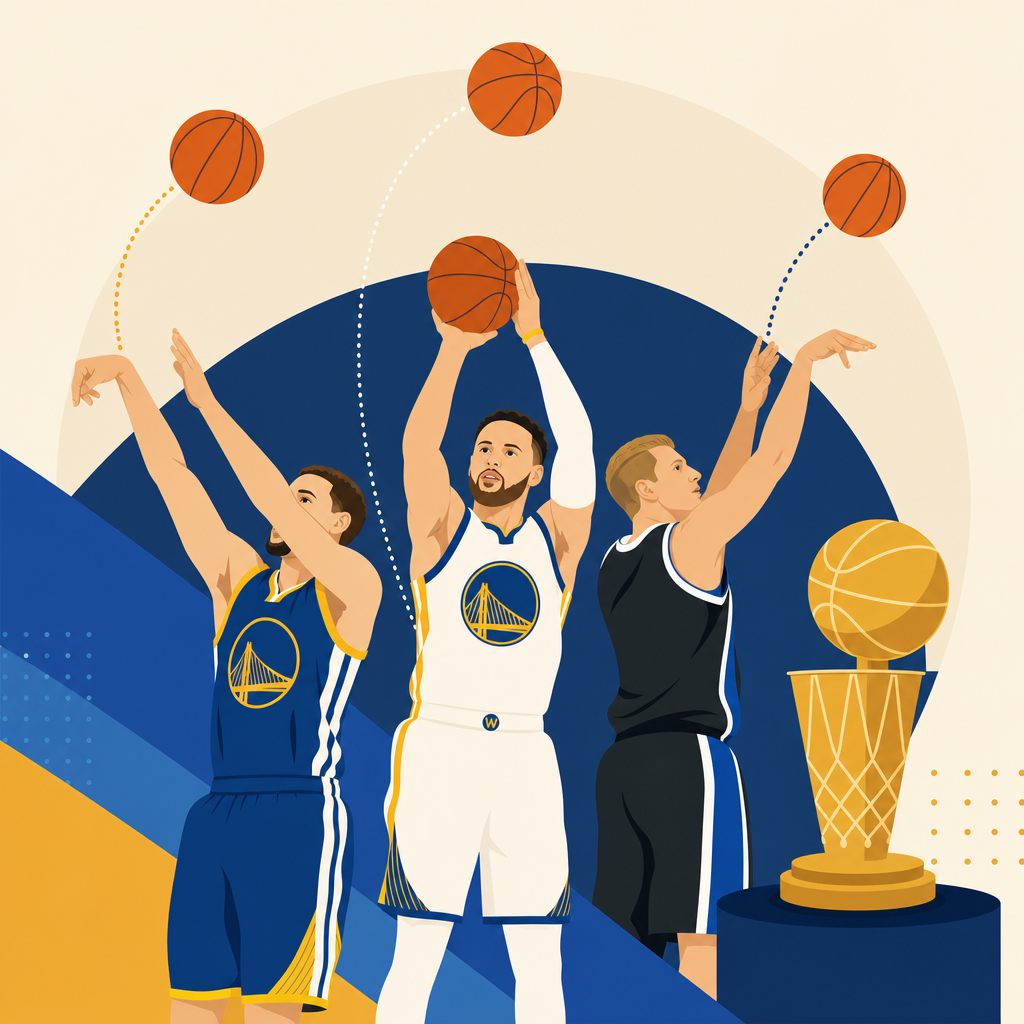
Stephen Curry and Klay Thompson brought the contest fully into the Warriors era of NBA history. Curry’s 2015 and 2021 wins matter for obvious reasons. He is the most transformative shooter the league has ever seen, and every shooting conversation after him begins from a different baseline. What made Curry so compelling in the contest was that his game shots and rack shots felt connected. The release, confidence, and deep comfort from any spot on the floor were authentic extensions of how he changed regular-season offense. Thompson’s 2016 title provided the complementary example: textbook mechanics, broad shoulders staying square, and one of the quickest clean releases in league history.
Devin Booker’s 2018 victory, with 28 points under the old money-ball arrangement, showed how a young star could pair volume scoring instincts with elite practice-speed precision. Karl-Anthony Towns winning in 2022 was another landmark moment. A center beating a field of guards in this event would have felt improbable in the 1990s. In the spacing era, it made sense. Damian Lillard’s back-to-back titles in 2023 and 2024 may be the clearest recent symbol of modern league history: deep pull-up range, logo confidence, and a star whose off-the-dribble shooting reputation translated into a composed contest routine.
Who Are the Best Winners Ever, and How Should They Be Ranked?
Ranking the best Three-Point Contest winners requires more than counting trophies. The strongest method weighs four factors: total titles, quality of individual performances, historical influence, and how clearly a player defined shooting in his era. By that standard, Larry Bird, Craig Hodges, Stephen Curry, Mark Price, and Damian Lillard belong in the top tier. Bird and Hodges own the signature dynasties. Curry owns the largest influence on league-wide shooting behavior. Price was a tactical bridge to the modern guard archetype. Lillard captured the deep-range standards of the current game.
A second tier includes Peja Stojakovic, Klay Thompson, Kyrie Irving, Jason Kapono, and Dirk Nowitzki. Peja’s repeated wins and stylistic significance matter more with time because the league eventually adopted many of the spacing principles his game hinted at. Thompson’s title came in perhaps the richest shooting era ever. Irving’s crown signaled that ball-dominant creators could still excel in a pure-shot environment. Kapono remains one of the contest’s most technically sound winners. Dirk deserves mention because his title symbolized the evolution of big-man offense in a way numbers alone cannot capture.
The key takeaway is that “best” depends on whether the question is about contest dominance, pure mechanics, or historical impact. Bird and Hodges dominated the event. Curry changed the sport. Price and Peja predicted where the league was heading. Lillard embodies what the long-range shot has become.
What This Event Tells Us About NBA League History Overall
The Three-Point Contest is not a perfect measurement of in-game greatness, but it is an excellent measurement of what the league values at a given moment. In the 1980s, the event celebrated shotmaking as a specialized excellence. In the 1990s, it rewarded disciplined technicians during a more physical, slower-paced era. In the 2000s, it reflected the spread of international skill and frontcourt shooting. In the 2010s and 2020s, it became a showcase for the league’s defining principle: spacing changes everything.
That is why this contest deserves a central place in any NBA history hub. It connects eras cleanly. It links stars, specialists, systems, and strategy. It also gives fans an accessible way to understand the league’s evolution. If you want to study how basketball moved from post touches and midrange counters to pull-up threes and five-out offense, start with the names on this trophy list. The best shooters who won the crown did more than survive one minute under bright lights. They revealed where the sport had been and where it was going. Explore the rest of NBA league history through that lens, and the story of the modern game becomes much easier to read.
Frequently Asked Questions
When did the NBA Three-Point Contest begin, and why does its history matter so much?
The NBA Three-Point Contest debuted in 1986, and that timing is a big part of why the event matters. At the time, the three-point shot was still not fully embraced as a central part of NBA offense. Many teams treated it as a specialty weapon rather than a foundation for spacing, shot creation, and efficiency. Because of that, the contest became more than a fun All-Star Weekend attraction. It turned into a yearly snapshot of which players were most comfortable with a shot that the league itself was still learning to value. Looking back at the winners offers a clear, easy-to-follow timeline of how basketball strategy evolved over the decades.
What makes the contest historically significant is that it tracks several eras at once. In the 1980s, it highlighted elite specialists and fundamentally sound shooters in a league that still revolved heavily around post play and mid-range scoring. In the 1990s and early 2000s, it showcased players who mastered shooting as a complementary superstar skill or as a role-player niche that could swing games. In the modern era, the event reflects a league transformed by pace, spacing, and volume three-point shooting. In other words, the competition is not just about who got hot for one round. It is a record of how the NBA’s offensive identity changed over time.
Who are some of the greatest winners in Three-Point Contest history?
Several champions stand above the rest because of their shooting resumes, their contest performances, or both. Larry Bird is one of the first names that comes up, and for good reason. He won the first three contests from 1986 through 1988, instantly giving the event credibility. Bird’s victories helped define the contest as a stage for swagger, precision, and big-moment shot-making. He was already one of the greatest players in the sport, so his dominance suggested that elite shooting was not just a sideshow skill. It was central to greatness.
Craig Hodges also belongs near the top of any discussion. He won three straight titles from 1990 to 1992 and was one of the purest long-range specialists of his era. Mark Price, a two-time winner, represented another important archetype: the technically brilliant guard whose shooting touch was rooted in rhythm, balance, and repeatable mechanics. Later winners such as Peja Stojakovic, Jason Kapono, and Jeff Hornacek strengthened the contest’s legacy by showing how international talent, movement shooting, and role-specific excellence all had a place in its history.
In the modern game, Stephen Curry and Klay Thompson are impossible to ignore. Curry’s victories matter not only because he won, but because he became the symbolic face of the three-point revolution itself. Thompson, meanwhile, brought his own level of historic credibility as one half of perhaps the greatest shooting backcourt ever assembled. More recent stars like Damian Lillard have continued that tradition by proving that the contest still reflects the league’s highest-level shot makers. The best winners are not only contest champions. They are also players whose success connects directly to broader basketball trends and lasting influence.
Did winning the Three-Point Contest always mean a player was the best shooter in the NBA?
Not necessarily, and that is one of the most interesting things about the event. Winning the Three-Point Contest absolutely requires elite shooting ability, but contest shooting is its own discipline. Players must move quickly from rack to rack, manage tempo, adapt to the money-ball structure, and perform under a unique kind of pressure. That means a great in-game shooter is not automatically guaranteed to win, and a contest champion may not always have been universally viewed as the single best shooter in the league at that exact moment.
The distinction matters because game shooting and contest shooting test overlapping but different skills. In games, players deal with defenders, fatigue from live play, off-ball movement, and varying shot types. In the contest, there is no defense, but the pressure is compressed and the margin for error is tiny. Success depends on rhythm, efficiency, and emotional control. Some players are spectacular pull-up shooters in real games but less comfortable with the stationary rack format. Others thrive in the contest because their mechanics are compact, repeatable, and built for rapid-fire repetition.
That said, the list of winners still serves as a strong guide to the NBA’s great shooters. Even if a title does not automatically settle the “best shooter alive” debate, champions almost always belong in that conversation. The award is best understood as a combination of shooting excellence and event-specific mastery. It tells you a player had the touch, confidence, and composure to own that stage, which is why the trophy remains meaningful even in a league full of elite perimeter scorers.
How does the Three-Point Contest reflect changes in NBA strategy and playing style?
Few events capture the NBA’s tactical evolution as neatly as the Three-Point Contest. In its early years, the competition existed alongside a league that still leaned heavily on interior scoring, physical half-court play, and mid-range offense. Three-point shooting was respected, but it was not yet the engine of most systems. Early winners often came from a mold of specialists or fundamentally polished guards and forwards who stood out precisely because long-range shooting was less common and less emphasized than it is today.
As the years passed, the profile of the winner started to change in ways that mirrored the league. Sharpshooting wings became more valuable. International players entered the spotlight and helped broaden offensive creativity. Teams began to prioritize spacing more aggressively, and the shot itself became central to lineup construction. By the time the modern era arrived, the contest no longer felt like a novelty built around a niche skill. It felt like a celebration of the most important shot in the sport.
That shift is especially clear when you compare eras. A player like Larry Bird symbolized elite shot-making in a period when the three was still emerging. A player like Stephen Curry symbolizes a period in which the three-point shot reshaped everything from youth development to late-game strategy to roster design. The contest’s history effectively charts the movement from selective perimeter shooting to a full-scale offensive philosophy. For readers exploring NBA history, that is what makes the event so valuable: its winners are not random names on a list, but markers of how the game itself changed.
Which Three-Point Contest winners left the biggest legacy beyond the event itself?
Larry Bird left one of the deepest legacies because he gave the contest instant stature. His early dominance helped define its mythology, and his confidence became part of NBA lore. Without a star of Bird’s caliber owning the event in its infancy, the contest might have taken longer to become a marquee attraction. Instead, it immediately felt important. Bird’s victories also reinforced the idea that shooting brilliance could be one of the game’s most intimidating weapons.
Stephen Curry’s legacy may be even broader because it extends far beyond the trophy count. Curry did not just win the contest; he helped transform how basketball is played at every level. His shooting range, efficiency, and freedom changed what coaches allow, what players practice, and what defenses fear. When Curry wins or even competes in the event, it carries historical weight because he is the most visible symbol of the three-point era. His presence ties the contest directly to the strategic revolution that made long-range shooting the centerpiece of modern offense.
Other winners left meaningful marks in different ways. Craig Hodges and Mark Price helped establish standards for pure shooting excellence in earlier eras. Peja Stojakovic represented the rise of skilled international stars who could stretch defenses and redefine frontcourt offense. Klay Thompson reinforced the value of catch-and-shoot precision at the highest level. Damian Lillard brought contemporary star power and clutch credibility to the event. The biggest legacy figures are those whose wins mean more than a single Saturday night. They represent entire chapters in the history of shooting, spacing, and NBA evolution.