
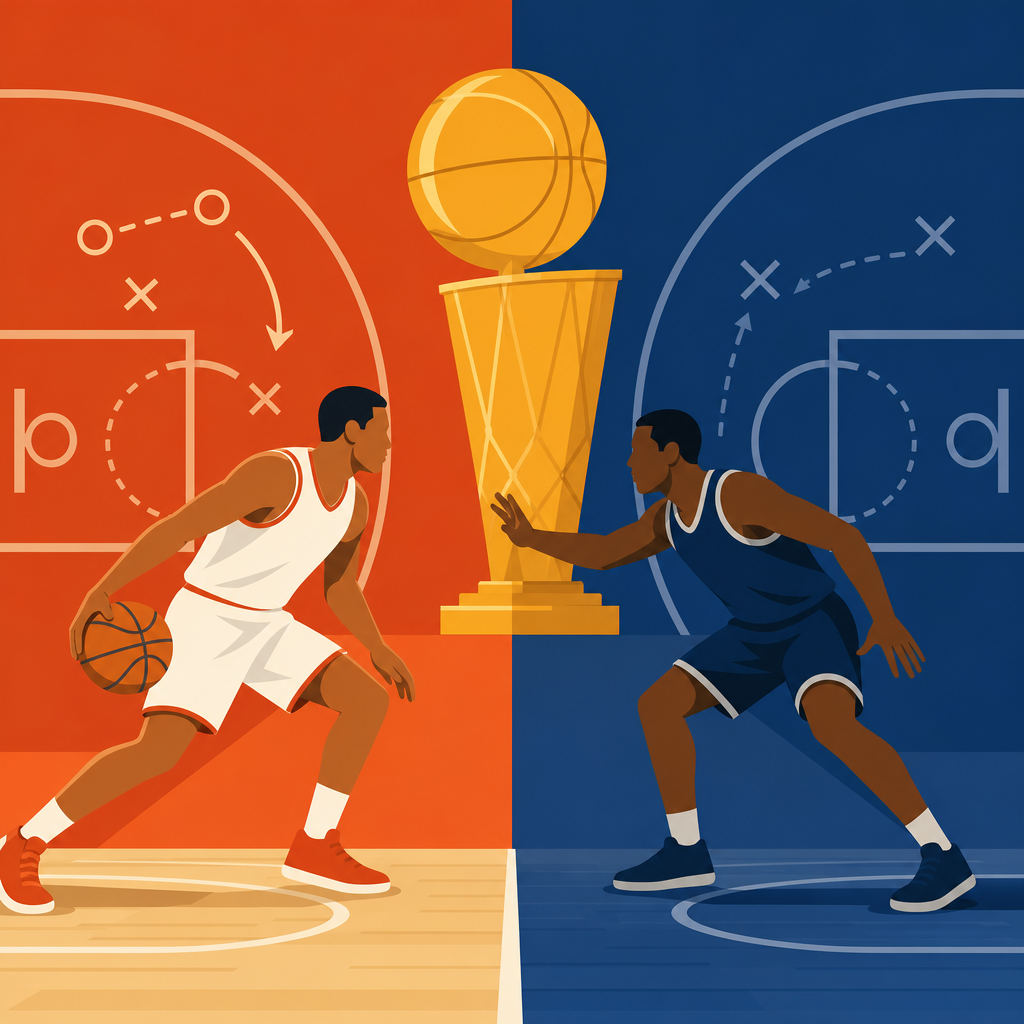
Offense versus defense is one of the oldest arguments in basketball, but in the NBA the real answer is more precise than the cliché that defense wins championships. Teams win titles by reaching an elite threshold on both sides of the ball, then using scheme, matchup flexibility, and late-play execution to tilt the margins in four playoff rounds. In NBA analysis, offense means the ability to create efficient shots, limit turnovers, pressure the rim, and generate free throws and open threes. Defense means suppressing shot quality, controlling the glass, forcing mistakes, protecting the paint, and surviving targeted attacks in switches and space. The question matters because championships are not decided by regular-season aesthetics. They are decided by whether a roster can hold up when opponents scout every action, remove first options, and force stars and role players into repeated half-court possessions. After years working through team film, lineup data, and playoff series trends, I have found that the best way to frame the debate is not offense or defense in isolation, but how each side scales under postseason pressure. This article serves as a strategy hub for NBA analysis, outlining the principles, metrics, and historical patterns that explain what actually carries teams from contender status to a championship parade.
How to Evaluate Offense and Defense in NBA Strategy
The cleanest starting point is efficiency. Offensive rating measures points scored per 100 possessions, while defensive rating measures points allowed per 100 possessions. Net rating, the difference between the two, is often the strongest regular-season shorthand for contender quality. Pace can distort raw points per game, so serious NBA strategy work relies on possession-based stats. Shot profile matters too. Modern elite offenses usually rank high in rim attempts, corner threes, free throw rate, and turnover avoidance. Elite defenses usually reduce opponent rim efficiency, stay out of rotation, finish possessions with defensive rebounds, and defend without fouling. Those are not abstract ideas. They are visible habits: tagging rollers on time, shrinking gaps at the nail, top-locking shooters, or leveraging a center in drop without conceding open pull-up threes every trip.
Context is essential because regular-season numbers can flatter teams with easy schedules, healthy lineups, or schemes that feast on average opponents but break in the playoffs. That is why I always pair team ratings with film and lineup-specific evidence. A top-five offense built around one heliocentric star may look unstoppable from November through March, then become vulnerable if opponents switch the screening actions, load two defenders to the ball, and dare weak shooters to make decisions. A top-three defense may dominate lesser guards, then get stretched by five-out spacing and attacked through slow-footed bigs in conference finals. Good NBA analysis treats metrics as a map, not the terrain itself.
When people ask which side of the ball wins championships, they are often asking a deeper question: what translates best when the game slows down? The answer is that repeatable shot creation has the highest ceiling-raising value, while versatile defense has the highest floor-preserving value. Champions usually need one of the best half-court offenses in the league because transition chances decline and every possession becomes scripted. They also need enough defensive versatility to avoid putting two weak links on the floor against elite creators. The strategic hub of this debate is scalability.
What Recent Champions Tell Us About the Formula
History shows that title teams almost always profile as excellent on both ends, even if they are remembered more strongly for one identity. The 2017 Warriors are the obvious offense-forward example. They combined Stephen Curry’s movement gravity, Kevin Durant’s isolation efficiency, Draymond Green’s short-roll playmaking, and Klay Thompson’s shooting into one of the most resilient playoff offenses ever. Yet they also had a switchable, communicative defense anchored by Green and Andre Iguodala. Their offense drew headlines, but their ability to defend multiple styles made the machine complete.
The 2020 Lakers leaned more heavily on defense. Anthony Davis erased mistakes at the rim, LeBron James quarterbacked rotations, and Frank Vogel built lineups that could blitz, drop, or switch depending on the matchup. Still, that team also produced enough shot creation and transition offense to avoid becoming one-dimensional. The 2021 Bucks are another useful case. Milwaukee’s title was remembered for Jrue Holiday’s point-of-attack defense and Giannis Antetokounmpo’s help coverage, but the offense mattered just as much. Giannis generated rim pressure no defense could fully solve, Khris Middleton hit difficult midrange shots late in games, and the Bucks survived ugly possessions because they had a star who could bend the paint.
Denver’s 2023 championship probably offers the best modern answer to the offense-defense question. The Nuggets were powered by Nikola Jokić, the most complete offensive hub in basketball, and by a two-man game with Jamal Murray that punished every coverage. Their half-court offense was the best problem-solving unit in the league. At the same time, Denver defended well enough by controlling the glass, using Aaron Gordon on the toughest forward assignments, and keeping Jokić in coherent coverages instead of asking him to play a style that did not fit. They were not the most dominant defense, but they reached the level required to let an elite offense decide the series.
| Champion | Primary Identity | Why It Worked |
|---|---|---|
| 2017 Warriors | Elite offense with elite versatility | Unstoppable spacing and creation, plus switchable defense |
| 2020 Lakers | Defense-first with transition scoring | Rim protection, size, and star playmaking |
| 2021 Bucks | Balanced power and physicality | Paint pressure, rebounding, and matchup defense |
| 2023 Nuggets | Half-court offense centered on a hub | Decision-making, shot quality, and adequate defensive support |
The lesson is consistent. No recent champion won four rounds with only one side of the ball. The title goes to the team whose strength survives scouting and whose weakness cannot be repeatedly hunted. That is why net rating, top-eight rankings on both ends, and lineup optionality are so common in champion profiles. There are stylistic paths to the trophy, but no shortcuts around two-way competence.
Why Elite Offense Usually Decides the Last Two Rounds
In playoff basketball, half-court offense becomes the most precious resource. Opponents get back in transition, possessions slow, and every pet action is on the scouting report. When that happens, teams need players who can create efficient shots against loaded defenses without relying on randomness. That is why high-end offensive engines matter so much. Jokić can score or pass against single coverage and double teams. Curry warps defenders before he touches the ball. LeBron has spent two decades solving coverages in real time. Luka Dončić, although still chasing a title, demonstrates the same playoff truth: if a defense cannot keep the ball from bending the first line, it eventually cracks.
Great playoff offense is not just star isolation. It is layered problem-solving. Boston’s recent approach under Joe Mazzulla emphasized five-out spacing, quick decisions, and high-volume threes, but the real strategic edge came from having multiple ballhandlers who could attack the second side. Miami’s best postseason runs under Erik Spoelstra have shown the opposite route: less overwhelming talent, but outstanding timing, screening, cutting, and matchup targeting. In both cases, offense travels when teams can produce a good shot after the first action is denied.
There is also a mathematical reason offense often feels more decisive late in the playoffs. Elite defenses reduce efficiency across the board, so the relative value of a creator who can still generate 1.0 point per possession or better in difficult environments rises sharply. Many role players lose accuracy under pressure or against longer defenders. Stars who maintain efficiency create separation. This is why championship teams almost always feature at least one top-tier offensive initiator and often two. Defense can keep you alive; shot creation wins the final possessions.
Why Elite Defense Still Sets the Championship Floor
Even in an offense-driven league, weak defense imposes a hard ceiling. Over a seven-game series, opponents identify the smallest defender, the slowest big, or the least disciplined helper and run actions at that target until the scheme breaks. That is why championship-level defense is less about raw steal or block numbers and more about staying functional across matchups. Can a guard fight over screens without dying on contact? Can a center play drop, show at the level, or switch for a possession without panic? Can wings peel in to help, then recover to shooters under control? Those are title questions.
The Celtics, Bucks, and recent Timberwolves teams illustrate the point. Their best defensive stretches come from size at the point of attack, rangy help defenders on the wings, and a big who communicates the back line. Rudy Gobert’s regular-season impact is enormous because he erases rim attempts and organizes the shell. Boston’s switching lineups are dangerous because they remove obvious matchup targets. Milwaukee at its peak combined Brook Lopez’s rim protection with Giannis as a roaming helper, a devastating pairing because one player handled the basket while the other cleaned up the mistakes around it.
Defense also travels better than shooting variance. A team can miss open threes for two games and still compete if it rebounds, protects the paint, and limits free throws. I have seen too many series where the prettier offense faded when jumpers cooled, while the more connected defense kept every game within reach. The limitation is that defense alone rarely wins if a team cannot score in the half court. But without sturdy defense, most contenders never reach the point where offensive brilliance can matter.
The Real Answer: Balance, Matchups, and Playoff Adaptability
The strongest conclusion is that championships are won by teams with an offensive advantage and a defensive answer. In practical terms, that means top-end creation plus enough versatility to survive opponent counters. The exact blend changes by roster. A team built around an elite center passer needs cutters, screeners, and defenders who complement him. A team built around a downhill superstar needs spacing, defensive size, and secondary playmaking. This is why roster construction matters as much as coaching. Skills must fit together.
Playoff adaptability is the tie-breaker. Can the coach move from drop to switch? Can the offense punish a trap by short-rolling into four-on-three actions? Can a bench player survive enough minutes to preserve the stars? The best organizations plan for these questions months before the postseason. They track lineup combinations, test closing groups, and acquire role players with one or two playoff-proof skills. Bruce Brown’s connective offense and defensive flexibility were perfect for Denver. Derrick White’s rim contests, shooting, and decision-making have made him ideal for Boston. Alex Caruso has repeatedly shown how one elite role defender can change the geometry of a series.
So which side of the ball actually wins championships? Offense usually provides the decisive edge because playoff series are ultimately solved by shot creation, spacing, and decision-making under pressure. Defense remains the gatekeeper because no team reaches the summit with exploitable weak points all over the floor. If you are evaluating contenders, look for a top-tier offensive engine, a defense with no obvious pressure point, and a coaching staff willing to adjust game to game. That combination, not a slogan, is the real championship formula. For deeper NBA analysis, use this strategy hub as the foundation for studying pace, shot profile, lineup construction, pick-and-roll coverages, and postseason matchup hunting. The debate becomes much clearer once you stop asking whether offense or defense matters more and start asking how each one holds up when the opponent knows exactly what is coming.
Frequently Asked Questions
Does offense or defense matter more when it comes to winning NBA championships?
In the modern NBA, the most accurate answer is that neither side of the ball wins championships by itself. Titles usually go to teams that reach an elite baseline on both offense and defense, then separate themselves with playoff-specific advantages such as matchup versatility, half-court execution, transition control, and late-game decision-making. The old phrase “defense wins championships” contains some truth because defensive breakdowns are often easier to expose in a seven-game series, but elite offense is just as essential because playoff basketball eventually becomes a half-court shot-creation contest. Teams need to score efficiently when transition chances disappear, defenses are locked in, and every opponent has time to take away first options.
What championship history shows is that balance matters more than ideology. A team with a dominant offense but a weak, targetable defense usually gets punished by elite opponents that can hunt mismatches over and over. On the other hand, a team with a great defense but limited scoring creation often struggles when games slow down and every possession demands shot-making under pressure. The true championship formula is usually an elite or near-elite profile on both ends, with enough offensive firepower to survive playoff defenses and enough defensive discipline to avoid giving that firepower right back. In other words, championships are less about choosing offense or defense and more about proving you have no fatal weakness on either side.
What does “elite offense” actually mean in NBA playoff terms?
Elite offense is not just about scoring a lot of points in the regular season. In playoff terms, it means creating efficient shots against prepared defenses that have days to study your actions, personnel, and tendencies. The best playoff offenses consistently pressure the rim, force help rotations, generate open threes, create free throws, and avoid turnovers. They also have multiple ways to score, which is critical because postseason opponents will take away your favorite option first. A truly elite playoff offense needs counters: primary creators, secondary playmakers, screening actions that can be varied, lineups with enough spacing, and players who can attack both single coverage and rotating defenses.
Late in the postseason, elite offense also becomes about solving the half-court puzzle when nothing easy is available. Can your best player create a good shot with the clock winding down? Can your team punish switches? Can your bigs finish in space or make quick decisions as short-roll passers? Can your guards handle pressure without coughing up possessions? Those details matter because playoff games often swing not on overall style but on whether a team can reliably manufacture quality looks in the final six minutes. So when analysts say offense wins in today’s NBA, they usually mean shot quality, creation versatility, spacing integrity, turnover control, and the ability to execute under playoff pressure.
Why is defense still so important if elite offense drives so much of modern NBA success?
Defense remains essential because the playoffs are built around pressure points, and weak defenses eventually get dragged into them. A defense does not have to shut down every good offense completely, but it does need to survive across multiple series without becoming predictable or easily exploitable. That means protecting the rim, containing dribble penetration, defending without fouling, rotating on time, contesting threes, and finishing possessions with rebounds. It also means having enough personnel flexibility to handle different opponents. One round might demand switching across positions, another might require drop coverage discipline, and another might hinge on shrinking the floor against a dominant driver without giving away uncontested threes.
Strong defenses win playoff games because they reduce an opponent’s margin for error. They can take away transition, force isolations late in the clock, and make elite scorers work deeper into possessions. Even if offensive stars still produce, making them inefficient by just a few percentage points can shift an entire series. Defense also travels more reliably when shooting variance swings from game to game. A team may have an off shooting night and still win if it controls the defensive glass, limits paint touches, avoids fouling, and communicates well. In that sense, defense is often the mechanism that stabilizes a contender when offense becomes streaky. It may not be sufficient alone, but without a high-level defense, playoff basketball becomes too fragile.
How do matchup flexibility and scheme affect the offense-versus-defense debate?
Matchup flexibility is one of the biggest reasons the offense-versus-defense argument is too simplistic. Playoff basketball is not played in a vacuum; it is played in a series format where every weakness gets tested repeatedly. Scheme matters because coaches and star players are constantly adapting. A team might be excellent offensively in the regular season, but if it depends on one action that can be switched, trapped, or top-locked in the playoffs, that offense can look ordinary very quickly. The same is true on defense. A team may post strong regular-season defensive numbers, but if one or two key players can be hunted in space or if the scheme breaks down against five-out spacing, that defense can collapse against the wrong opponent.
The best championship teams usually have lineup and scheme optionality. They can play big or small, switch or drop, attack mismatches in the post or spread the floor with shooting, and adjust their rotation based on the opponent’s strengths. That versatility is often the real separator. It allows a team to preserve its identity while still changing the details of how it plays. In practical terms, this means offense and defense are linked through adaptability. Great offenses need defensive enough lineups to stay on the floor. Great defenses need enough offensive functionality to avoid being ignored or outscored. The champion is often the team that can solve different stylistic problems over four rounds without sacrificing too much on either end.
So what actually wins NBA championships if the answer is not simply offense or defense?
What actually wins championships is a combination of two-way quality and playoff execution. The typical title team has top-tier talent, an offense that can create efficient shots in the half court, and a defense that can hold up against multiple elite opponents. But beyond those broad qualities, championships are often decided by narrower edges: turnover battle, foul discipline, defensive rebounding, star shot-making, bench viability, health, and how well a coaching staff adjusts from game to game. In close playoff series, the margins are tiny. One team gets a cleaner shot profile, one team commits fewer live-ball turnovers, one team can survive a bad shooting night because its defense holds, and suddenly that becomes the difference between advancing and going home.
Late-play execution is especially important. Once a series reaches the highest level, both teams usually have answers for each other’s main actions. That is when decision-making, composure, and versatility become decisive. Can your stars create without forcing? Can your role players make quick reads under pressure? Can your defense communicate through screens and scrambles in the final two minutes? Those moments reveal why championships are won by complete teams rather than one-dimensional ones. The best way to frame the debate is this: offense gets you into the championship conversation, defense keeps you alive in it, and the title usually goes to the team that can do both at an elite level while executing better than everyone else when the margins get tight.