
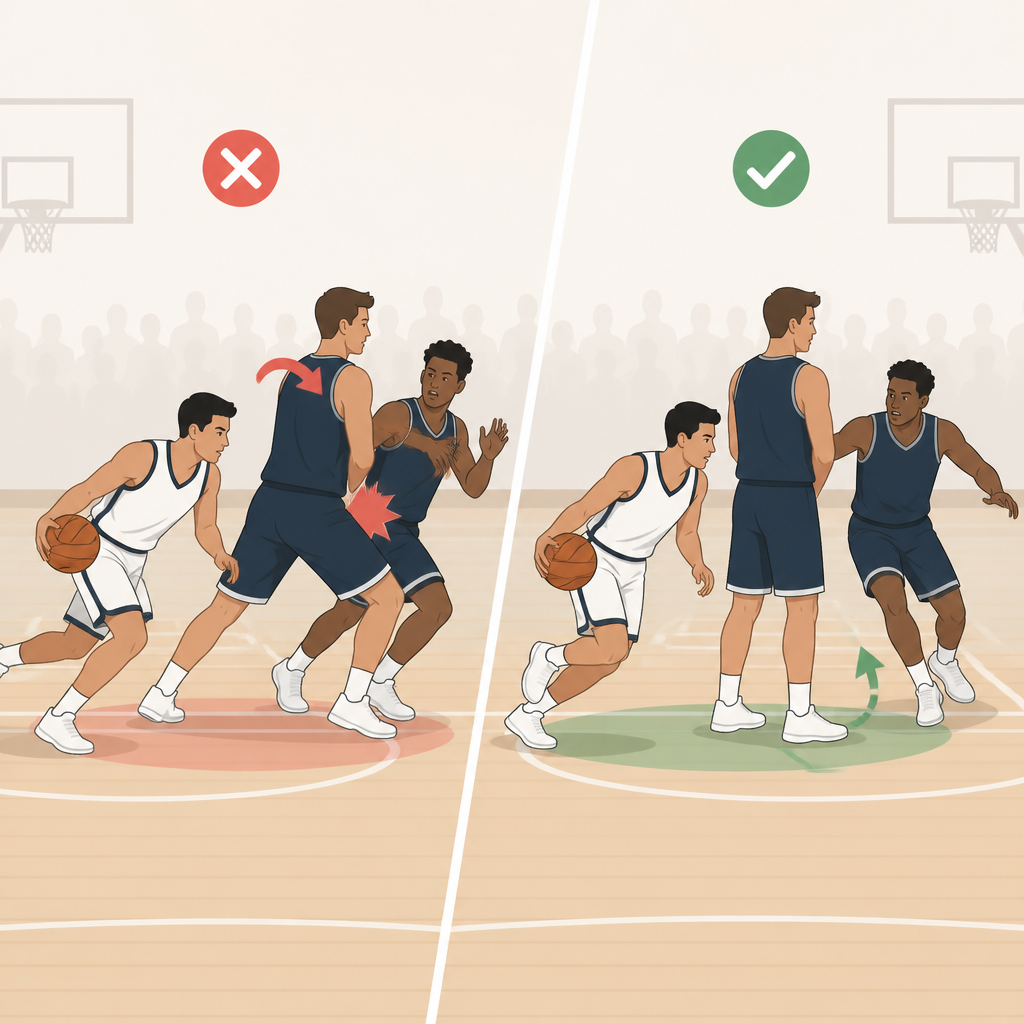
An illegal screen in basketball happens when the player setting the pick does not establish a legal position, moves into the defender, extends a hip, shoulder, knee, or arm, or fails to give the defender enough time and space to avoid contact. That sounds simple, but in real games it is one of the most misunderstood parts of basketball game rules. I have coached players through film sessions where everyone in the room thought the screener was “just standing there,” only to see on replay that his feet were still sliding or his body leaned into the hit. If you want to understand why referees call moving screens, why some picks create open shots while others become turnovers, and how this rule connects to broader NBA rules, you need to know the details.
A screen, often called a pick, is an offensive action where one player positions himself to delay or redirect a defender so a teammate can cut, drive, or shoot. A legal screen is stationary when contact occurs and is set with proper spacing based on the defender’s movement and field of vision. An illegal screen, also called an illegal pick or moving screen, is a personal foul on the screener. In the NBA, NCAA, and NFHS rulebooks, the exact wording differs slightly, but the core principles are the same: establish position legally, avoid movement into the defender, and do not create contact unfairly.
This rule matters because screening is central to modern offense. Pick-and-roll, pick-and-pop, flare screens, wide pin-downs, and Spain actions all depend on the screener obeying game rules while still creating an advantage. Teams build entire half-court systems around screening angles and timing. Defenses counter with switching, top-locking, icing, and drop coverage. Because the action is physical and fast, a small technical error can decide a possession, erase a made three, or put a key big man in foul trouble. For anyone learning the sport, this is one of the clearest examples of how basketball rewards precision, not just strength.
As a hub for basketball game rules under the NBA rules umbrella, this guide explains what makes a screen legal, what turns it into a foul, how referees judge common plays, how players can set better picks, and where the rule creates gray areas. If you understand this page, you will have a stronger grasp of offensive foul rules, defender rights, player positioning, contact principles, and the rhythm of half-court basketball.
What the Rule Actually Says in Practice
The plain-language version of the illegal screen rule is this: the screener must arrive at the spot first, get set, and avoid causing contact by moving into the defender. Referees look at three things immediately. First, was the screener stationary at the moment of contact? Second, did the screener establish a legal position before the defender got there? Third, did the screener give the defender enough distance to stop or change direction, especially if the defender was moving and could not see the screen?
That last point is critical. Basketball game rules do not treat every defender the same way. A defender who sees the screen coming can be screened more tightly than a defender running full speed while focused on the ball. Rule interpretations commonly distinguish between a stationary defender and a moving defender, and between an on-screen defender and a blind-side defender. If the defender is outside the screener’s field of view or approaching from behind, the screener usually must allow more room.
In NBA officiating language, screeners are entitled to a spot on the floor, but not to move an opponent out of the way. If the screener sticks out a leg, turns his hips at the last second, widens his stance after contact begins, or shuffles sideways to maintain contact, the referee has the basis for an offensive foul. Many moving screen calls come from subtle lower-body movement rather than obvious upper-body shoves.
What Makes a Pick Illegal
Most illegal screens fall into a handful of repeat categories. The first is movement. If the screener is still sliding into position when contact happens, the play is vulnerable to a whistle. This often occurs in transition or early offense, where the big is sprinting into a drag screen and never fully gets set. The second is extension. A screener who leans a shoulder, sticks out a hip, flares a knee, or places an arm on the defender changes from creating legal obstruction to initiating illegal contact.
The third category is lack of time and distance. A screener cannot teleport into a moving defender’s path and expect the defender to disappear. If the defender has no reasonable chance to stop or avoid contact, the screen is illegal even if the screener appears upright. The fourth category is re-screen movement. Many players set one pick legally, then pivot, slide, or walk into the defender again. The first screen may be clean; the second motion draws the foul.
Another common issue is angle. A legal screen can still be called illegal if the screener rotates at the moment of impact and clips the defender from the side or back. This is especially common on pin-down screens for shooters and on ghost-screen fakes where the screener starts to leave before establishing position. In film work, I tell players to think of the screen as “arrive, stop, absorb.” If the order becomes “arrive, turn, chase contact,” trouble follows.
How Referees Judge the Play in Real Time
Officials do not judge screens by aesthetics alone. They judge advantage, responsibility, and sequence. The first question is who created the contact. If the defender barrels straight through a stationary screener who established position in time, the contact is on the defender and play should continue. If the screener’s body movement altered the defender’s path or caused the collision, that usually becomes an offensive foul.
Referees also read the defender’s speed and sightline. A defender trailing a ball handler around a high pick is often moving quickly and watching the dribbler, not the screener. That means the screener must be cleaner and earlier. By contrast, if a defender is already chest-to-chest with the screener, sees him clearly, and still runs through him, the offense has stronger protection. This is why fans sometimes think the same amount of contact is called differently; the defender’s perspective changes the ruling.
NBA officials are trained to watch the screener’s feet first, then the torso and lower-body flare. Broadcast replays often highlight hands, but knees and hips cause many fouls. Veteran defenders know this and sell the contact by stopping abruptly or snapping their heads, yet embellishment alone does not make a legal screen illegal. The underlying movement still has to exist. Good officiating separates real displacement from acting.
Common Screen Types and Their Risk Level
Not every pick carries the same foul risk. A stationary down screen on the weak side is usually easier to legalize than a high-speed step-up screen near the sideline. The more dynamic the action, the more precise the screener must be.
| Screen Type | How It Works | Main Illegal Screen Risk |
|---|---|---|
| High ball screen | Big screens for the ball handler above the arc | Feet still moving on contact against a trailing defender |
| Step-up screen | Screener approaches from the side to change driving angle | Late arrival leaves no time and distance |
| Down screen | Screener frees a shooter moving from baseline to wing | Hip turn or leg extension as defender chases over |
| Flare screen | Screener helps a teammate move away from the ball to the perimeter | Rotating into the defender’s side |
| Back screen | Screener blocks a defender behind the play for a cutter | Blind-side contact without enough space |
| Spain pick-and-roll screen | Second screener back-screens the big defending the ball screen | Walking into the defender after the initial setup |
In the NBA, step-up screens and transition drag screens produce many whistles because they happen at speed and with awkward angles. Back screens are also dangerous because the defender often cannot see them. Coaches teach screeners to arrive early, widen their base before contact, keep arms tight, and expect the defender to react unpredictably.
How to Set a Legal Screen
A legal screen starts before contact. The screener must read the defender’s path, beat him to the spot, and stop with balance. Feet should be planted shoulder-width apart or slightly wider, knees bent, chest upright, and hands tucked close to the body. Once the defender commits to a route, the screener absorbs contact rather than chasing it. That last point separates disciplined screeners from foul-prone ones.
Timing matters as much as stance. Young players often sprint into a pick and feel pressure to “hit” the defender. In reality, the best screeners arrive half a beat early and let the defender run into a legal wall. Think of Steven Adams, Al Horford, or Bam Adebayo at their best: they create force through angle and stillness, not through lunging. The ball handler also helps by waiting for the screen to be set before using it. When the dribbler leaves too early, the screener tends to move with him and gets called.
Angle is the hidden skill. A legal screen should influence the defender’s route without requiring extra body movement. On a side pick-and-roll, for example, a screener who points his chest toward the sideline may force the defender to brush the pick cleanly. If he faces too squarely or too narrowly, he feels compelled to rotate at impact, and the whistle becomes likely. Great screening is geometry under pressure.
Why Illegal Screens Are So Common in the NBA
The NBA game stretches the rule because spacing, speed, and shot value reward even tiny delays. A legal screen that slows a defender for one step can create a pull-up three or a downhill drive. Because that advantage is so valuable, players push the edge. Bigs re-angle picks, wings slip into contact, and ball handlers snake dribbles tight enough that any extra lean from the screener becomes significant.
Modern defensive schemes also increase pressure on screen legality. Switching defenders try to split gaps aggressively. Point-of-attack defenders fight over picks harder than they did a decade ago because teams hunt mismatches and launch more threes. That means collisions are sharper and easier to spot. The league has also emphasized freedom of movement in different periods, which changes how tightly referees police off-ball contact and screening technique.
There is another reason fans get confused: some illegal screens are ignored because officiating must balance flow with accuracy. If every minor brush were whistled, games would bog down. Officials therefore focus on material contact that changes the play. This creates a practical threshold. Coaches understand that threshold and teach players to operate just under it. The result is a constant cat-and-mouse game between instruction, execution, and enforcement.
Gray Areas, Counters, and Teaching Points
The hardest plays involve shared responsibility. If a defender grabs the cutter’s arm while the screener is slightly moving, either action could be called first. If the defender flops backward from modest contact, the official must decide whether there was real displacement. If the screener establishes position but widens his stance after contact starts, the initial legality can be erased by secondary movement. These are not contradictions; they are sequence judgments.
Offenses can reduce risk with simple counters. Slip screens avoid prolonged contact by having the screener fake the pick and cut early, but the fake must not include a body check. Ghost screens by shooters can create confusion without contact if timed well. Rescreens can be effective if the screener fully resets instead of drifting into the defender. On youth and high school courts, I stress “screen, pause, release.” That pause keeps players from turning one legal action into a moving foul.
For defenders, the best counter is anticipation. Call the screen, change level, and choose a route early. Players who wait until the last instant often crash into legal contact and expect a whistle that will not come. For screeners, the safest checklist is simple: beat the defender to the spot, come to a complete stop, keep limbs inside the frame, hold the angle, and trust your teammate to use the pick correctly.
How This Rule Fits the Bigger Game Rules Picture
Illegal screens are one piece of a larger game rules framework that includes personal fouls, team fouls, offensive fouls, freedom-of-movement points of emphasis, legal guarding position, and cylinder principles. Learning this rule helps players understand several others at once. You see why some contact is allowed when both players have rights to space, why moving into an opponent creates liability, and why off-ball actions matter as much as on-ball defense.
For anyone building a broader knowledge of NBA rules, screen legality connects directly to hand-checking, blocking versus charging, verticality, rebounding displacement, and off-ball holding. The same basic question keeps appearing: who got to the spot legally, and who created the unfair contact? That principle explains a huge percentage of whistle decisions across the sport.
The clearest takeaway is that a pick becomes a foul when the screener moves into contact, fails to establish position, or removes the defender’s chance to avoid the collision. A legal screen, by contrast, is early, balanced, stationary on impact, and shaped by smart angle rather than extra force. If you coach, play, or watch closely, this single rule will sharpen your understanding of half-court offense and refereeing immediately.
Use this page as your starting point for basketball game rules within the NBA rules topic, then apply it when you watch the next pick-and-roll possession. Pause the replay, check the feet, hips, timing, and defender’s view, and you will usually find the answer. The more precisely you see screens, the more clearly you see the game.
Frequently Asked Questions
What is an illegal screen in basketball?
An illegal screen is a personal foul committed by the player setting the pick when that player does not establish or maintain a legal screening position. In plain terms, a screener cannot create contact by sliding into a defender’s path, leaning into the defender, sticking out a hip, knee, shoulder, or arm, or setting the screen so late and so close that the defender has no fair chance to stop or change direction. A legal screen is not just about “standing still.” It is about where the screener gets to, when the screener gets there, and whether the defender is given a realistic opportunity to avoid contact.
This is why illegal screens are so often misunderstood. From the stands, on the bench, or even in live action on the floor, a pick can look harmless because the screener appears stationary at the moment of impact. But officials also judge the approach to the screen and the screener’s body position. If the screener shuffled into the defender at the last second, widened the base unnaturally, turned the body into the defender, or created contact with an extended body part, it can still be a foul. The rule is designed to prevent the screener from gaining an unfair physical advantage while still allowing teams to use screens as a core part of offensive strategy.
What makes a screen legal instead of a foul?
A legal screen starts with legal position. The screener must get to the spot first and then establish position without causing contact. In most situations, that means the screener should be stationary when contact occurs and keep the arms close to the body, the feet set naturally, and the torso upright. If the defender is already moving, the screener cannot simply step into the path at the last instant and expect the defender to disappear. Time and distance matter. The defender must be given enough room and enough time to avoid the screen when the screen is set outside the defender’s field of vision.
Another key factor is whether the screener remains legal through the contact. A screen that begins legally can become illegal if the screener leans, pivots into the defender, widens the body, or moves laterally to continue blocking the defender’s path. Coaches often teach screeners to arrive early, get balanced, stay compact, and let the defender run into the screen rather than “delivering” the screen. That is the safest rule of thumb. If the screener chases the defender, angles the body to clip the defender, or turns a stationary pick into a moving obstacle, officials are much more likely to call a foul.
Can a player be called for an illegal screen if they look like they are standing still?
Yes, absolutely. This is one of the biggest reasons players, coaches, and fans get frustrated with the call. A screener may appear motionless at the exact moment of contact, but the official may have already seen something illegal happen just before that moment. For example, the screener may have slid one step to the side as the defender tried to go over the top, turned a shoulder into the defender, or stepped in too late for the defender to avoid the collision. On film, these details often become much clearer than they seem in real time.
There is also a difference between being still and being legal. A player can be standing still but still be too close when setting the screen, especially on a blind-side or rear-angle screen where the defender cannot reasonably see it coming. Likewise, a screener who sets the feet but sticks out a hip or knee to catch the defender is not legal just because the feet stopped moving. Officials evaluate the whole action, not just a freeze-frame. That is why good screening technique is about timing, spacing, body control, and discipline, not merely stopping your feet for a split second.
How much time and space does a defender need for a screen to be legal?
The exact amount is not measured with a stopwatch or a ruler in a game, but the principle is clear: the defender must be given a reasonable chance to avoid the contact. If the screener sets up within the defender’s field of vision, the defender is expected to recognize and react to the screen more quickly. But if the screen is set outside the defender’s line of sight, such as from the side or behind, the screener has a greater responsibility to allow enough time and distance for the defender to stop or change direction safely.
This is why late-arriving screens are so often whistled illegal. Imagine a defender chasing a shooter around the perimeter. If the screener steps into the path only an instant before contact, the defender may have no realistic way to avoid crashing into the screen. Even if the screener then freezes, the official can still call an illegal screen because the defender was not given time and space. At every level of basketball, teaching players to “be early, be still, and be seen” helps reduce these fouls. If a screener gets into position early enough that the defender can read the play and react, the screen is far more likely to be ruled legal.
How can players set better, legal screens without losing effectiveness?
The best legal screeners are disciplined technicians. First, they arrive early to the spot instead of sprinting into contact. Second, they come to balance with a wide but natural base, chest up, and hands tucked in rather than flared out. Third, they hold their position and let the ball handler use the screen instead of trying to “hit” the defender. A screener should think about creating an obstacle, not delivering a block. The more controlled and compact the body position, the less likely the screener is to commit a foul.
Timing and communication also matter. A great screen is not just legal; it is useful. Screeners should angle the pick to help the ball handler force the defender over, under, or into the help defense, but they must set that angle before the defender arrives. They should avoid leaning, re-screening while still moving, and turning the hips or shoulders at the moment of contact. Film study is especially valuable here because many illegal screens come from habits players do not realize they have, such as drifting sideways or subtly extending a leg. When players learn to get set earlier, keep their frame quiet, and trust positioning over force, they often become both more effective and less likely to be called for offensive fouls.