
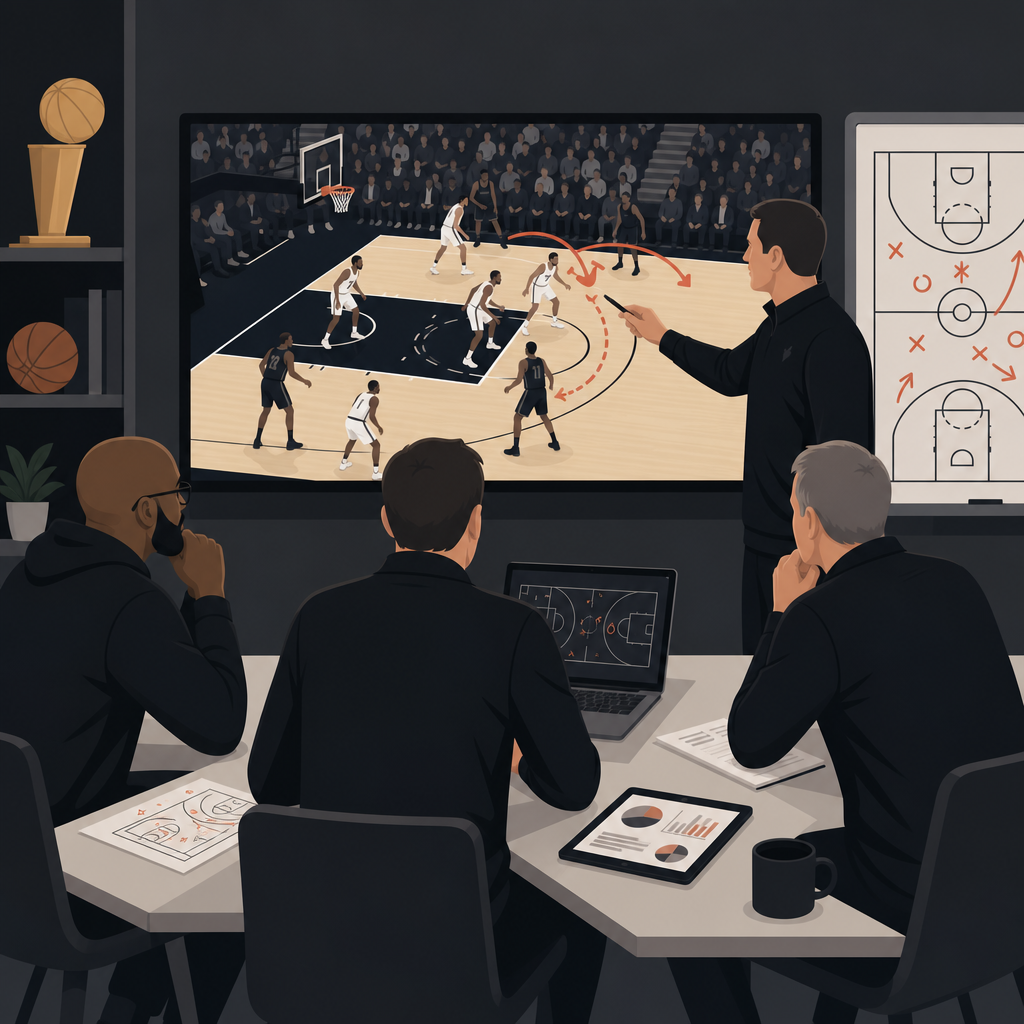
NBA coaches build game plans by turning film, data, and practice time into a precise strategy for the next opponent, then adjusting that plan possession by possession as the game unfolds. In practical terms, a game plan is the set of offensive actions, defensive coverages, matchup decisions, rotation guidelines, and late-game contingencies a staff prepares before tipoff. The film room process is the engine behind all of it. Coaches use video breakdown software, synergy reports, lineup data, and scouting notes to answer direct questions: Where does this team score most efficiently? Which actions trigger help mistakes? Which defenders can be forced into screening actions? Which bench units change the opponent’s style?
This matters because the NBA is too skilled, too fast, and too tactical for intuition alone. A modern staff must balance league-wide principles with opponent-specific detail. Over years of studying coaching workflows, sitting in on prep sessions, and building scouting reports from platforms like Synergy Sports, Second Spectrum, and Hudl, I have seen that strong plans are rarely built on one big idea. They are built on layers: transition rules, pick-and-roll coverage, post help, offensive spacing, timeout counters, foul management, and substitution timing. The best coaches simplify those layers so players can execute under pressure. That is why understanding how NBA coaches build game plans is essential to understanding NBA strategy itself.
Start With Film Study and Opponent Identity
The first step in the film room process is defining opponent identity. Coaches do not watch random clips and hope themes emerge. They begin with a framework: pace, shot profile, play frequency, preferred lineups, end-of-quarter habits, after-timeout tendencies, and defensive scheme consistency. Film is organized by possession type, not just by game. A staff wants to know how often a team runs empty-side pick-and-roll, Chicago action, Spain pick-and-roll, pindown into dribble handoff, horns, delay, zoom action, or early drag screens. On defense, they chart whether the opponent plays drop, at-the-level, switch, weak, ice, peel switching, scram switching, or zone, and in which game contexts those calls change.
Synergy Sports has become central because it tags actions and provides efficiency by play type. A coach can quickly see that a team ranks in the 82nd percentile as the roll man, but only average on post-ups, or that its corner-three frequency spikes when a specific bench guard enters. Second Spectrum tracking adds location and movement data: average defensive distance, help positioning, screen angles, and passing windows. Film then gives the context the numbers cannot. A report may show that a team’s transition defense is poor, but film reveals why: the corners crash too hard, the five contests at the rim and cannot recover, or the point guard argues with officials and loses floor balance responsibility.
Opponent identity also means separating signal from noise. Coaches usually study a recent sample, a larger season sample, and direct matchups against similar archetypes. If the next opponent just played three games without its starting center, season-long rim protection numbers may mislead. If a team faced five switching defenses in a row, its half-court offense may look worse than it will against a drop team. Good staffs contextualize everything. They ask not only what happened, but against whom, with which personnel, and under what score and clock conditions. That discipline prevents overreacting to one hot shooting night or one ugly loss.
Build a Defensive Plan Around Priorities, Matchups, and Coverage Rules
Most coaches start game planning from the defensive side because defense requires connected decisions from all five players. The first question is simple: what must be taken away? Against one opponent, the priority is limiting rim attempts and free throws. Against another, it is staying attached to movement shooters and denying clean catch-and-shoot threes. A strong defensive game plan usually has three levels. First are nonnegotiables, such as sprinting back, loading to the ball in transition, and tagging the roller. Second are matchup choices, including who guards the primary creator and which weak defender can be hidden. Third are coverage rules for specific actions.
Coverage rules are where the film room earns its value. Consider guarding a high-usage pick-and-roll star. If he punishes deep drop with pull-up threes, the staff may choose at-the-level coverage or a hard show, then rotate low man early from a non-shooter. If the screener is an elite short-roll passer, the same coverage may be too risky, so coaches might mix in switch-to-peel principles or “weak” the ball toward the help side. Against a dominant post hub like Nikola Jokic, the plan may change by floor zone: single coverage above the slot, baseline dig from the nail on left-block catches, and immediate scram help if a guard gets pinned. These are not broad preferences. They are situational directives taught with exact clips.
Matchups are equally strategic. Coaches rarely assign defenders only by position. They think in functional roles: point-of-attack stopper, screen navigator, nail helper, rim protector, and low-man communicator. If the opponent’s best scorer lives off pindowns, the ideal defender might be a wing with top-lock discipline rather than the team’s strongest on-ball defender. If the opposing center spaces to the corner, the staff may use a more mobile big to preserve help timing. Film shows where players lose concentration. Some stars reject screens in late clock. Some role players relocate on drives without ever being called as primary options. The game plan marks all of it.
Coaches also prepare counters in advance. If the opponent starts slipping screens against aggressive coverage, what is the call? If the first unit handles switching but the bench unit cannot, does the scheme shift by lineup? Clear answers matter because halftime is too late to invent structure. The best defensive plans sound simple in the locker room because the complexity has already been solved in the film room.
Create an Offensive Plan That Targets Pressure Points
Offensive game plans are not just a list of favorite plays. They are targeted attempts to create the specific mistakes a defense is prone to making. Coaches begin by identifying pressure points: a center slow to contain the ball, a wing who ball-watches on the weak side, a switch scheme vulnerable to offensive rebounding, or a drop defense that concedes mid-range pull-ups. Then they choose actions that force those defenders into repeated decisions. If a team struggles to defend empty-corner pick-and-roll, the offense will clear the side and make the low man travel farther. If the opponent top-locks shooters, the answer may be back cuts and ghost screens. If the weak-side tagger hugs the corner, the roll man gets more direct pocket-pass opportunities.
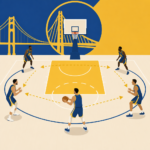
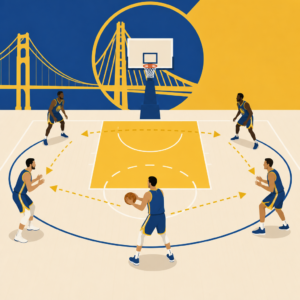
Spacing rules are central. In many scouting sessions, coaches spend as much time on where players stand as on what play is called. Correct spacing widens help rotations and determines whether a star sees one defender or three. Against aggressive nail help, coaches may flatten the weak-side wing to the corner and lift the slot shooter late to create a longer closeout. Against switching teams, they may invert actions to force small guards to defend larger screeners, then flow immediately into a seal or duck-in. Against teams that over-help on drives, the plan may emphasize 45 cuts, drift passes, and shake action behind penetration. Every adjustment has a purpose tied directly to film.
Play sequencing matters too. Experienced staffs think in chains. They might open with horns to test whether the defense switches both screens, then return later with the same alignment flowing into Spain action. They may run a simple Chicago set early not because it is the best shot, but because it establishes a curl read that becomes valuable in the fourth quarter. One of the most overlooked parts of the film room process is scripting. Coaches often script the first few offensive possessions to gather information while calming the team. Those calls are diagnostic as much as tactical.
After-timeout offense receives special attention because it offers the cleanest chance to attack a known tendency. The staff studies whether the opponent switches baseline out-of-bounds plays, zones under the basket, or overplays the inbound to deny stars the first catch. Late-game offense is planned separately, with options for needing a two, needing a three, advancing the ball, attacking a foul-prone defender, or preserving timeout inventory. These details often decide close games far more than one flashy sideline play.
Translate Film Into Player-Friendly Teaching and Practice Reps
A great scouting report fails if players cannot apply it at full speed. That is why translation is a coaching skill equal to analysis. Most NBA staffs condense large film libraries into short teaching edits: transition clips, pick-and-roll clips, special-situation clips, and individual matchup clips. The point is not to impress players with volume. It is to show the minimum evidence required to prove the plan. Veterans usually want direct cause and effect. Young players often need repeated examples tied to one clear rule. Strong coaches tailor delivery without changing the substance.
Terminology must stay consistent. If “red” means an aggressive trap in October, it cannot mean a soft blitz in March. If “x-out” is the weak-side rotation behind a corner closeout, everyone must picture the same movement. Consistent language speeds recognition during games. Practice then converts recognition into habit. Walkthroughs cover alignment and communication. Shell drills cover help positioning and tagging. Live segments rehearse opponent actions with assistant coaches or scout-team players mimicking timing, angle, and spacing.
| Film Room Output | What Coaches Emphasize in Practice | Game Impact |
|---|---|---|
| Transition clips showing cross-matches | First three steps back, floor balance, early communication | Fewer runout layups and cleaner matchups |
| Pick-and-roll edit against a pull-up guard | Screen navigation, rearview contests, nail help timing | Lower efficiency on high-ball screens |
| Weak-side help breakdowns | Low-man tags, x-out rotations, corner closeouts | Fewer open corner threes |
| Opponent switch vulnerabilities | Slip timing, ghost screens, deep seals | Better shot quality against switching |
| Late-game baseline out-of-bounds film | Inbound denial, switch communication, foul awareness | More reliable execution in final possessions |
Scout-team accuracy is underrated. If the second unit simulating the opponent does not mirror pace, screening angle, and spacing discipline, the starters rehearse the wrong reads. Good assistants are meticulous here. They tell the scout guard where the opponent likes to reject screens, remind the stand-in big whether to short roll or dive, and insist that weak-side shooters relocate exactly as the film shows. That realism makes the eventual game feel familiar. Familiarity reduces hesitation, and hesitation is often what elite opponents punish most.
Use Analytics, Rotation Planning, and In-Game Adjustments to Refine the Plan
No NBA game plan is complete at the whiteboard. It must connect to who can actually play, for how long, and in which combinations. Rotation planning is strategic because schemes live inside lineups. A team may prefer switching, but if its backup center cannot contain guards in space, the coverage must shift when he enters. A bench group with two non-shooters may need more off-ball screening and offensive rebounding emphasis. A closing lineup may sacrifice size for better decision-making. Coaches map these realities before the game so substitution patterns support the plan instead of undermining it.
Analytics sharpen those choices. Lineup net rating alone is not enough, but lineup possession data, shot location profiles, and opponent-specific on-off trends can reveal combinations worth testing. If the opponent’s second unit bleeds points against spread pick-and-roll, a coach may stagger a lead creator to attack that window. If tracking data shows an opposing wing contests poorly after navigating multiple screens, the staff may extend shooting actions across several trips to tax him. Foul rates, rebound percentages, and turnover sources all matter. A team that rarely fouls might invite more direct rim pressure; a team that crashes the offensive glass may require sacrificing some transition offense for defensive rebounding shape.
In-game adjustment is where preparation meets reality. Early possessions function like live diagnostics. Is the opponent switching a matchup they usually chase? Are they putting a smaller defender on the screener to pre-switch? Has a shooter changed corners to pull in the low man? The head coach, lead assistants, analytics staff, and player development coaches are all scanning for these deviations. Modern benches often receive live data on play frequency and shot quality during the game. But the best adjustments still come from recognition, communication, and trust. Players must believe that if the staff asks for a coverage tweak in the second quarter, it is grounded in a pattern, not panic.
Halftime is often misunderstood. It is not a long strategy seminar. Coaches usually reinforce what is working, identify one or two changes, and present them in simple language. The teams that adjust best are usually the teams that prepared the most counters beforehand. By the fourth quarter, game plans become narrower. Coaches lean on lineups that can execute the most important rules, whether that means switching everything, targeting one defender, or simplifying the offense around two-man actions. The film room process shows up here as clarity under pressure.
NBA strategy becomes easier to understand when you see that every game plan is a chain from evidence to teaching to execution. Coaches study film to define opponent identity, build defensive priorities, target offensive pressure points, translate details into clear language, and refine everything through analytics, rotations, and live adjustment. The value of the film room is not just finding weaknesses. It is turning complex information into choices players can trust on the floor. That is how NBA coaches build game plans, and it is why the best staffs consistently win the possession battle before the ball even goes up.
As a hub for NBA Analysis strategy coverage, this framework connects to every deeper topic in the category: pick-and-roll defense, matchup hunting, transition offense, after-timeout design, lineup optimization, and playoff adjustment cycles. If you want to read the game like a coach, start by asking the same questions coaches ask. What is the opponent trying to force? What are they willing to concede? Which lineups change the answer? Follow those questions through the film, and the strategy on the court becomes much clearer. Explore the rest of the strategy coverage with that lens, and every possession will tell you more.
Frequently Asked Questions
What does an NBA game plan actually include before a game starts?
An NBA game plan is much more than a short list of plays on a whiteboard. Before tipoff, coaches build a complete strategy that covers how the team wants to attack offensively, how it wants to defend the opponent’s main actions, which matchups make the most sense, how the rotation may shift against certain lineups, and what the team should be prepared to do in late-clock and late-game situations. That means identifying the opponent’s favorite actions, isolating the lineups that create the most problems, deciding where help defense should come from, and choosing which shots are acceptable to concede versus which ones must be taken away. On offense, it also means targeting weak defenders, planning counters if the opponent switches or traps, and scripting ways to create quality shots for primary scorers and role players alike.
In the film room, all of those decisions are connected. Coaches study recent games, special-situation possessions, and lineup trends to determine what is repeatable and what is noise. They also filter the plan through their own roster. A strong game plan is never just about what the opponent does best; it is about what your team can realistically execute under pressure with limited preparation time. The final result is usually a layered plan with clear priorities: a primary approach, a backup adjustment, and a set of emergency counters if the game moves in an unexpected direction.
How do NBA coaches use film to prepare for a specific opponent?
Film study is the foundation of opponent preparation because it turns raw information into teachable patterns. Coaches do not simply watch highlights or full games at random. They use video breakdown tools to sort possessions by play type, lineup, player, game situation, and result. That allows them to isolate how an opponent scores in pick-and-roll, where its shooters tend to relocate, what triggers its transition game, how its star player responds to double teams, and which defensive coverages it prefers against different offensive threats. By watching those clips in volume, coaches begin to see recurring habits that matter far more than one-off outcomes.
The most valuable part of film work is translating observation into action. If film shows that a team’s ball handler prefers rejecting screens when the big defender is in a deep drop, that influences the coverages practiced the next day. If clips reveal that a second unit struggles against physical top-locking on shooters, coaches may install that tactic for bench-heavy stretches. Film also helps with timing and communication. Players can see exactly when a weak-side defender is late, where a tagger should stand against a roll man, or how quickly an offense flows from one action into the next. In that sense, the film room is where coaches reduce complexity. They turn a huge amount of video into a smaller set of reads and rules that players can trust in real time.
What role do analytics and lineup data play in building an NBA game plan?
Analytics sharpen the game plan by showing coaches which patterns truly drive winning possessions. Film may reveal what a team likes to do, but data helps measure how often it does it, how efficient it is, and under what conditions it becomes more or less effective. Coaches and analysts look at lineup combinations, shot profiles, play-type efficiency, pace, turnover rates, foul-drawing trends, transition frequency, and opponent-specific splits to understand where the leverage points are. For example, a staff may learn that an opponent’s starting group is elite in half-court offense but vulnerable on the defensive glass, or that a bench-heavy lineup gives up corner threes at a high rate when forced into rotation.
Lineup data is especially important because NBA games are rarely played by one static unit. Coaches need to know not only what a team does overall, but what changes when certain players share the floor. A star with a stretch big may create a very different pick-and-roll environment than that same star paired with a rim runner. Defensively, some lineups may switch everything while others rely on drop coverage or zone principles. Good staffs combine those numbers with film so they do not overreact to small samples or miss the context behind the stats. The goal is not to let spreadsheets replace coaching judgment. It is to use analytics to confirm what the film suggests, challenge assumptions, and prioritize the areas where a tactical edge is most likely to matter.
How is the game plan taught to players without overwhelming them?
This is one of the most important parts of coaching, because even the smartest plan fails if players cannot absorb and execute it. NBA staffs usually organize information by priority. They focus first on the opponent’s core actions, the most dangerous players, and the defensive or offensive rules that must hold up under pressure. Instead of flooding players with every possible detail, coaches often present the game plan in a structured way: here are the three things we must take away, here are the two coverages we are most likely to use, here is what changes if the opponent goes small, and here is how we want to attack specific matchups. The language is usually direct and repeatable so players can recall it during live possessions.
Film sessions, walkthroughs, and practice segments all work together. In the film room, players see examples of the opponent’s habits and the correct responses. On the court, those responses are rehearsed so the reads feel automatic rather than theoretical. Veteran teams often process this quickly, while younger teams may need simpler rules and more repetition. Coaches also tailor instruction by role. A starting center may need detailed coverage notes on screening actions and rim protection responsibilities, while a wing reserve may need sharp clarity on transition matchups, closeout discipline, and spacing in second-unit offense. The best staffs know that communication is part strategy. They simplify without dumbing things down, making sure each player understands not just what to do, but why it matters within the larger plan.
How do NBA coaches adjust the game plan once the game is underway?
Game plans are built before the game, but they are managed possession by possession once the game begins. Coaches and assistants constantly track whether the original assumptions are holding up. Is the opponent getting to its preferred spots anyway? Is a certain coverage exposing a mismatch? Is a role player hurting the defense more than expected? Are the referees calling the game in a way that changes how physical defenders can be? Those answers determine whether the staff sticks with the initial plan, tweaks it slightly, or makes a more significant change. In-game adjustments might include changing who guards the primary scorer, moving from drop coverage to switching, sending help from a different shooter, altering substitution patterns, or calling more actions to attack a specific defender.
The bench is effectively an extension of the film room. Assistants often monitor different tactical areas in real time, relaying quick observations backed by pregame research and live data. Timeout huddles become moments to reinforce one key correction rather than re-teach the entire plan. Halftime is where the staff can be more surgical, using clips, notes, and possession-level trends to decide what needs to change for the second half. The best coaching staffs are disciplined enough not to abandon a sound plan after a few bad possessions, but flexible enough to recognize when the game has shifted. That balance between preparation and adaptation is what makes NBA game planning so demanding. The film room starts the process, but great coaching is about continuing that process under live pressure.