
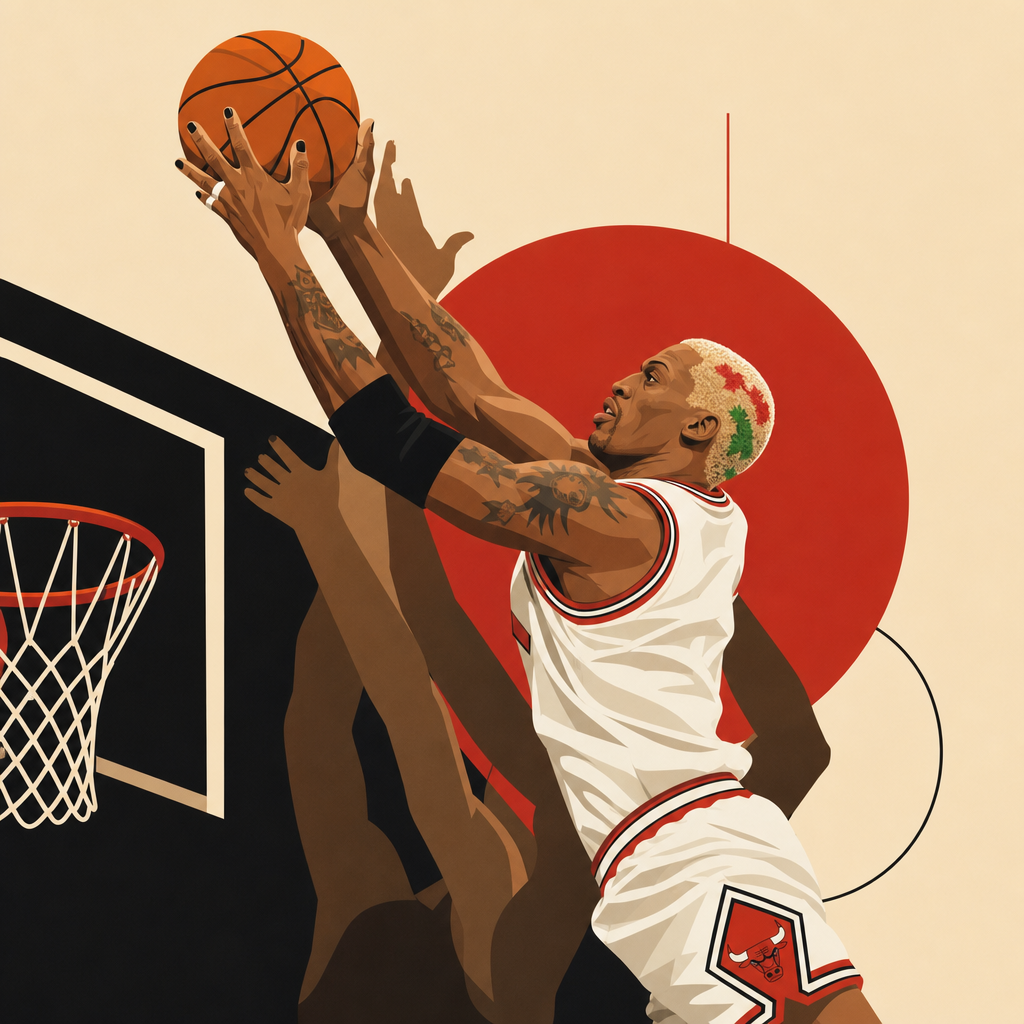
Dennis Rodman’s rebounding record stands as one of the most unusual achievements in NBA history because it turned a supposedly gritty, secondary skill into a defining art form. In player profiles, most stars are introduced through points per game, signature moves, or championship moments, yet Rodman built a Hall of Fame legacy by mastering missed shots better than almost anyone who has ever played. His profile matters not only because of what he won with the Detroit Pistons and Chicago Bulls, but because his rebounding numbers, defensive versatility, and relentless physicality changed how coaches, scouts, and fans evaluate impact beyond scoring.
To understand the Dennis Rodman rebounding record, it helps to define the terms that shape the discussion. A rebound is secured after a missed field goal or free throw, and it can be offensive, creating another scoring chance, or defensive, ending the opponent’s possession. Rebounding rate and rebounds per game are the most common ways to measure it, but context matters: pace, minutes played, shot profile, lineup construction, and era all influence raw totals. Rodman excelled across these contexts. He did not simply collect easy rebounds from height advantages. At roughly 6-foot-7, he routinely outworked centers, anticipated long misses, leveraged angles, and used lower-body strength to win space before the ball ever touched the rim.
That is why this player profile hub matters within the broader NBA Players topic. Rodman is a gateway for understanding how to profile players comprehensively rather than superficially. A useful player profile explains role, skill translation, team fit, historical impact, and measurable outcomes. Rodman gives every one of those categories real substance. He was not the tallest rebounder, not the most polished scorer, and not a conventional franchise centerpiece, yet he became indispensable on title teams. In my experience analyzing player profiles, Rodman is one of the clearest examples of why specialists can become superstars when their specialty directly controls possessions, tempo, and defensive identity.
His case also answers common questions searchers have. What record did Dennis Rodman set? Why was he such a great rebounder? How did he dominate bigger players? Was his success mostly effort, or was it technique? The short answer is that Rodman led the NBA in rebounds per game for seven straight seasons and produced some of the highest single-season rebounding rates ever recorded in the modern era. The fuller answer is more interesting. He treated rebounding like a science experiment and a combat sport at the same time, studying spin, trajectory, and shooter tendencies while embracing contact with unusual commitment. That combination made his physicality look less like chaos and more like disciplined obsession.
What Dennis Rodman’s Rebounding Record Actually Includes
The headline achievement is straightforward: Dennis Rodman led the NBA in rebounds per game for seven consecutive seasons, from 1991-92 through 1997-98. That streak spanned his late Pistons years, his San Antonio Spurs period, and his championship run with the Bulls, which makes it more impressive because he sustained elite rebounding across multiple systems and roster environments. During that stretch, he posted seasons of 18.7, 18.3, 17.3, 16.8, 16.4, 16.1, and 15.0 rebounds per game. Those are not inflated one-year outliers. They represent durable, repeatable dominance.
His peak single-game rebounding total in the regular season was 34, and he had multiple games above 25 rebounds despite playing in an era that already featured outstanding big men. He also produced elite offensive rebounding numbers, often creating extra possessions that did not appear glamorous but directly changed playoff games. Advanced metrics reinforce the eye test. Basketball-Reference credits Rodman with some of the highest offensive and defensive rebounding percentages ever recorded, and his total rebound percentage seasons belong in the top tier historically. Wilt Chamberlain and Bill Russell own much of the all-time rebounding mythology, but among modern players competing after the pace explosion of the 1960s, Rodman remains a benchmark.
One important note in any accurate player profile is the difference between totals and rates. Rodman does not own the all-time career total rebounds record; that belongs to earlier giants who played more minutes in faster eras. What Rodman owns is a uniquely modern case for per-possession rebounding supremacy, especially given his size. This distinction matters for readers comparing him with Chamberlain, Russell, Moses Malone, Hakeem Olajuwon, Andre Drummond, or Kevin Garnett. If the question is who made rebounding his central identity and delivered it at the highest relative level without traditional center size, Rodman has a very strong claim to being the best ever.
Why Rodman Was a Rebounding Genius, Not Just a Hustle Player
Calling Rodman a hustle player undersells his method. He prepared for rebounds with a level of detail that coaches and teammates repeatedly described as obsessive. Rodman studied opponents’ releases and knew that different shooters tended to create different caroms. A flat jumper often produced a harder, longer rebound. A softer shot from a corner angle could die near the rim or kick to the weak side. He learned where the ball was likely to go before others reacted. That anticipation is the hidden engine of elite rebounding. The best rebounders are moving early, not jumping late.
His body mechanics were just as important. Rodman had a low center of gravity, extraordinary balance, and quick second jumps. He did not always try to leap over bigger players; often he wedged them off their line, rode contact through the hips, and arrived at the ball first. Boxing out sounds simple, but Rodman turned it into a sequence: identify the shooter, locate the likely miss zone, make first contact, hold position without losing sight of the ball, then explode into the rebound with two hands. Many players do some of those steps. Rodman did all of them almost every possession.
He also understood when to tap the ball rather than force a catch in traffic. On the offensive glass, that skill created extra possessions even when he could not control the rebound immediately. Coaches value that because it extends possessions against set defenses and wears down frontcourts. Rodman’s rebounding, then, was not random energy. It was repeatable possession engineering built on film study, timing, leverage, conditioning, and appetite for contact.
How Physicality Became Rodman’s Competitive Advantage
Rodman’s physicality was not merely aggression. It was legal, purposeful disruption applied before and after the shot. He fought for early position, bumped cutters off preferred routes, fronted post entries, and converted every half-step of contact into leverage. In an NBA that allowed more hand-checking and interior wrestling than today’s game, that toughness gave him a structural edge. He welcomed collisions that other players tolerated. Over four quarters, that matters. Rebounding is cumulative punishment.
What made Rodman different was that he stayed active without wasting motion. Some players mistake constant movement for impact. Rodman used quick jabs, forearm placement, reverse pivots, and angle cuts to stay attached to the play. When a shot went up, he was rarely standing upright. He was loaded like a sprinter in the blocks. That athletic posture let him attack the space of the rebound instead of reacting to it. This is a crucial concept in player evaluation: the ball does not create the rebound; positioning does.
There is also a psychological dimension. Rodman made opponents feel every possession. Big men had to work to establish seals, wings saw him crash from the perimeter, and coaches knew he could tilt momentum without taking a shot. In playoff basketball, where possessions tighten and half-court offense gets harder, that kind of physical specialist becomes even more valuable. His rebounding was exhausting to play against, and that exhaustion created mistakes.
Rodman’s Role on Championship Teams
Great player profiles connect individual numbers to team outcomes, and Rodman’s career offers a clear example. With the Bad Boys Pistons, he developed into an elite defender who could guard multiple positions while supporting stars like Isiah Thomas and Joe Dumars. On those teams, rebounding and defense were foundational to identity. Rodman’s growth into a possession-dominating forward helped Detroit win back-to-back titles in 1989 and 1990.
His later Bulls years are even more instructive because they show how a non-scorer can become essential on a star-heavy roster. Chicago already had Michael Jordan and Scottie Pippen to carry perimeter creation and scoring. What it needed was a relentless rebounder and defensive connector who would clean up misses, switch onto bigger players, and free others from interior banging. Rodman gave the Bulls exactly that during the 1995-96, 1996-97, and 1997-98 championship seasons. In the 1995-96 regular season, he averaged 14.9 rebounds per game and often swung games by generating extra possessions when the offense stalled.
| Season | Team | Rebounds Per Game | Why It Mattered |
|---|---|---|---|
| 1991-92 | Pistons | 18.7 | Established him as the league’s dominant rebounder despite undersized frontcourt role |
| 1993-94 | Spurs | 17.3 | Proved his production traveled across systems and teammates |
| 1995-96 | Bulls | 14.9 | Anchored possession battles for a 72-win championship team |
| 1996-97 | Bulls | 16.1 | Delivered elite rebounding deep into a second straight title run |
| 1997-98 | Bulls | 15.0 | Closed his seven-year rebounding-title streak during the Last Dance season |
This is why Rodman belongs at the center of any serious player profile hub. He demonstrates how role optimization works at the highest level. Teams do not only need primary scorers; they need specialists whose elite skill changes possession math. Rodman’s rebounding and defense gave championship teams stability, especially when playoff games became ugly and every miss mattered.
How Rodman Compares With Other Elite Rebounders
Comparing Rodman with other great rebounders requires context. Wilt Chamberlain and Bill Russell dominated in a faster era with far more missed shots and huge minute loads. Moses Malone was perhaps the greatest offensive rebounder among traditional big men, punishing defenses with second and third efforts. Charles Barkley, another undersized force, combined power and explosiveness in a different way. More recently, players like Andre Drummond have posted large rebounding totals in lineups designed to funnel boards their way.
Rodman stands out because his production remained historically high without the usual center profile or offensive focal-point status. He did not need post touches to stay engaged. He defended across positions. He played next to stars who controlled usage. And still, he vacuumed up rebounds at a rate that forced every opponent to account for him. That portability is rare. In scouting language, his skill translated independent of scheme because it was built on anticipation, contact balance, and motor rather than play-calling.
There are fair limitations to acknowledge. Rodman was never a scorer, offered little floor spacing, and could complicate offensive spacing in some lineups. His free throw shooting was unreliable, and his volatility could test coaches and teammates. A trustworthy player profile does not erase those realities. But the tradeoff was worth it on the right roster. If a team already had creators and needed defense, edge, and possession control, Rodman’s value was enormous.
What Modern Players and Evaluators Can Learn From Rodman
Rodman’s legacy extends beyond nostalgia because it teaches practical lessons for modern basketball evaluation. First, elite impact can come from obsession with one phase of the game. Young players often chase highlights, but coaches reward repeatable winning actions: finishing possessions, rotating early, screening with force, and creating extra chances. Rodman became unforgettable by mastering those details at an extreme level.
Second, rebounding is partly teachable. Height helps, but the transferable habits are film study, reading shot trajectory, tagging bodies early, and pursuing the ball with a plan. Development staffs now use tracking data, shot charts, and lineup analytics to study these patterns in ways Rodman largely did by instinct and repetition. His example shows that “effort” is only useful when paired with technique and anticipation.
Third, player profiles should measure fit, not just talent in isolation. Rodman with the Bulls is a classic fit case: surround high-usage scorers with a defender-rebounder who does not need touches. The same principle drives modern roster building around stars who need support skills more than duplicate shot creation. For readers exploring NBA player profiles, Rodman is the clearest reminder that basketball value is interconnected. One player’s rebounds become another player’s transition chance, another lineup’s defensive rating, and sometimes another championship banner.
Dennis Rodman’s rebounding record endures because it captures something larger than statistics: the power of turning a neglected craft into a competitive weapon. He led the league in rebounds per game for seven straight seasons, dominated despite being undersized for his role, and helped championship teams win the possession battle when it mattered most. Those facts alone secure his place in NBA history, but they do not fully explain the fascination. The deeper lesson is that Rodman made rebounding visible. He showed that timing, leverage, film study, conditioning, and controlled physicality could elevate a player from specialist to legend.
For anyone building or reading player profiles, that is the key takeaway. A complete profile does not stop at points, fame, or highlights. It asks how a player influences possessions, teammates, matchups, and winning. Rodman answered those questions as clearly as any non-scorer ever has. His career is a blueprint for evaluating impact with more precision and less bias toward shot volume. Explore the rest of the NBA Players hub with that lens, and many careers will make more sense.
Frequently Asked Questions
What exactly is Dennis Rodman’s rebounding record, and why is it considered so remarkable?
Dennis Rodman’s rebounding record is remarkable because he dominated one of basketball’s most physical, detail-driven skills for an extended period in a way very few players ever have. He led the NBA in rebounds per game for seven straight seasons, a streak that immediately separates him from most great rebounders, because sustaining that level of production year after year requires durability, discipline, anticipation, and relentless effort. Rodman was not simply collecting easy rebounds because he happened to be tall or because his teams played at a faster pace. He was often undersized compared to traditional centers and power forwards, yet he consistently finished possessions better than bigger players who were supposedly built for that role.
What makes the achievement feel even more unusual is that Rodman built an all-time legacy without relying on scoring volume. In a league where stars are typically defined by points, flashy offensive moves, or shot creation, Rodman became famous for tracking angles, battling for position, reading spins off the rim, and treating every missed shot like a puzzle to solve. That is why his rebounding numbers still stand out historically. He did not just lead the league once or twice; he made rebounding his identity and transformed it into something close to a specialized art form. His record matters because it proves that total commitment to a supposedly secondary skill can be so overwhelming that it reshapes how greatness is understood.
How did Dennis Rodman become such a dominant rebounder despite not being the tallest player on the floor?
Rodman became a dominant rebounder because he relied on timing, leverage, anticipation, and obsession rather than height alone. While many players approach rebounding as a matter of effort in the moment, Rodman approached it like advanced preparation. He studied shooters, shot trajectories, and the way the ball came off the rim from different spots on the floor. He learned that not all misses are random. Some shots bounce long, some die near the rim, and some spin differently depending on who took them and from where. By learning those patterns, Rodman often reacted before everyone else had even identified where the rebound was headed.
He also mastered body positioning. Rodman was exceptionally strong, especially through his lower body and core, which allowed him to root larger opponents away from their preferred spots. He used angles the way elite interior defenders do, getting inside position early and forcing taller players to rebound over or around him. Just as important, he played with constant motor. Rebounding is exhausting because it demands repeated collisions, quick second jumps, and attention on every possession. Rodman embraced that grind. He treated loose balls and missed shots with the urgency that most players reserve for scoring opportunities. That combination of study, physical technique, and relentless commitment is why he could outperform players who had more size but less precision.
Why does Dennis Rodman’s rebounding legacy matter so much in NBA history?
Rodman’s rebounding legacy matters because it challenged the hierarchy of basketball fame. Traditionally, the game celebrates scoring first, then playmaking, then the less glamorous work that supports winning. Rodman inverted that logic. He showed that a player could become historically important by mastering the hardest invisible labor on the court. Rebounding ends defensive possessions, creates extra offensive chances, changes momentum, and punishes opponents physically and mentally over the course of a game. Rodman turned that impact into a starring trait rather than a supporting one.
His legacy also matters because it shaped championship basketball at the highest level. With the Detroit Pistons, he was a crucial part of a rugged, defensive identity that helped the team win titles. With the Chicago Bulls, he gave Michael Jordan and Scottie Pippen an elite possession-finishing and possession-extending force who fit perfectly beside their scoring and perimeter defense. In both settings, Rodman proved that rebounding was not just cosmetic hustle. It was championship infrastructure. When people study NBA history, Rodman stands out because he made specialists more respected. He became evidence that dominance does not have to look conventional to be real, and that winning often depends on players who control the game in ways box-score culture can underestimate.
Was Dennis Rodman’s rebounding success mostly about effort, or was there a deeper skill behind it?
Effort was absolutely part of Rodman’s success, but reducing his rebounding to hustle alone misses the sophistication of what he was doing. Plenty of players compete hard. Very few translate that effort into historically elite production over many seasons. Rodman’s greatness came from turning effort into a repeatable science. He had an unusually advanced understanding of ball flight, shooter tendencies, footwork, leverage, and spatial awareness. He knew how to make contact without losing mobility, how to box out opponents before the shot reached the rim, and how to keep a play alive even when he could not secure the rebound cleanly on the first try.
He also had rare mental focus for a role many players consider dirty work. Rodman remained locked in on the details of every possession. He anticipated misses instead of reacting to them, and he often pursued the ball with the kind of preparation a receiver uses to run a route. That is why coaches, teammates, and serious basketball analysts have long treated him differently from the average high-energy rebounder. Rodman was not just trying harder than everyone else; he was seeing the rebounding battle earlier and more clearly. His success was a blend of obsession, intelligence, timing, and physical courage, which is exactly why it has held up as one of the most distinctive skill profiles the league has ever seen.
How should fans interpret Dennis Rodman’s rebounding record today in the context of the modern NBA?
In the modern NBA, Rodman’s rebounding record should be viewed as both historically secure and conceptually influential. The game has changed with more three-point shooting, more spacing, more switching, and different positional expectations, which means rebounds now come off the rim in different patterns and are often shared across lineups in new ways. Even so, Rodman’s core lessons still translate. He demonstrated that elite rebounding is not merely a function of size or circumstance; it can be the result of deliberate study, technique, and total commitment. That idea remains highly relevant in today’s game, where players who win the possession battle still have enormous value even if they do not dominate the scoring column.
Fans should also interpret his record as a reminder that basketball greatness comes in multiple forms. Rodman’s career pushes back against the assumption that only offensive stars define an era. He influenced games through disruption, extra possessions, defensive versatility, and emotional edge, with rebounding serving as the clearest measurable expression of that impact. In an analytics-driven age, his value is arguably easier to appreciate, not harder, because modern evaluation places more emphasis on possession control and efficiency. Rodman was doing that work before many fans had the language to describe it. His rebounding record endures not just because the numbers are huge, but because they represent a philosophy: if you understand where games are really won, even the messiest part of basketball can become a masterpiece.