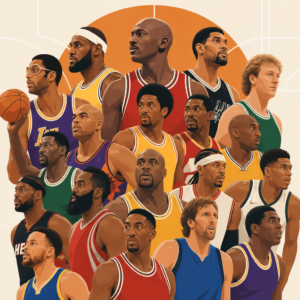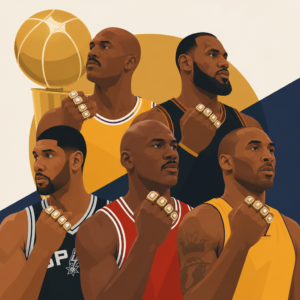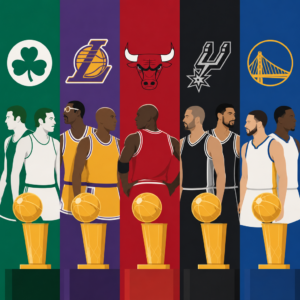

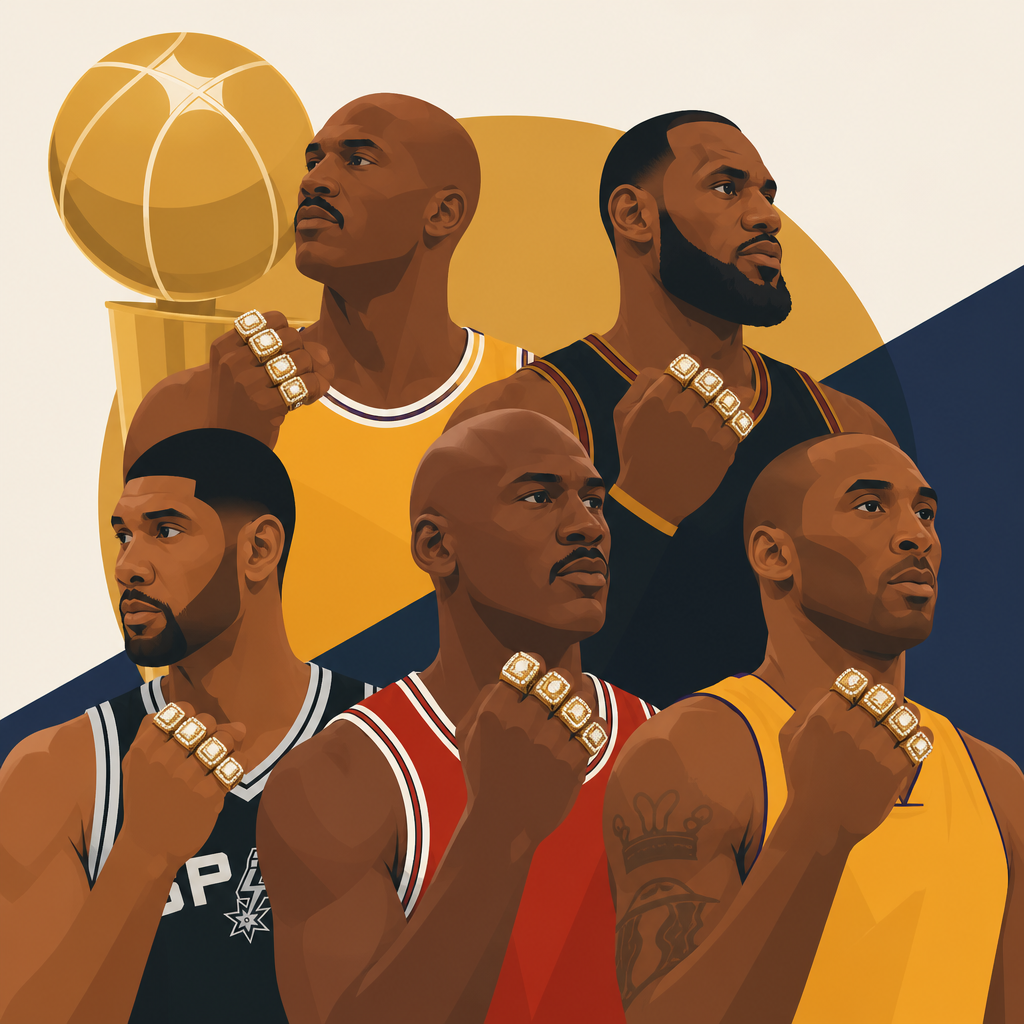
The NBA players with the most rings occupy a special place in basketball history because championships remain the league’s clearest measure of team success and one of its most debated standards for individual legacy. A championship ring is awarded to members of the title-winning organization, but when fans ask which NBA players have the most rings, they are really asking a deeper question: which stars consistently translated talent into postseason results. In my experience building player-history databases and cross-checking Basketball Reference, NBA.com archives, and Hall of Fame records, ring counts are among the simplest facts to list and among the hardest to interpret well. Context matters. Era matters. Role matters. Teammates, coaching, league size, playoff structure, and even expansion all shape how difficult each title run was.
This records-and-milestones hub explains the all-time championship leaders, where their ring totals came from, and how to evaluate those numbers without reducing basketball history to a single column. Bill Russell sits alone at the top with 11 championships as a player, won with the Boston Celtics from 1957 through 1969. Sam Jones follows with 10. Four players share third place with eight: Tom Heinsohn, K.C. Jones, Satch Sanders, and John Havlicek. Modern fans usually know Michael Jordan’s six, Kareem Abdul-Jabbar’s six, Scottie Pippen’s six, and LeBron James’s four, but the full leaderboard reveals the dominance of the Celtics dynasty and the rarity of repeated title success in every era.
Why does this milestone matter so much? First, rings often decide all-time debates, Hall of Fame framing, and how media summarize careers in one line. Second, ring counts connect eras by giving fans a common benchmark across changing styles of play. Third, this topic serves as a gateway to related NBA records and milestones: Finals appearances, playoff wins, dynasties, back-to-back champions, Finals MVPs, and players who changed franchises through championship impact. This article functions as a hub under NBA Players by mapping the leaders, explaining the historical patterns behind the numbers, and pointing to the right way to compare champions from the Russell era to the Jordan era to today’s parity-driven league.
The all-time NBA players with the most rings
If the question is simply who has the most NBA championships as a player, the answer is Bill Russell with 11. He won in 1957, then again from 1959 to 1966, and added titles in 1968 and 1969. Russell’s ring total is not a trivia fluke; it reflects the greatest sustained defensive dynasty in league history. He anchored Boston’s system with elite rim protection, rebounding, outlet passing, and unmatched command of team defense long before blocks were officially recorded. The Celtics of that era also benefited from deep continuity, Red Auerbach’s organizational edge, and a smaller league, but none of that minimizes Russell’s impact. Boston won because Russell turned defense into a repeatable championship engine.
Behind Russell is Sam Jones with 10 rings, the most ever by a player not named Bill Russell. Jones was not just a passenger on great teams. He was a high-level scorer, a deadly bank-shot shooter, and one of the league’s most reliable clutch performers. In many playoff series, he delivered the perimeter scoring Boston needed when opponents loaded up on the frontcourt. That matters when evaluating ring leaders: not every multiple-time champion had the same role, and Jones was central to title outcomes.
The next tier features Celtics legends Tom Heinsohn, K.C. Jones, Satch Sanders, and John Havlicek with eight championships apiece. Heinsohn helped establish the franchise’s early winning identity as an aggressive scorer and rebounder. K.C. Jones brought perimeter defense and calm decision-making. Sanders specialized in defense, toughness, and assignment basketball before those contributions were widely celebrated. Havlicek bridged eras, winning titles both with Russell and after Russell retired, which strengthens his case as one of the most adaptable winners ever.
| Player | Championships | Primary Teams | Title Years |
|---|---|---|---|
| Bill Russell | 11 | Boston Celtics | 1957, 1959-1966, 1968-1969 |
| Sam Jones | 10 | Boston Celtics | 1959-1966, 1968-1969 |
| Tom Heinsohn | 8 | Boston Celtics | 1957, 1959-1965 |
| K.C. Jones | 8 | Boston Celtics | 1959-1966 |
| Satch Sanders | 8 | Boston Celtics | 1961-1966, 1968-1969 |
| John Havlicek | 8 | Boston Celtics | 1963-1966, 1968-1969, 1974, 1976 |
| Jim Loscutoff | 7 | Boston Celtics | 1957, 1959-1964 |
| Frank Ramsey | 7 | Boston Celtics | 1957, 1959-1964 |
| Robert Horry | 7 | Rockets, Lakers, Spurs | 1994-1995, 2000-2002, 2005, 2007 |
That table shows the key truth of the ring leaderboard: Boston’s 1950s and 1960s dynasty dominates it. Robert Horry is the major exception near the top and the clearest modern-era outlier. Horry won seven titles across three franchises, including two with Houston, three with the Shaq-Kobe Lakers, and two with San Antonio. He was never a franchise centerpiece, but he was an elite playoff role player whose spacing, late-game shot-making, and defensive versatility fit championship environments perfectly. If you want proof that rings can reflect role excellence as well as superstardom, Horry is the best case study.
Why the Celtics dominate the championship leaderboard
Any serious discussion of NBA players with the most rings has to explain why so many names come from one franchise and one era. The biggest factor was structural dominance. From 1957 to 1969, the Celtics won 11 championships in 13 seasons. During that span, the NBA had fewer teams than it does today, talent was concentrated differently, and playoff paths were shorter. That reduced the number of rounds required to win a title, but it did not remove the challenge of repeatedly beating elite rivals. Boston’s consistency came from a repeatable formula: top-tier defense, unselfish offense, roster continuity, and a front office that understood fit before fit became front-office shorthand.
Russell was the center of everything. Teammates changed, scorers rose and declined, and stars aged out, but Boston’s defense remained overwhelming because Russell erased mistakes, controlled the glass, and initiated transition with quick outlet passes. Auerbach also built lineups with complementary skills rather than redundant scoring. Sam Jones provided shot creation. Havlicek supplied relentless two-way play. Sanders took hard defensive assignments. K.C. Jones organized the perimeter. This is one reason ring counts need context: the Celtics were not just stacked with famous names; they were assembled with unusual precision.
There were also cultural advantages. Boston established expectations that every player would defend, sacrifice touches, and accept roles in service of another title. Dynasty teams often describe this as institutional memory. I have seen similar patterns when reviewing film and playoff accounts from later champions like the 1990s Bulls and 2010s Warriors: once a team learns how to win four rounds, details become habits. The Russell Celtics mastered those habits earlier and more completely than anyone.
How to compare ring counts across eras
Comparing championships across eras is where most debates go wrong. A ring in 1962, 1996, or 2023 does not come from the same league conditions. The number of teams changed. The playoff format changed. Free agency changed roster stability. Salary cap rules changed team-building strategy. Sports medicine, travel, and scouting changed preparation. Because of that, ring totals should be treated as evidence, not as the only verdict.
The cleanest method is to ask four questions. First, what role did the player have on those title teams: best player, co-star, starter, specialist, or reserve? Second, how much playoff value did he create beyond the box score through defense, screening, spacing, or matchup flexibility? Third, how strong was the competitive environment, including league depth and postseason path? Fourth, did the player win across multiple roster constructions or only in one very specific setting?
By that standard, Russell’s 11 remain untouchable without requiring us to pretend every era is identical. Jordan’s six in six Finals are extraordinary because they came in a larger league with full playoff gauntlets and with him as the undisputed engine. Kareem Abdul-Jabbar’s six are uniquely impressive because they spanned two franchises and very different career phases, from dominant Bucks superstar to Lakers anchor and later veteran star beside Magic Johnson. LeBron James has four rings, fewer than several historical leaders, but his 10 Finals appearances and titles with three franchises show a level of portable contention that ring counts alone cannot capture.
Modern stars, famous champions, and what ring totals really say
Most fans entering this topic want to know where the modern icons stand. Michael Jordan won six championships with the Chicago Bulls from 1991 to 1993 and from 1996 to 1998. Scottie Pippen won the same six and remains one of the clearest examples of a player whose all-time standing is elevated by being both a premier defender and the second-best player on a dynasty. Kareem won six. Magic Johnson won five. Kobe Bryant won five. Tim Duncan won five. Shaquille O’Neal won four. LeBron won four. Stephen Curry has four. These totals matter because they show sustained excellence under pressure, but they do not all mean the same thing.
Take Duncan and Curry. Duncan’s five titles with one franchise over 15 years represent long-range organizational stability and incredible adaptability. He won in 1999 in a compressed season, in the slower defensive environment of the early 2000s, and again in 2014 with beautiful ball movement and spacing. Curry’s four titles reflect a different transformation: he reshaped shot selection across the sport while serving as the offensive center of gravity for a modern dynasty. Same basic ring count logic, very different basketball realities.
Then consider Horry versus Jordan. Horry has more rings than Jordan, but no informed evaluator would rank him higher. That is not disrespect; it is role interpretation. Rings tell you who was present for championship success. To decide legacy, you must ask who drove it. This distinction is why Finals MVP, All-NBA selections, playoff usage, on-off impact, and film study all belong in the conversation. Championship totals start the debate. They do not finish it.
Using this hub to explore NBA records and milestones
As a sub-pillar hub under NBA Players, this page should lead readers to the broader records-and-milestones landscape. Ring leaders connect naturally to several related topics. Finals appearances add important context because repeated trips to the championship round can reveal dominance even when a player falls short of the title. Finals MVP awards identify who most directly controlled the last series. Playoff wins and playoff games played show both longevity and deep-run consistency. Consecutive championships help explain true dynasties. Franchise records reveal which stars transformed team histories rather than only building on existing powers.
This hub also frames useful questions for deeper articles. Which players won the most championships as the best player on the team? Which stars have the most rings without a Finals MVP? Which dynasties were hardest to sustain under modern cap rules? Which all-time greats had relatively few championships despite elite individual production, such as Charles Barkley, Karl Malone, Allen Iverson, or Chris Paul? Those questions matter because rings are meaningful precisely when they are balanced against opportunity, competition, and team context.
The best way to use championship data is to treat it as a map. It points you toward players, eras, and franchises worth studying, then asks you to look closer. Bill Russell’s 11 tell the story of basketball’s greatest winner. Sam Jones and Havlicek show how elite supporting stars sustain dynasties. Horry proves specialized playoff skills can shape league history. Jordan, Kareem, Duncan, Kobe, Magic, LeBron, and Curry show that modern legacies still run through June. If you are building your understanding of NBA records and milestones, start with rings, then follow the links into Finals performance, playoff impact, and dynasty construction. That is where the numbers become history, and where basketball arguments become smarter.
Frequently Asked Questions
Which NBA player has the most championship rings in league history?
Bill Russell holds the all-time record for the most NBA championship rings by a player, with 11 titles. He won all of them with the Boston Celtics during one of the most dominant dynasties in professional sports history, spanning the late 1950s through the 1960s. That number is the benchmark every all-time championship discussion begins with, and it remains one of the most untouchable records in basketball. Russell’s teams were built on defense, rebounding, intelligence, and an unselfish style that consistently translated into postseason success.
What makes Russell’s total so remarkable is not just the number itself, but the context. The Celtics were expected to win every year, and Russell was the anchor that made that possible. He was the emotional leader, defensive centerpiece, and ultimate winner on a team loaded with Hall of Fame talent. When people debate the greatest champions in NBA history, Russell’s 11 rings are always central to the conversation because they represent sustained excellence at the highest level over more than a decade.
Who are the NBA players with the most rings after Bill Russell?
After Bill Russell’s 11 championships, Sam Jones sits next on the list with 10 rings, also as a member of the Boston Celtics dynasty. Jones was one of the most dependable scorers of that era and played a major role in Boston’s ability to keep winning year after year. Beyond him, several legendary Celtics from that run won eight titles, including Tom Heinsohn, K.C. Jones, Satch Sanders, and John Havlicek, though Havlicek’s championships stretched across multiple phases of the franchise’s dominance. These names appear repeatedly in all-time ring rankings because Boston’s dynasty was so overwhelming.
Outside that Celtics era, modern fans usually recognize players like Robert Horry, who won seven championships with three different franchises: the Houston Rockets, Los Angeles Lakers, and San Antonio Spurs. Horry stands out because, unlike many players near the top of the ring list, he won across different systems, teammates, and coaching staffs. Other famous multi-time champions include Kareem Abdul-Jabbar, Michael Jordan, Scottie Pippen, and Magic Johnson, each of whom built a legacy that blends individual greatness with repeated team success. The full list shows that ring totals often reflect both personal brilliance and the rare opportunity to play key roles on elite teams for many years.
Do championship rings determine who the greatest NBA players are?
Championship rings matter a great deal, but they do not tell the whole story by themselves. In NBA history, rings have always been one of the most visible ways fans measure legacy because the ultimate goal of every season is to win a title. If a player consistently leads teams deep into the playoffs and comes away with championships, that usually strengthens the case that he impacted winning at the highest level. That is why players such as Michael Jordan, Tim Duncan, Kobe Bryant, and LeBron James are so often discussed in terms of both statistics and titles.
At the same time, rings are team accomplishments. Basketball may spotlight superstars, but no player wins alone. Coaching, roster construction, injuries, competition level, front-office stability, and even timing all affect whether an all-time great finishes with one ring, several rings, or none at all. Charles Barkley, Karl Malone, Allen Iverson, and Steve Nash are examples of historically great players whose lack of multiple championships does not erase their individual greatness. So while rings are a major part of the evaluation, they work best when viewed alongside MVPs, All-NBA selections, defensive value, postseason performance, longevity, and era context.
Why do so many of the players with the most rings come from the Boston Celtics dynasty?
The simple answer is that the Celtics dominated the NBA in a way few teams in any sport ever have. From 1957 through 1969, Boston won 11 championships in 13 seasons, including an incredible streak of eight straight titles. When one franchise controls the league for that long, its core players naturally fill the top of the all-time ring leaderboard. That is why names like Bill Russell, Sam Jones, K.C. Jones, Tom Heinsohn, Satch Sanders, and John Havlicek appear so prominently whenever the conversation turns to championship totals.
There were several reasons for that dominance. The Celtics had exceptional leadership, a clear defensive identity, strong coaching under Red Auerbach, and a deep roster full of smart, disciplined players who embraced team basketball. Russell, in particular, changed everything with his defense, rim protection, rebounding, and ability to elevate the entire system around him. It is also important to remember that the league was smaller then, which created a different competitive environment than the modern NBA. That does not diminish the achievement, but it does help explain why the ring leaderboard is so heavily shaped by that era. In practical terms, one historic dynasty produced a large share of the players at the top of the championship list.
How should fans compare ring totals across different NBA eras?
Comparing championship rings across eras requires balance and context. On one hand, a ring is always meaningful because every champion has to survive the pressure of the postseason and finish the job. On the other hand, the path to a title has changed dramatically over time. Earlier eras had fewer teams, different playoff formats, different travel conditions, and different styles of play. Modern players deal with longer playoff runs, expanded talent pools, free agency movement, salary-cap constraints, and round-the-clock media scrutiny. Because of that, a direct one-to-one comparison of ring counts can be misleading if it ignores the environment in which those titles were won.
The best approach is to treat rings as one major part of the story rather than the entire story. Bill Russell’s 11 championships deserve enormous respect because no one else has matched that level of team success. At the same time, winning six rings in the Jordan era, five in the Duncan era, or four in today’s parity-heavy NBA each reflects a different kind of greatness. Fans should look at role, competition, leadership, peak performance, and postseason impact in addition to raw ring totals. That produces a much clearer picture of how championship success shapes a player’s legacy without oversimplifying one of the most complex debates in basketball history.