
Full-court press is one of basketball’s most disruptive defensive strategies, designed to pressure the ball from baseline to baseline and force mistakes before an offense can even begin its set. In NBA analysis, understanding the full-court press matters because it connects game management, roster construction, player decision-making, conditioning, and modern spacing into one tactical choice. Coaches use the term to describe any coordinated defense that applies pressure across the entire floor, but the details vary widely. Some presses are man-to-man, some are zone-based, some deny inbounds passes, and some bait teams into advancing the ball toward traps. I have broken down film on presses from youth leagues through professional games, and the core truth is consistent: a press is not just “playing harder.” It is an organized attempt to shorten time, shrink vision, and turn the offense sideways instead of downhill.
The reason this topic deserves a hub-level strategy article is simple. A full-court press touches nearly every major basketball concept. Tempo changes when pressure starts immediately after a made basket. Turnover rate becomes a central efficiency metric. Ball security, outlet spacing, dribble habits, inbound alignment, and middle-of-the-floor decision-making all become more important. The press also reveals coaching priorities. An underdog may press to increase possession variance. A deep, athletic roster may press to wear down a weaker ballhandling team. A trailing team may press late to speed up the game and create extra chances. At the same time, a press can backfire badly if the offense breaks the first line and attacks numbers. That tension is what makes the full-court press so useful to study.
At a basic level, teams press for three reasons: to force turnovers, to burn clock, and to disrupt rhythm. Forcing turnovers is the obvious goal, but many effective presses work even when they do not create steals. If the offense crosses half court with 16 seconds left instead of 20, its playbook shrinks. If the primary initiator gives the ball up early and receives it back under pressure, the possession begins off schedule. If a team has to throw a high, floating inbound pass rather than enter safely to a point guard, the defense has already won part of the exchange. In today’s NBA, where half-court offenses are highly optimized, even small disruptions can lower expected points per possession.
What a full-court press is and how it differs from simple pressure
A full-court press is not the same as picking up full court with one defender. Many teams ask a guard to provide token pressure after a made basket, mainly to drain a few seconds and steer the ballhandler. A true full-court press involves coordinated coverage behind that pressure. It includes designated trap areas, rotations to protect the middle, rules for denying reversal passes, and emergency assignments if the offense breaks free. In coaching terms, the press is a system, not an effort level.
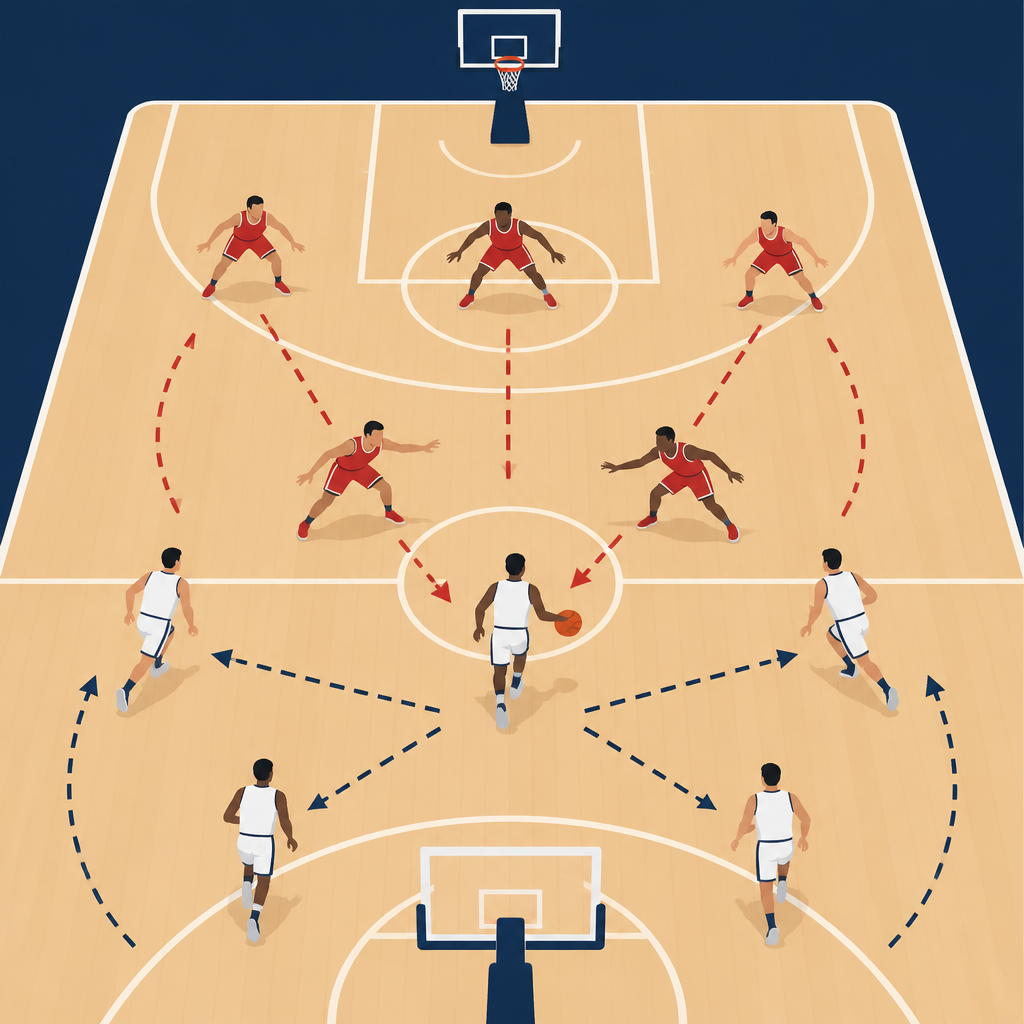
The most common press structures fall into a few recognizable families. A man-to-man press assigns direct matchups and relies on individual containment plus selective traps. A 2-2-1 press places two players high, two around the middle, and one deep as a safety. A 1-2-1-1, often called a diamond press, puts one defender on the inbounder’s first option, two across the next line, one in the middle, and one back. A 1-3-1 alignment stretches wings into passing lanes and dares offenses to make long diagonal reads. These structures can be run aggressively for steals or conservatively to slow tempo. The same alignment may look very different depending on whether the defense wants immediate traps or delayed contain.
The NBA uses full-court pressure less often than college basketball because professional guards are stronger, passing windows are easier to exploit with wider spacing, and the defensive three-second rule changes some help principles once the press flows into the half court. Still, presses appear in specific moments and from specific coaches. Nick Nurse has long used pressure looks to change momentum. Erik Spoelstra has mixed in trapping schemes that begin early in the floor. Rick Pitino’s college teams made the modern language of pressure familiar to many fans, and the concepts still influence pro assistants. Even when an NBA team does not “live” in a press, it often installs one or two pressure packages for situational use.
When teams use a full-court press
Teams most often use a full-court press after made baskets, dead balls, or free throws because those moments allow the defense to set its shape. Pressing off a live-ball miss is harder because floor balance is less predictable. Late-game situations are the most obvious use case. A team trailing by eight with three minutes left may press to create quick turnovers, force rushed entries, and increase total possessions. This is less about getting perfect stops in the half court and more about introducing chaos. If the defense can turn one clean offensive possession into two messy ones, the comeback math improves.
Another common use is as a changeup against a shaky secondary ballhandler. If a star initiator checks out and the backup guard struggles with pressure, coaches attack that moment. I have seen this repeatedly on film: the press is less about a team identity and more about opponent targeting. A reserve who is comfortable running pick-and-roll at the top may still be vulnerable catching near the sideline, turning his back, or making the skip pass over a trap. The best pressure coaches recognize these personnel windows immediately.
Pressing can also help teams hide size disadvantages by dictating where the possession starts. Smaller lineups often want the game sped up and fragmented. If they allow a larger opponent to walk the ball into a stable half-court entry, they may get buried on the glass or in the post. By pressing, they ask the bigger team to make quick decisions over distance. That can reduce clean post entries and increase fatigue for frontcourt players not used to sprinting into outlets. On the other hand, a deep and athletic team may press simply because it has ten playable bodies and wants to weaponize stamina over forty-eight minutes.
| Situation | Why teams press | Main risk |
|---|---|---|
| Late-game comeback | Create extra possessions and speed up tempo | Easy baskets if traps fail |
| After made free throws | Set alignment and force a difficult inbound | Cross-match confusion in retreat |
| Against weak backup guards | Target limited ballhandling and vision | Fouls from overaggressive reaches |
| With deep bench units | Leverage energy and wear down opponents | Defensive rebounding suffers after scramble rotations |
| To break offensive rhythm | Burn clock and disrupt play calls | Open threes after press is broken |
How the press works in practice
A successful full-court press follows clear principles. First, it narrows the offense’s usable space by treating sidelines and the baseline as extra defenders. Second, it forces the ball to a predefined area, usually a corner, hash mark, or sideline near half court, where a trap can arrive. Third, it protects the middle. Coaches teach this constantly because the middle breaks pressure. Once the ball reaches the center of the floor, the offense can pass to either side, attack downhill, and produce numbers advantages. The strongest presses may appear aggressive on the edges, but they are built around denying central release valves.
Footwork and body angle matter as much as scheme. The on-ball defender usually shades to one side, inviting the dribbler toward help. The second defender times the trap on the receiver’s catch or second dribble, not randomly. Back-line defenders split two threats and read the passer’s shoulders. Good presses are quiet in their movement. Bad presses chase the ball. When the defense is undisciplined, one pass beats two defenders and the floor opens. That is why communication terms such as “red,” “run-and-jump,” “middle,” and “rotate” are drilled repeatedly. Everyone must know whether a trap is automatic, optional, or triggered by a poor catch.
Run-and-jump pressure deserves special attention because fans often notice the surprise but not the rule set behind it. In this approach, an off-ball defender suddenly leaves his assignment to trap the dribbler, while the nearest teammate rotates to cover the vacated man. It looks improvised, yet effective teams rehearse exact cues: the dribbler turns his back, picks up the dribble, exposes the ball on a crossover, or gets steered toward the sideline. The point is to trap when vision is limited. The danger is obvious too. If the exchange is late, the offense slips a pass behind the trap and attacks a scrambling defense with numbers.
How offenses break a full-court press
The first rule for breaking a full-court press is simple: do not make the floor small. Offenses fail against pressure when inbounders stand still, guards retreat toward the baseline, and receivers catch near the sideline with no next pass available. Press breakers work by stretching the defense vertically and horizontally at the same time. The inbounder should know the first, second, and safety options before receiving the ball. The primary ballhandler should catch on the move whenever possible. Bigs must become active passers, not stationary spectators. One skilled frontcourt playmaker at the nail or middle circle can dismantle an entire press.
The best release point is usually the middle, especially around the center circle. Once the ball gets there under control, the offense should attack immediately rather than reset passively. Numbers are often in its favor because two defenders may be committed to the trap behind the play. This is why coaches tell press breakers to “look long, look middle, look opposite.” A deep pass for a layup is ideal, but the middle pass is often safer and just as damaging because it triggers a 3-on-2 or 4-on-3. The mistake many teams make is treating escape as the goal. The real goal is conversion into an advantage offense.
Personnel choices shape every press breaker. Multiple handlers are essential. Putting the ball in one guard’s hands for the entire backcourt journey is predictable and exhausting. Reversal passes, quick handbacks, and diagonal flashes make the defense declare its intentions. Against a 2-2-1, a guard-to-big-to-guard sequence often works better than dribbling through pressure. Against man pressure, screening the inbound defender or using stack and box alignments can free the first catch. Against traps, a “short middle” flash by a mobile forward is often the cleanest answer. Teams such as the Warriors and Nuggets have punished pressure historically by letting playmakers at different positions touch the ball early.
There are also practical habits that separate poised teams from panicked ones. Do not jump to pass unless the target is clear. Avoid dead dribbles near the sideline. Meet the pass instead of waiting for it. Pivot away from traps to widen passing angles. Use the inbounder as a return outlet after the first pass, because the inbounder is unguarded until touching the court and often re-enters with vision. Most importantly, expect the trap before it arrives. Pressure beats teams mentally before it beats them physically. When players view a press as a puzzle with standard solutions, its intimidation value drops sharply.
Tradeoffs, counters, and what modern NBA strategy teaches
No press is universally good. The tradeoff is always between disruption and exposure. If the defense forces a turnover on 15 percent of pressed possessions, that is valuable. If the remaining possessions produce layups, dunks, and corner threes, the expected return may still be negative. That is why elite coaches monitor more than steals. They watch points allowed after broken pressure, foul accumulation, and whether the press damages transition defense. Analytics departments often evaluate these sequences by possession type rather than reputation. A press that feels aggressive can still be mathematically unsound against a composed opponent.
Modern spacing has made reckless pressing harder to justify. Shooters stand deeper, bigs handle better, and passing skill across positions is far higher than it was twenty years ago. Yet those same trends create selective opportunities. Because offenses prioritize pace-and-space, some teams use smaller lineups with vulnerable rebounding and thinner ballhandling depth. A strategic press can attack the second point guard issue or force a non-creator to make live decisions in the middle. The lesson from recent basketball is not that the full-court press disappeared. It evolved from base identity into targeted weapon.
For anyone studying NBA strategy, the full-court press is worth mastering because it teaches a broader principle: every scheme is really a bet on where the next decision will happen. A press bets that the offense will decide under stress, early, and far from its comfort zone. Breaking it requires structure, spacing, and calm. When teams understand both sides of that equation, pressure becomes less mysterious and far more readable. Watch the next close game with that lens. Track where traps are set, who flashes middle, and how quickly the offense converts escape into advantage. That is where the chess match lives, and it is where smart analysis begins.
Frequently Asked Questions
What is a full-court press in basketball, and how is it different from standard half-court defense?
A full-court press is a defensive strategy in which a team applies organized pressure from baseline to baseline rather than waiting for the offense to cross midcourt and begin its set. The goal is not just to guard the first pass or slow the ball-handler for a moment. It is to make every dribble, pass, cut, and inbound read more difficult over the entire length of the floor. In practical terms, that means defenders are active immediately after a made basket, dead ball, or inbound, trying to disrupt the offense before it can get into its preferred actions.
That is what separates a full-court press from standard half-court defense. In a typical half-court setup, a defense may pick up the ball around the three-point line or after the offense advances into the frontcourt. The priority there is usually protecting the paint, contesting shooters, switching actions, and managing help coverage once the offense is in structure. A full-court press shifts that battle earlier. Instead of defending the possession once it is organized, the defense tries to prevent organization from happening at all.
There are also multiple forms of full-court pressure. Some teams use man-to-man pressure, where each defender matches up and harasses the ball throughout the floor. Others use zone press concepts such as 1-2-1-1 or 2-2-1 looks, where defenders guard areas and trap at specific spots like the sidelines, corners, or just over half court. Some presses are aggressive turnover-hunting schemes, while others are more about draining clock, tiring the primary ball-handler, or forcing the offense into a late-clock possession. So when analysts talk about a full-court press, they are referring to a broad family of pressure defenses that all share one core idea: make the offense uncomfortable before it ever reaches normal flow.
When do teams usually use a full-court press, and why is it often situational in the NBA?
Teams usually deploy a full-court press in moments when the potential reward outweighs the energy cost and structural risk. The most common situations are late-game deficits, momentum swings, after timeouts, following made free throws, or against opponents with shaky ball-handling depth. A coach may call for a press to speed the game up, create a turnover or two, burn valuable seconds off the shot clock, or force the ball out of a star playmaker’s hands. In those moments, the press is not just a defensive scheme. It becomes a game-management tool.
That situational use is especially important in the NBA. Professional teams are generally too skilled, too well spaced, and too prepared to be pressed for long stretches without consequences. If the press is broken cleanly, it often produces a numerical advantage for the offense, leading to open threes, downhill drives, or transition finishes before the defense can recover. NBA players are also better passers, stronger ball-handlers, and more capable of making quick reads than players at lower levels, so a reckless press can backfire quickly.
That is why NBA coaches often treat the full-court press as a change-up rather than a base defense. They may use it to alter rhythm, hide a matchup problem, test an opponent’s composure, or inject urgency into a game that is slipping away. It can also be useful against reserve-heavy lineups, young guards, or teams missing their primary initiator. In playoff environments, it may appear as a targeted wrinkle designed for one opponent’s inbound habits or weak secondary handlers. In short, the full-court press is situational in the NBA because the league’s spacing and decision-making punish overuse, but in the right moment, the tactic can still be highly disruptive and strategically valuable.
What are the main goals of a full-court press besides forcing turnovers?
Forcing turnovers is the most obvious objective, but it is far from the only one. A well-designed full-court press can shorten the offense’s working time by making it take eight, ten, or even twelve seconds just to initiate the set. That matters because an offense that crosses half court late has less time to run counters, create a second side action, or recover if the first option is denied. Even without a steal, the defense may have already won part of the possession by reducing it to a rushed late-clock decision.
Another major goal is dictating who handles the ball and where the ball goes. A press can be used to deny the inbound to the preferred playmaker, force a catch toward the sideline, or bait a less experienced handler into making advance passes under pressure. Coaches often want to steer the offense into predictable escape routes so the next defender can trap or rotate on cue. In that sense, the press is about control as much as chaos. It narrows the offense’s choices and tests whether all five players can make calm, accurate reads.
Pressing can also have a physical and psychological effect. It taxes conditioning, especially for teams that rely heavily on one primary creator. Repeated pressure can wear down legs, sharpen fatigue, and reduce late-game clarity. Mentally, it can make players feel rushed even after the press is no longer active. Ball-handlers may pick up the dribble too early, bigs may become hesitant outlet targets, and wings may drift away from ideal spacing because they are thinking more about survival than execution. Over time, that stress can change shot quality and offensive discipline.
Finally, some teams use the full-court press to alter tempo and identity. A trailing team may want more possessions. An athletic roster may want a more chaotic game. A coach may want to energize the bench, engage the crowd, or disrupt a polished opponent that is too comfortable in a half-court rhythm. So while takeaways matter, the full-court press is also about clock pressure, ball-direction control, fatigue, composure, and pace manipulation.
How do teams break a full-court press effectively?
Breaking a full-court press starts with organization before the ball is even inbounded. Teams need clear spacing, reliable outlet options, and players who understand where the next pass is supposed to go if the first receiver is pressured. One of the biggest mistakes against a press is bunching up near the ball, which allows defenders to trap and shrink passing angles. Good press offense stretches the floor vertically and horizontally, giving the inbounder multiple targets and creating room for reversal passes, diagonal outlets, and middle flashes.
The middle of the floor is often the key. Press defenses love the sideline because it acts like an extra defender, limiting escape routes and making traps easier. Offenses that can enter the ball to the middle usually break pressure more cleanly because the receiver can pivot and see both sides of the court. That middle touch does not always have to come from a guard. Skilled forwards and centers can be excellent release valves if they can catch, turn, and make the next pass quickly. Once the middle is secured, the offense often has a numbers advantage and can attack before the defense resets.
Passing is usually more powerful than overdribbling. Many press breaks fail because the ball-handler tries to beat the pressure alone, dribbling into traps or wasting time while teammates become spectators. Quick, decisive passes shift the defense faster than one player can dribble through it. Reversing the ball, using short safety passes, and hitting the advance pass at the right moment can turn a dangerous situation into an easy scoring opportunity. That said, decision-making is crucial. Blind long passes can be just as damaging as panicked dribbles.
Personnel matters too. Teams break presses best when they put multiple handlers on the floor, use an inbounder who can make accurate reads, and avoid lineups with too many limited decision-makers. Coaching details also matter: flashing back to the ball, not catching near the corner, keeping proper spacing after the first pass, and attacking once the press is broken instead of casually walking into the frontcourt. The best press-breaking teams do not simply survive pressure. They punish it by turning broken traps into odd-man rushes, open threes, and layups.
Why is the full-court press less common as a full-time strategy in modern NBA basketball?
The biggest reason is risk. Modern NBA offenses are built around spacing, shooting, and high-level playmaking, which means any defensive mistake across the full court can lead to an immediate advantage the other way. If one trap is late, one rotation is missed, or one defender gets split, the offense may suddenly be attacking a scattered floor with elite finishers and shooters filling the lanes. That is a dangerous trade-off to accept over and over in a league where efficient offense is already difficult to contain.
Energy cost is another major factor. Sustaining full-court pressure requires constant sprinting, communication, and concentration from all five defenders, not just the guard on the ball. Over a long NBA season, that is a heavy physical burden. Coaches have to manage minutes, foul trouble, back-to-backs, and the cumulative wear placed on key players. A press that creates short-term chaos may also sap the legs needed for half-court defense, rebounding, and offensive execution later in the game.
Roster construction also matters. To press consistently, a team typically needs multiple quick