
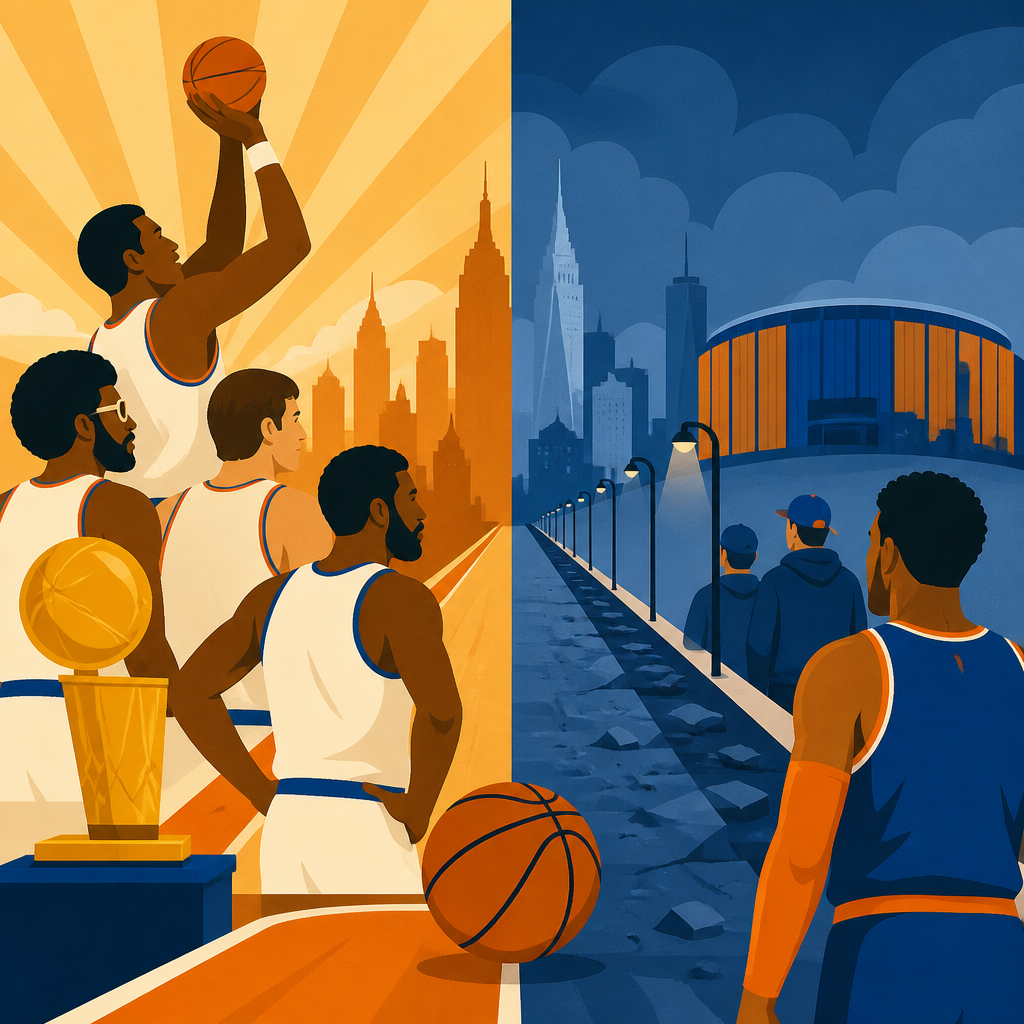
The New York Knicks history mirrors the arc of the NBA itself: early improvisation, marquee stars, cultural dominance, painful decline, and repeated attempts to regain relevance in a city that treats basketball as both sport and civic identity. For a team founded in 1946 as one of the league’s original franchises, the Knicks occupy a singular place in professional basketball. They play in Madison Square Garden, often called the sport’s most famous arena, and they have influenced how fans, media, and players understand big-market pressure. Any serious look at NBA team histories must include the Knicks because their story combines championships, iconic personalities, business missteps, and enduring brand power in equal measure.
When discussing New York Knicks history, several terms matter. The “golden age” usually refers to the late 1960s and early 1970s, when Red Holzman coached disciplined, defense-first teams led by Willis Reed, Walt Frazier, Bill Bradley, Dave DeBusschere, and later Earl Monroe. “Relevance” in the Knicks context means more than making the playoffs. It means competing deep into spring, shaping league conversation, and matching the expectations created by the franchise’s size and visibility. The “long road” describes the decades after the 1973 championship, when brief peaks in the 1990s and isolated star eras failed to produce another title. I have covered and studied NBA franchise development long enough to know that few organizations show the costs of unstable leadership as clearly as the Knicks do.
This article serves as a hub for Knicks team history within the broader NBA Teams topic by tracing the franchise from its founding through the championship years, the rugged Patrick Ewing era, the post-Ewing wilderness, and the more credible modern rebuild. Along the way, it explains why certain teams worked, why others failed, and what the Knicks represent today. The goal is direct: if a reader asks when the Knicks were great, why they fell off, who defined each era, and whether they are finally relevant again, the answers should be here in full.
Founding Years, Early Finals, and the Search for an Identity
The Knicks were established in 1946 in the Basketball Association of America, which later merged with the National Basketball League to form the NBA in 1949. Their name, short for Knickerbockers, references early Dutch settlers associated with New York. In the league’s chaotic early years, the franchise was competitive but not yet distinctive. The Knicks reached the NBA Finals in 1951, 1952, and 1953, led by players such as Harry Gallatin, Carl Braun, and Dick McGuire. Those teams were tough, organized, and ahead of many peers in professionalism, but they lost all three Finals appearances, twice to the Minneapolis Lakers and once to the Syracuse Nationals.
Those early Knicks mattered because they established New York as a viable basketball market before the NBA became a national television product. Madison Square Garden gave the league visibility, and doubleheaders featuring college and pro games helped normalize professional basketball for urban audiences. Yet by the late 1950s and early 1960s, the franchise drifted. Coaching changes, uneven roster planning, and the absence of a transformational superstar kept the Knicks in the middle or lower end of the standings. The team still drew attention because of the city, but attention without coherent team building rarely creates sustained success.
The key turning point came when the Knicks began accumulating the right people rather than chasing quick fixes. They drafted center Willis Reed in 1964, added guard Walt Frazier in 1967, and hired Red Holzman as head coach during the 1967-68 season. Holzman installed a style rooted in ball movement, half-court execution, communication, and committed team defense. In historical terms, that shift was profound. The Knicks stopped acting like a franchise searching for an identity and became one with a repeatable basketball philosophy.
The Golden Age: Red Holzman, Willis Reed, and the Championship Standard
The golden age of New York Knicks history reached its height from 1969 through 1973. These were not glamorous teams in the simplistic sense. They were intelligent, versatile, and relentlessly connected. Reed anchored the interior with strength and leadership. Frazier controlled tempo, defended elite guards, and gave the offense style without sacrificing efficiency. Bill Bradley brought spacing and discipline. Dave DeBusschere, acquired in a 1968 trade, added rebounding, defense, and toughness. Together, they created one of the most balanced cores of the era.
The 1969-70 season remains the franchise’s defining campaign. The Knicks finished 60-22, then a franchise record, and won the 1970 NBA championship by defeating the Los Angeles Lakers in seven games. Game 7 became immortal because of Reed’s injured thigh. He had missed Game 6 and entered the deciding game visibly limited, scoring the Knicks’ first two baskets and changing the emotional geometry of the night. Frazier then delivered one of the greatest Finals performances ever: 36 points and 19 assists. Reed won Finals MVP, but the larger truth is that the title validated Holzman’s team-first structure.
The Knicks won again in 1972-73, this time with an even deeper roster. Earl Monroe, acquired in 1971, added creativity to the backcourt, and Jerry Lucas provided frontcourt skill and passing. That championship team went 57-25 and beat the Lakers in five games in the Finals. Reed, though physically diminished compared with 1970, remained central as an organizer and emotional leader. These championship seasons created the standard by which every later Knicks team would be judged: smart basketball, defensive commitment, unselfish play, and stars who fit a collective identity rather than overpowering it.
| Era | Key Figures | Defining Traits | Best Result |
|---|---|---|---|
| Early Years 1946-1967 | Dick McGuire, Carl Braun, Harry Gallatin | Competitive foundation, early Finals trips, inconsistent long-term direction | NBA Finals appearances in 1951, 1952, 1953 |
| Golden Age 1968-1973 | Red Holzman, Willis Reed, Walt Frazier, Bill Bradley, Dave DeBusschere | Elite defense, ball movement, depth, leadership | NBA championships in 1970 and 1973 |
| Ewing Era 1985-2000 | Patrick Ewing, Pat Riley, Jeff Van Gundy, John Starks | Physical defense, playoff consistency, near misses | NBA Finals in 1994 and 1999 |
| Post-Ewing Decline 2001-2019 | Allan Houston, Carmelo Anthony, Donnie Walsh | Frequent resets, poor asset management, short bursts of hope | Second round in 2013 |
| Modern Rebuild 2020-present | Tom Thibodeau, Jalen Brunson, Leon Rose, Julius Randle | Defensive structure, patient roster building, renewed credibility | Return to regular playoff contention |
Why were the early 1970s Knicks so important beyond the titles? First, they became a model for basketball played by five connected decision-makers rather than one dominant scorer. Second, they embedded the Knicks into popular culture. Frazier’s flair, Bradley’s public profile, and Madison Square Garden’s media spotlight gave the team national reach. Third, they left a burden of memory. Every later roster would be measured against a championship ideal that was aesthetically pleasing as well as successful. That combination is rare in NBA history.
After the Titles: Decline, Transition, and the Arrival of Patrick Ewing
Championship windows close quickly, especially when key players age together. Reed retired in 1974. Frazier was traded in 1977. Holzman eventually left the bench. The Knicks remained visible but lost the structural coherence that had defined their best years. Through the late 1970s and early 1980s, they cycled through coaches and rosters, made some playoff appearances, and occasionally landed compelling talent, but they no longer looked like a title blueprint. Financial muscle could not compensate for uneven drafting and roster imbalance.
The franchise’s next transformational moment came in 1985 when it won the first NBA draft lottery and selected Georgetown center Patrick Ewing. Ewing was not merely a star prospect; he was one of the most anticipated big men in basketball history, with Olympic, college, and defensive credentials that suggested franchise-level impact. He delivered. Across 15 seasons with New York, Ewing became the face of the team, an 11-time All-Star, a reliable 20-point scorer in his prime, and one of the best rim protectors of his era. In pure historical terms, he is the greatest Knicks player after Reed and Frazier, and many would place him above both based on longevity and individual production.
Still, the early Ewing years were not instantly triumphant. The Knicks had talent but lacked consistent organizational alignment. That began to change in the early 1990s under head coach Pat Riley, who built a bruising defensive identity around Ewing, Charles Oakley, John Starks, and later Anthony Mason and Derek Harper. The Knicks became one of the Eastern Conference’s defining teams, regularly winning 50 games and consistently ranking among the league’s top defenses. Their style was physical, deliberate, and unpopular with opponents, which in New York often translated into admiration.
The 1990s: Contender Status, Playoff Wars, and the Pain of Near Misses
The 1990s Knicks were relevant in the fullest modern sense. They did not win a championship, but they mattered every year and forced elite opponents into draining playoff battles. The central rival was Michael Jordan’s Chicago Bulls. New York pushed Chicago harder than many remember, especially in 1992 and 1993, when the Knicks’ defense and rebounding made every possession costly. After Jordan’s first retirement, the Knicks reached the 1994 NBA Finals, where they lost to the Houston Rockets in seven games. That series still haunts the franchise. Ewing played heavy minutes and anchored the defense, but New York struggled offensively in late-game situations. John Starks, heroic in earlier rounds, shot 2 for 18 in Game 7.
Pat Riley left after that Finals run, but the identity endured under Jeff Van Gundy. The Knicks remained rugged, disciplined, and difficult to score against. They battled the Indiana Pacers in a rivalry defined by Reggie Miller’s shot-making and Madison Square Garden volatility. In 1999, as an eighth seed in the lockout-shortened season, the Knicks made a surprising run to the NBA Finals after defeating Miami, Atlanta, and Indiana. Larry Johnson’s four-point play against the Pacers became one of the signature moments in modern Knicks lore. Injuries, especially Ewing’s Achilles issue, undermined their chances against San Antonio, and the Spurs won the series in five games.
The lesson of the Ewing era is nuanced. On one hand, the Knicks failed in the narrowest sense because they never won a title. On the other, they sustained relevance for more than a decade in a brutally competitive conference and came within reach of a championship more than once. In franchise history, that matters. Teams are judged by banners, but they are remembered by eras, and the 1990s Knicks created one of the league’s most clearly defined identities.
The Long Road to Relevance: Missteps, Star Chasing, and Organizational Instability
After Ewing’s departure in 2000, the Knicks entered their most dysfunctional period. This is the “long road to relevance” that defines the franchise for many younger fans. The problems were not mysterious. They overpaid aging veterans, traded draft assets too freely, changed strategic direction repeatedly, and often prioritized name recognition over roster fit. Front office turbulence compounded the issue. Successful NBA organizations align ownership, executives, coaching, sports science, and scouting. The Knicks too often worked against that model.
One major example was the Isiah Thomas era in the mid-2000s. Thomas, first as an executive and then as coach, assembled expensive, ill-fitting rosters that included Stephon Marbury, Steve Francis, Eddy Curry, Jamal Crawford, and others. Individual talent existed, but coherent team structure did not. Defensive discipline was poor, cap flexibility vanished, and public drama overshadowed player development. The result was predictable: losing seasons, little continuity, and a brand that remained famous while the basketball product deteriorated.
There were brief corrections. Donnie Walsh improved the cap sheet and helped position the franchise for a major free-agent pursuit. The Knicks then acquired Carmelo Anthony in 2011, pairing him with Amar’e Stoudemire in an effort to restore star power. Anthony was an elite scorer and a legitimate franchise centerpiece, but the trade cost New York depth and future assets. The team peaked in 2012-13, winning 54 games under Mike Woodson and reaching the second round. Anthony won the scoring title, and veterans like Tyson Chandler, Jason Kidd, and JR Smith contributed to a credible, if imperfect, contender. That run, however, did not last.
What held the Knicks back in these years was not simply bad luck. It was the repeated temptation to skip team-building steps. Franchises rise when they draft well, develop role players, preserve optionality, and add stars at the right moment. The Knicks often inverted that process, chasing the headline before building the foundation. For a sub-pillar on NBA team histories, this point is essential: organizational process usually determines whether a famous franchise acts powerful or merely looks powerful.
The Modern Rebuild: Thibodeau, Brunson, and a More Credible Future
The Knicks’ modern return to relevance has been less flashy and more competent, which is exactly why it has worked better. Leon Rose’s front office emphasized contract discipline, tradable salaries, better depth, and incremental improvement. Tom Thibodeau, hired in 2020, restored defensive standards and accountability. The 2020-21 team won 41 games in a 72-game season, earned the fourth seed in the East, and changed the tone around the franchise. Julius Randle had a breakout year, and the team’s effort level became dependable.
The true inflection point was signing Jalen Brunson in 2022. Brunson gave the Knicks what they had lacked for years: a poised lead guard who could organize the offense, score efficiently in the half court, and elevate teammates in late-game settings. His footwork, change of pace, and decision-making translated directly to playoff basketball. Alongside Randle, OG Anunoby, Josh Hart, Mitchell Robinson, and later other complementary pieces, Brunson helped transform New York from a hopeful story into a serious, structurally sound playoff team.
Modern relevance does not yet equal a championship, and that distinction matters. The Knicks still need elite health, enough shooting, and perhaps one more top-tier creator to maximize a title window. But the difference between the current era and the drift that followed Ewing is substantial. The franchise now looks organized. Its roster generally makes sense. Its best players fit the coach’s demands. The defense travels, the rebounding is strong, and the team can survive postseason physicality. In a city conditioned to distrust Knicks momentum, competence itself has become persuasive.
The New York Knicks history is compelling because it combines the league’s oldest ambitions with some of its most modern lessons. The franchise proved in the 1970s that teamwork, discipline, and shared purpose can beat more glamorous opponents. It proved in the 1990s that sustained contention creates lasting identity even without a title. It also demonstrated, painfully, that market size cannot rescue bad process. For years, the Knicks confused visibility with strength and paid for it in lost seasons, squandered assets, and constant reinvention.
Today, the Knicks are relevant again because they have returned to fundamentals that once defined their best periods: defensive commitment, clear roles, and stars who elevate structure rather than replace it. Reed and Frazier established the championship standard. Ewing carried the franchise through its toughest competitive decades. Brunson and the current core are trying to connect those memories to the present. That pursuit is why Knicks history remains central to any broader study of NBA team histories.
If you are building out coverage of NBA Teams and team histories, use the Knicks as a model for how a franchise can shape the league even across uneven decades. Study the championship blueprint, the Ewing near-misses, and the modern rebuild side by side. They explain not only where the Knicks have been, but what real relevance in the NBA actually requires.
Frequently Asked Questions
What makes the New York Knicks such an important franchise in NBA history?
The New York Knicks matter because their story is deeply tied to the rise of professional basketball in the United States. Founded in 1946, they are one of the NBA’s original franchises, which means their history stretches back to the league’s formative years, when pro basketball was still defining its identity, rules, and national appeal. The Knicks were present during that early period of experimentation and growth, and over time they became one of the league’s most visible and culturally significant teams.
A major reason for that importance is geography and symbolism. Playing in New York City, the country’s largest media market, gave the Knicks an influence that went beyond wins and losses. Madison Square Garden became more than a home arena; it became a stage where basketball was elevated into spectacle, celebrity, and civic theater. Great players, rivalries, playoff moments, and even disappointing seasons took on added meaning because they unfolded in a city that expects excellence and magnifies every result.
The Knicks also helped shape the emotional and cultural language of the NBA. They have been associated with blue-collar toughness, defensive discipline, star power, and larger-than-life narratives at different points in their history. Their highs have often felt larger than those of many other teams, and their lows have been discussed just as intensely. In that sense, the franchise has long served as a mirror for the league itself: ambition, reinvention, pressure, celebrity, and the constant push to stay relevant. Even in seasons when they were not championship contenders, the Knicks remained central to basketball conversation simply because of what they represent in the sport’s history.
When was the Knicks’ true golden age, and why is it remembered so fondly?
The Knicks’ golden age is most commonly identified with the late 1960s and especially the early 1970s, when the franchise reached its highest competitive peak and established the identity that still defines its best historical image. This was the era of Red Holzman, Willis Reed, Walt Frazier, Bill Bradley, Dave DeBusschere, and Earl Monroe, a group that combined intelligence, defense, unselfish offense, and remarkable composure. The team won NBA championships in 1970 and 1973, and those titles remain the only two in franchise history.
What made that period so memorable was not just the championships themselves, but the style and character of the team. Those Knicks played with balance rather than relying solely on one superstar. They defended relentlessly, moved the ball beautifully, and projected a sense of professionalism that resonated in New York. They were tough without being chaotic, glamorous without losing their discipline, and successful without feeling manufactured. For many fans and historians, that combination made them one of the most admired teams of their era.
The 1970 title, in particular, holds a near-mythic place in NBA lore because of Willis Reed’s dramatic return in Game 7 of the Finals against the Los Angeles Lakers. Reed, injured and uncertain to play, emerged from the tunnel and scored the first two baskets, igniting Madison Square Garden and giving the team an emotional lift that has become one of basketball’s most enduring images. Walt Frazier then delivered one of the greatest performances in Finals history, sealing the championship. Moments like that transformed a successful team into a legend.
The 1973 championship reinforced that the first title was not a fluke. It confirmed the Knicks as a true power and cemented their reputation as one of the NBA’s model organizations. That era is remembered so fondly because it represents the ideal version of Knicks basketball: smart, resilient, team-oriented, and capable of thriving under immense pressure in the sport’s biggest city.
How did the Knicks remain culturally dominant even during long periods without a championship?
The Knicks remained culturally powerful because, in New York, basketball is never just about the standings. The team exists at the intersection of sports, entertainment, politics, fashion, and media, which means its relevance often extends beyond simple competitive success. A winning Knicks team can feel like a citywide event, but even a struggling Knicks team generates national debate in ways that many franchises cannot. That visibility has allowed the team to maintain a unique place in the NBA imagination, even when championships were not realistic.
Madison Square Garden is a major part of that enduring influence. The arena has long been treated as a basketball cathedral, a place where big performances seem to carry extra historical weight. Opposing stars often talk about wanting signature moments in the Garden, and celebrities sitting courtside add to the sense that every important Knicks game is also a cultural event. Because of that atmosphere, the team’s games often feel central to the league’s story, regardless of where the Knicks sit in the standings.
The franchise also benefited from several distinct eras that kept it in the spotlight. The rugged, defensive Knicks teams of the 1990s, led by Patrick Ewing and shaped by fierce rivalries with teams like the Chicago Bulls, Indiana Pacers, and Miami Heat, gave the organization another identity that fans could rally around. Those teams did not win a title, but they were tough, combative, and built for playoff drama. Later, even uneven eras featuring stars such as Carmelo Anthony kept the Knicks relevant because elite players in New York always attract outsized attention.
Just as importantly, the Knicks symbolize possibility. Because of the market, the history, and the arena, fans and commentators are constantly waiting for the team to matter again at the highest level. That perpetual sense of expectation keeps the franchise alive in public consciousness. Few teams can go through prolonged stretches of disappointment and still dominate headlines, but the Knicks can, because their identity is woven into the broader story of basketball itself.
Why did the Knicks struggle for so long after their championship years?
The Knicks’ long road back to relevance came from a combination of front-office instability, uneven roster construction, changing eras of basketball, and the enormous pressure that comes with operating in New York. After the championship teams aged out, the franchise struggled to build sustained continuity. There were periods of competitiveness, and at times the Knicks had star talent, but they repeatedly found it difficult to create the long-term organizational alignment needed to remain at the top of the league.
One of the central issues was inconsistency in team-building philosophy. Over the decades, the Knicks often shifted directions too quickly, trading assets, changing coaches, or pursuing short-term solutions instead of developing a stable foundation. In some seasons they chased star power; in others they tried to rebuild; and too often those plans overlapped in ways that left the roster unbalanced. In a league where successful franchises usually pair vision with patience, the Knicks frequently seemed caught between immediate expectations and long-term needs.
The pressure of the market intensified those problems. New York is not a place where anonymity exists for a major sports team, and every decision is analyzed heavily by fans and media. That environment can create urgency, but it can also lead to overcorrection. A few bad months can feel like a crisis, and a promising stretch can create demands for accelerated success. For a franchise already carrying the weight of history, that cycle made smart, methodical rebuilding harder to sustain.
It is also important to remember that the Knicks were not uniformly irrelevant across all those years. The Patrick Ewing era produced multiple deep playoff runs and an NBA Finals appearance in 1994, followed by another Finals trip in 1999. The issue was that those teams ran into historically strong opponents and could not break through for a title. Later declines were more severe, especially in the 2000s, when poor contracts, organizational turnover, and a lack of coherent identity undercut progress. So the “long road” was not one continuous failure, but rather a sequence of near-misses, false starts, and rebuilding attempts that never fully restored the golden-age standard.
What does “the long road to relevance” mean for the Knicks today?
For the Knicks, “the long road to relevance” refers to more than simply trying to make the playoffs again. It describes the challenge of living up to a history that includes championships, iconic players, and a cultural footprint unlike almost any other team in basketball. Relevance in New York means being credible, competitive, and meaningful in the championship conversation, not just being respectable for a single season. That is a much higher bar than many franchises face, and it explains why the team’s rebuilding efforts are judged so intensely.
Today, that phrase also reflects the importance of organizational credibility. Modern NBA success typically depends on smart drafting, player development, financial flexibility, coaching stability, and a front office that can make disciplined decisions over several years. For the Knicks, becoming truly relevant again has meant trying to replace chaos with structure. Fans are not only looking for star talent; they are looking for evidence that the franchise has finally built a repeatable model for winning.
There is also an emotional dimension to the phrase. Knicks fans have lived through cycles of hype, disappointment, and cautious optimism for decades. As a result, relevance is not just measured in headlines or celebrity attention, because the team has always had those. It is measured in whether the Knicks can once again become a serious basketball power whose success feels sustainable rather than accidental. In other words, the goal is not merely to be interesting, but to matter deeply in late spring and early summer when championships