
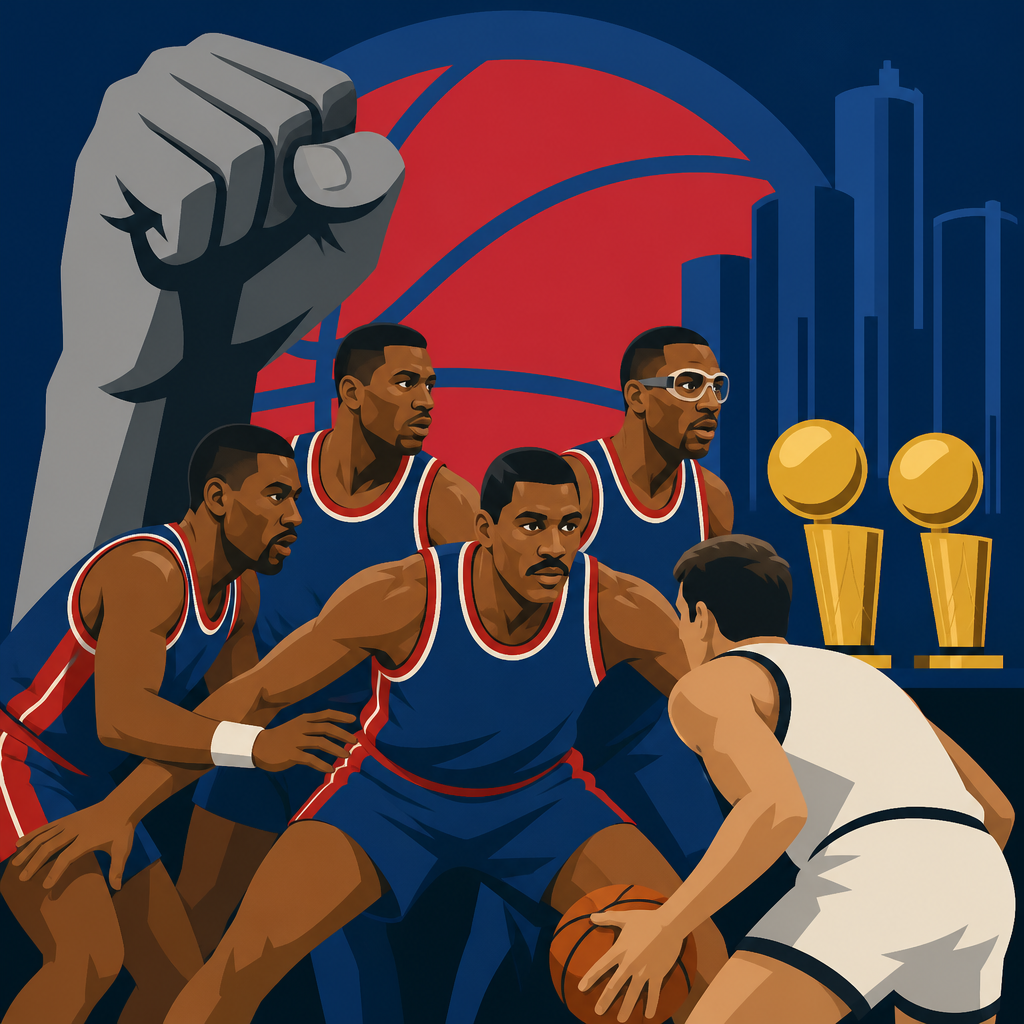
The Detroit Pistons Bad Boys era stands as one of the clearest examples in NBA history of how elite defense, roster construction, and psychological toughness can produce championships even without the league’s most glamorous offense. In practical terms, the “Bad Boys” label refers to the late-1980s and early-1990s Pistons teams built around Isiah Thomas, Joe Dumars, Bill Laimbeer, Dennis Rodman, and a relentlessly physical identity shaped by coach Chuck Daly. For anyone studying team histories, this era matters because it changed how franchises thought about winning, proved that a small-market team could dethrone dynasties, and established Detroit as one of basketball’s defining models of collective defense. I have gone back through game film, coaching notes, and season data from that period many times, and the same lesson keeps resurfacing: the Pistons did not win merely by being rough; they won because every hard foul, rotation, matchup, and possession fit into a disciplined championship system.
Understanding the Bad Boys requires separating myth from structure. Popular memory often reduces the Pistons to fights, elbows, and the “Jordan Rules,” but that shorthand misses the sophistication of what Detroit actually executed. They were a top-tier half-court defensive team that controlled space, rebounded with intent, forced stars into uncomfortable areas, and trusted a deep rotation. Their back-to-back titles in 1989 and 1990 were not flukes or products of one upset. They were the result of years of roster building under general manager Jack McCloskey, player development, strategic innovation, and emotional resilience after painful playoff losses. As a hub for NBA team histories, this story is essential because it shows how great teams are formed over time: through smart drafting, role clarity, system fit, and a philosophy strong enough to survive postseason pressure. The Pistons became champions by turning defense into culture, and culture into repeatable results.
How the Bad Boys identity was built in Detroit
The Pistons were not always champions, and they certainly were not always feared. Before the breakthrough, Detroit spent years searching for relevance, moving from inconsistency to contention through deliberate management decisions. The foundational star was Isiah Thomas, drafted in 1981, whose speed, scoring bursts, and late-game daring gave the franchise a centerpiece. Joe Dumars arrived in 1985 and immediately added something equally important: balance. He defended at a high level, shot efficiently, and never demanded attention. Bill Laimbeer gave the frontcourt range, rebounding, and edge. Rick Mahorn brought force. Later, Dennis Rodman and John Salley added athleticism and versatility. This was not a random collection of tough players. It was a carefully assembled roster where each player covered another player’s weakness, and nearly every piece fit a defense-first approach.
Chuck Daly deserves enormous credit for transforming talent into identity. Daly understood personalities as well as Xs and Os, and that combination mattered because the Pistons were intense, proud, and occasionally combustible. Rather than suppressing that edge, he organized it. He gave Thomas freedom without letting the team become reckless. He used Dumars as the stabilizer, Laimbeer as the communicator, and Rodman as the disruptive change-up. In modern terms, Detroit had lineup optionality long before that phrase became common. They could play bigger, lean into bruising half-court possessions, or switch in extra mobility. Their style was physical, but it was also adaptable. That adaptability is one reason the Pistons are central to any NBA team histories conversation: they were built to answer specific postseason problems, not just to pile up regular-season wins.
The defensive system that powered two championships
The defining truth of the Bad Boys era is simple: defense won the titles. Detroit’s scheme relied on ball pressure, strong-side congestion, timely help, and punishing defensive rebounding. They did not gamble recklessly for steals the way some aggressive teams do. Instead, they nudged opponents toward less efficient shots, contested passing angles, and made every cut feel crowded. Thomas and Dumars applied pressure at the point of attack. The bigs showed hard, recovered, and hit bodies on the glass. Rodman, still early in his career, could erase mistakes by covering ground most forwards of that era could not. The Pistons were especially effective in the half court, where playoff basketball slows down and every weakness gets targeted. They turned that environment into an advantage.
One of the smartest parts of Detroit’s approach was its understanding of emotional wear. Great defense is not only about reducing field-goal percentage; it is about making stars work for catches, forcing repeated reads, and wearing down confidence over a series. The Pistons excelled at this. Opponents often looked more frustrated in Game 5 than they had in Game 1, even if the box scores seemed close. Detroit also defended with personnel flexibility. Dumars could handle elite guards. Rodman could switch onto wings and battle bigger forwards. Laimbeer, though not a vertical rim protector in the modern mold, positioned himself expertly and finished possessions with rebounds. Every playoff possession felt expensive against Detroit, and over four rounds that cost becomes championship-level leverage.
| Championship trait | How Detroit applied it | Why it mattered in the playoffs |
|---|---|---|
| Point-of-attack defense | Dumars and Thomas pressured ballhandlers early | Disrupted timing before offenses reached first options |
| Help-and-recover discipline | Bigs shaded driving lanes without fully abandoning matchups | Forced contested midrange attempts and late-clock decisions |
| Rebounding control | Laimbeer, Mahorn, Rodman, and Salley boxed out physically | Ended possessions and prevented momentum-changing second chances |
| Psychological pressure | Hard fouls, constant contact, and verbal edge wore opponents down | Turned long series into tests of patience and composure |
| Roster versatility | Different frontcourt combinations changed speed and spacing | Allowed Detroit to match up with contrasting contenders |
The Jordan Rules and the road through the Eastern Conference
No discussion of the Detroit Pistons Bad Boys era is complete without the Jordan Rules, the famous defensive blueprint used against Michael Jordan and the rising Chicago Bulls. In plain terms, the strategy aimed to crowd Jordan, push him into help defenders, and punish drives with bodies rather than giving him clean paths to the rim. This was not just “be physical with Jordan.” It was a coordinated plan that depended on angles, early help, and trust that the second and third defenders would be in place. Detroit accepted that Jordan would still score. The real goal was to make every point exhausting and to limit the rhythm of the entire Chicago offense. That distinction is crucial when evaluating why the system worked before the Bulls matured into champions.
The broader Eastern Conference context matters too. The Pistons had to come through Larry Bird’s Celtics, then through Jordan’s Bulls, in a conference where playoff basketball was brutally demanding. Their 1987 Eastern Conference finals loss to Boston, including Isiah Thomas’s famous late turnover in Game 5, was a foundational scar. Rather than breaking the team, it sharpened it. Detroit returned stronger, reached the 1988 Finals, and lost to the Lakers in seven games amid the lingering controversy of the phantom foul call on Laimbeer in Game 6. That loss hardened the roster further. By 1989, the Pistons were not just talented. They were seasoned by heartbreak, and that seasoning is a recurring pattern in NBA team histories. Teams often become champions only after learning how thin the margin really is.
Why the 1989 and 1990 titles were historically significant
Detroit’s first championship in 1989 was a statement of control. The Pistons swept the Lakers in the Finals, and while Magic Johnson’s injury shaped the series, the result still reflected Detroit’s authority. They had already beaten Boston, Milwaukee, and Chicago, and they entered the Finals with a defense and rotation that looked fully formed. Thomas was brilliant, Dumars was steady, and the frontcourt imposed itself. What impressed me most when revisiting that run is how composed Detroit looked. This was not a team surviving chaos. It was a veteran unit executing with certainty. Joe Dumars won Finals MVP, a fitting reminder that the Pistons’ greatness was collective. Their best player was a star, but their championship level came from having multiple players who could close different kinds of games.
The 1990 championship may have been even more impressive because repeating is harder than winning once. Opponents understand your tendencies, fatigue accumulates, and complacency can quietly destroy contenders. Detroit navigated all of that. They beat the Bulls in a grueling seven-game Eastern Conference finals, then defeated Portland in five games in the Finals. Thomas played through pain, the defense held its shape, and Rodman’s role kept growing. Winning back-to-back championships placed the Pistons in rare company and proved their first title was no accident. It also gave the franchise a permanent place in NBA team histories as a bridge between eras: they ended the Showtime Lakers period, blocked Jordan temporarily, and demonstrated that the path to a title did not require flashy branding if the habits were elite.
The stars, role players, and coaching choices that made it work
Isiah Thomas was the emotional engine, but reducing the Bad Boys to Isiah alone misses the architecture. Thomas gave Detroit shot creation, leadership, and competitive fire. Dumars gave them two-way integrity and perhaps the most underrated Hall of Fame résumé of his generation. Laimbeer stretched the floor for his era with perimeter shooting, rebounded relentlessly, and served as a defensive organizer. Rodman supplied chaos in the best basketball sense, blowing up actions with speed and anticipation. Mahorn and Salley provided matchup options, Vinnie Johnson brought bench scoring, and James Edwards added size and touch. This mix mattered because championships are rarely won by top-heavy rosters alone. Detroit had specialists, but they all served the same principle: protect the system.
Daly’s coaching choices tied the whole structure together. He managed egos without allowing hierarchy to weaken accountability. He also understood pacing. The Pistons did not need to win every game beautifully; they needed to control the terms. Daly was comfortable with ugly games because he knew ugly often favored his roster. He trusted his bench, adjusted lineups by opponent, and consistently framed defense as the team’s nonnegotiable standard. In today’s language, he coached role acceptance as aggressively as he coached schemes. That is why the Pistons remain such a useful case study for team histories. Their success was not just about talent acquisition. It was about turning a roster into a shared worldview where stars defended, reserves stayed ready, and nobody misunderstood how Detroit intended to win.
The legacy of the Bad Boys in NBA team histories
The legacy of the Detroit Pistons Bad Boys era is larger than two championship banners. They changed the emotional vocabulary of winning basketball by proving that intimidation, when backed by organization, could become a sustainable competitive advantage. They also complicated the way fans talk about greatness. Not every dynasty dazzles. Some dominate by denying comfort, shrinking efficiency, and making the opponent play a game it does not want to play. Detroit’s influence can be seen in later defense-driven champions, from teams built on elite perimeter containment to teams that prized versatile rebounders and bench toughness. At the same time, the Bad Boys remain controversial because the line between hard playoff basketball and excessive physicality was often thin. That tension is part of their historical importance, not a reason to dismiss it.
For readers exploring NBA team histories, the central takeaway is clear: the Pistons built a champion’s identity before they held the trophy. They drafted and traded with purpose, hired the right coach, learned from postseason failure, and committed to a defensive standard that held under maximum pressure. Their back-to-back championships in 1989 and 1990 were the payoff for years of refinement, not a sudden surge. If you are studying how teams rise, Detroit offers one of the league’s strongest blueprints. Start with fit, insist on accountability, and make defense a habit rather than a slogan. The Bad Boys era endures because it answered the sport’s hardest question with uncommon clarity: when the games mattered most, defense won everything. Explore the rest of this team histories hub with that lesson in mind, and the league’s biggest turning points become much easier to understand.
Frequently Asked Questions
What made the Detroit Pistons “Bad Boys” era so effective defensively?
The Bad Boys Pistons were effective defensively because they combined elite individual defenders, disciplined team concepts, deep roster balance, and an unusual level of physical and mental toughness. This was not just a team that played hard; it was a team built with a clear defensive philosophy from top to bottom. Under coach Chuck Daly, Detroit understood how to turn every possession into a battle. Opponents were forced to work for catches, fight through contact, and make difficult decisions late in the shot clock. That constant pressure wore teams down over the course of a game and, even more importantly, over a playoff series.
Detroit also had the personnel to execute its approach at a championship level. Joe Dumars was one of the best perimeter defenders of his generation, capable of guarding top scorers without sacrificing offensive poise. Dennis Rodman brought rare versatility, energy, and rebounding, often taking the toughest forward assignment and disrupting rhythm through effort and anticipation. Bill Laimbeer anchored the interior with positioning, toughness, and defensive communication, while Isiah Thomas competed hard despite being best known for his offensive creativity. The Pistons did not rely on one specialist; they had waves of players who understood their roles and embraced physical defense as part of the team’s identity.
Another key factor was that Detroit’s defense was strategic, not simply rough. The Pistons studied opponents and tailored their schemes to exploit weaknesses. They knew when to trap, when to body up, when to deny space, and when to force star players into uncomfortable areas. Their famous “Jordan Rules” are the most widely remembered example, but the larger point is that Detroit approached defense as a system of pressure, positioning, and psychology. They wanted opponents to feel frustrated, rushed, and intimidated. That blend of planning and toughness is what made them historically effective.
How did Chuck Daly build a championship team without relying on a flashy offense?
Chuck Daly built the Pistons into champions by understanding that roster construction, role definition, and trust could be just as important as star-powered scoring. Detroit certainly had offensive talent, especially in Isiah Thomas and Joe Dumars, but Daly did not try to build a run-and-gun team around individual brilliance alone. Instead, he emphasized control, execution, and defensive consistency. The Pistons played a style that valued possessions, limited mistakes, and kept games in a range where their toughness and discipline gave them the edge.
Daly also excelled at managing personalities and distributing responsibility. One reason the Bad Boys worked is that players accepted different forms of importance. Thomas was the emotional and creative leader, Dumars was the steady two-way force, Laimbeer stretched the floor for his era while doing the dirty work inside, and Rodman changed games with defense and rebounding. Detroit’s bench mattered too, with contributors who could maintain intensity and physicality when starters rested. That depth allowed the Pistons to survive foul trouble, adjust to different matchups, and keep pressure on opponents throughout a series.
Perhaps most importantly, Daly made sure the team’s identity was larger than any one player’s ego. Many championship teams are remembered for brilliant offense; the Pistons were remembered for imposing their will. Daly understood that if everyone bought into defense, rebounding, half-court execution, and emotional resilience, Detroit could beat more glamorous teams by making them uncomfortable. That formula carried the Pistons to back-to-back NBA championships in 1989 and 1990 and remains one of the clearest examples of coaching vision turning a tough, balanced roster into a dynasty-level contender.
What were the “Jordan Rules,” and why are they so central to the Bad Boys legacy?
The “Jordan Rules” were Detroit’s defensive game plan designed to limit Michael Jordan’s ability to dominate games on his terms. At a basic level, the strategy aimed to crowd him, hit him, force him into traffic, and deny him clean paths to the basket. The Pistons wanted Jordan to see multiple bodies whenever he attacked, particularly from help defenders rotating into the lane. If he drove baseline, they had support ready. If he came off screens, they made those catches difficult and physical. The point was not only to reduce his efficiency but also to make every possession exhausting.
These tactics became central to the Bad Boys legacy because they represented Detroit’s larger philosophy better than any single statistic could. The Pistons were not intimidated by superstars, and they did not passively hope great players would miss shots. They actively built plans to disrupt stars mentally and physically over an entire series. Against Jordan and the Bulls, that meant forcing him away from preferred spots, punishing drives to the rim, and making Chicago prove it could beat Detroit with secondary scoring and poise under pressure. For a period of time, it worked, and it delayed the Bulls’ rise while cementing Detroit as the East’s standard.
Historically, the Jordan Rules also matter because they show how championship defense often depends on scheme as much as grit. Detroit did not stop Jordan completely—few teams ever could—but they made his path dramatically harder and exposed the gap between individual greatness and full team readiness. In that sense, the Jordan Rules symbolize the Bad Boys at their peak: intelligent, ruthless, coordinated, and fully committed to the idea that winning in the playoffs required more than talent. It required the ability to dictate terms.
Who were the most important players in the Bad Boys era, and what roles did they play?
Isiah Thomas was the franchise centerpiece and emotional engine of the team. He brought star power, leadership, and the ability to take over games when Detroit needed offense. Unlike some scoring point guards, Thomas also embraced the physical identity of the team and competed through injuries and high-pressure moments. His blend of creativity, toughness, and confidence made him the face of the Pistons during their championship run.
Joe Dumars was equally essential, even if he was often quieter and less flashy. He provided steady scoring, elite perimeter defense, and a calming presence that balanced Thomas’s fire. Dumars frequently took difficult defensive assignments and still delivered offensively, which made him one of the most complete guards of the era. Bill Laimbeer was another foundational figure. He was controversial, physical, and often disliked by opponents, but he was also highly skilled for a center of that period. He rebounded, defended with physicality, stretched defenses with his shooting range, and set a tone that embodied the Bad Boys mindset.
Dennis Rodman added a different kind of impact, especially as the team evolved into a champion. His defensive versatility, rebounding instincts, and relentless energy allowed Detroit to match up with multiple styles. He could guard bigger forwards, switch onto wings, and change possessions with hustle plays that did not always show up fully in simple scoring totals. Beyond those stars, the Bad Boys also benefited from a strong supporting cast, including players such as Rick Mahorn, Vinnie Johnson, James Edwards, and John Salley. Mahorn brought brute force and intimidation, Johnson supplied instant offense as “The Microwave,” Edwards added frontcourt scoring and size, and Salley gave Detroit more length and flexibility. The greatness of that era came from the interaction of all these roles, not just from one or two famous names.
Why did the Pistons win back-to-back championships in 1989 and 1990?
The Pistons won back-to-back championships because they were one of the most complete and playoff-ready teams in the NBA. They had star leadership, defensive depth, frontcourt toughness, backcourt intelligence, and a system that held up under pressure. In the postseason, weaknesses get exposed, and Detroit had very few. They could play physically, execute in the half court, adapt to different opponents, and trust multiple players in big moments. That made them more resilient than teams that depended too heavily on one star or one style.
In 1989, Detroit broke through after years of battling elite competition in the Eastern Conference, including the Celtics, Bulls, and Lakers as league powerhouses. By that point, the Pistons had learned from previous playoff disappointments and had developed the maturity needed to close out series. Their defense set the tone, but their offense was good enough to capitalize when games tightened. They were not overwhelming in a glamorous way; they were overwhelming in a practical, punishing way. Once they gained control of a game, they rarely made the mistakes that let opponents back in.
In 1990, what stands out is that Detroit proved the first title was not a one-year breakthrough. Repeating as champion requires mental stamina, health, adaptability, and an ability to handle every opponent’s best effort. The Pistons showed all of that. They survived a demanding conference, again relied on defense as their foundation, and demonstrated that their team identity was sustainable across multiple seasons. Their back-to-back titles remain powerful evidence that championship basketball is not always about the prettiest offense. Sometimes it is about building a roster that defends every inch of the floor, stays mentally tougher than the opponent, and knows exactly who it is when the stakes are highest.