
The greatest shooting guards in NBA history are measured by far more than scoring titles, and that is exactly why any serious list must go well beyond Michael Jordan. In NBA position rankings, the shooting guard spot has always carried a distinctive burden: create offense on the perimeter, space the floor, defend elite wings, and deliver in late-game situations when every possession narrows. As someone who has built player ranking frameworks for editorial projects and spent years comparing eras through film, box scores, and possession-based data, I can say this position is one of the hardest to rank cleanly. Roles changed from the hand-check era to the pace-and-space era, and the best two guards adapted to very different tactical demands.
A shooting guard, traditionally the number two position, is usually a backcourt scorer who operates off the ball and on the ball. The classic archetype was a high-volume perimeter scorer with a reliable midrange game and strong point-of-attack defense. Today, the role is broader. Some shooting guards function as primary initiators, others as movement shooters, and others as two-way wings who slide between guard and forward assignments. That flexibility is why all-time shooting guard rankings require clear criteria. Talent alone is not enough. The discussion has to include peak performance, longevity, playoff translation, efficiency, defensive value, championships, and influence on how the game is played.
This hub article covers position rankings comprehensively by explaining how to evaluate the spot and by identifying the players who truly make the cut beyond Jordan. It also works as a guide for deeper NBA Players coverage because shooting guard history connects directly to debates about era strength, playoff performance, and the evolution of perimeter offense. If a reader asks who the best shooting guards ever are, why Kobe Bryant ranks where he does, whether Dwyane Wade’s peak tops James Harden’s, or how Jerry West fits despite positional ambiguity, those answers should live here clearly and directly.
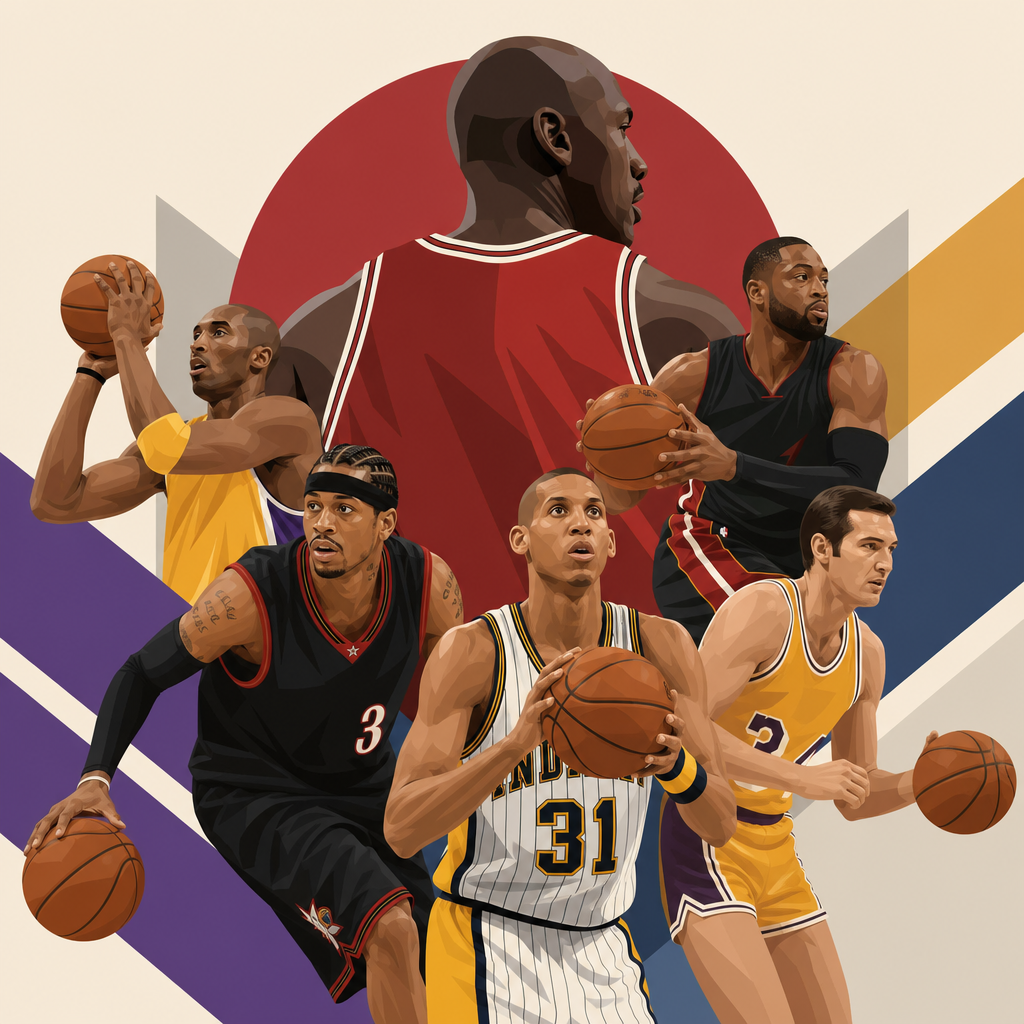
The short version is simple. Jordan remains the standard because he combined the best peak, the best two-way résumé, elite playoff scoring, and six championship runs without a Finals loss. But the all-time conversation becomes more interesting after him. Kobe Bryant, Dwyane Wade, Jerry West, James Harden, and Clyde Drexler form the core of the next tier, while Allen Iverson, George Gervin, Ray Allen, Reggie Miller, and Manu Ginobili shape the extended historical picture. The real challenge is deciding what matters most when players won in different contexts and under different offensive environments.
How to Rank Shooting Guards Across Eras
To rank shooting guards fairly, I use a blend of film study and historical production. Basic totals matter, but they cannot stand alone. Points per game can be inflated by pace, minute loads, or usage spikes. A better starting point is offensive responsibility paired with efficiency. True shooting percentage, assist rate, turnover pressure, and on-off impact all help explain whether a guard merely scored or actually drove winning offense. For defense, All-Defensive selections help, but matchup film, screen navigation, help instincts, and playoff role difficulty often tell a fuller story than awards voting does.
Context is essential. Jerry West played in a league with fewer teams and a tighter talent concentration. Reggie Miller played in lower-possession, lower-efficiency environments where a 61 percent true shooting mark was unusually valuable. James Harden benefited from modern spacing and favorable foul-drawing rules, but he also shouldered unprecedented heliocentric creation loads. Dwyane Wade’s prime came in a more congested floor environment, which makes his rim pressure especially impressive. When I compare players from separate eras, I adjust for what they were asked to do, what the league allowed defenders to do, and how their skills held up in the postseason.
Championships matter, but only as part of the total file. A shooting guard can be historically great without six titles, just as a ring total alone does not settle individual rank. Supporting casts, health, coaching, conference strength, and front office stability all influence who gets the cleanest path to a title. The better question is whether a player scaled upward against elite competition. Did he maintain efficiency in the playoffs? Could he create shots late? Did teams have to warp coverages to contain him? Those are the pressure tests that separate very good stars from all-time legends.
The Standard: Why Michael Jordan Still Sits Alone
Any article on the greatest shooting guards in NBA history has to establish why Jordan remains untouchable at the top. He won 10 scoring titles, earned five regular-season MVPs, captured six Finals MVPs, and made nine All-Defensive First Teams. Those numbers are not just impressive; they describe a player with no real weakness at his peak. Jordan led the league in points per game while also creating steals, blowing up actions on the perimeter, and controlling games from the mid-post, in transition, and from isolation.
What makes Jordan difficult to challenge is the completeness of his résumé. In the 1991 through 1998 championship years, he adapted from a high-flying slasher to a more methodical post and midrange killer, proving that his dominance was not dependent on one athletic phase. His 1991 Finals performance against the Lakers showed elite playmaking growth. His 1993 run included 41.0 points per game in the Finals against Phoenix. His 1998 title run showed he could still close a championship with timing, footwork, and defensive command even after mileage reduced some explosiveness.
Jordan also solved the hardest playoff problem: scoring efficiently against prepared defenses over multiple rounds. His career postseason average of 33.4 points per game remains the highest in league history. That is not empty volume. Opponents loaded up to stop him, and he still delivered in slower, more physical postseason environments. When analysts say a player has a scalable playoff game, Jordan is the model. Every later shooting guard is really competing for second place.
The Next Tier: Kobe Bryant, Dwyane Wade, and Jerry West
Kobe Bryant has the strongest longevity case after Jordan. He scored 33,643 regular-season points, won five championships, made 15 All-NBA teams, and spent roughly a decade as one of the league’s most feared perimeter closers. Kobe’s footwork, shot versatility, and comfort from difficult areas of the floor made him almost impossible to scheme out completely. I have always valued how his game translated across roster types. He could work beside Shaquille O’Neal as a secondary star, then later carry huge usage as the primary engine on title teams in 2009 and 2010.
The strongest argument against Kobe relative to Jordan or even Wade at peak is efficiency. Bryant’s shot diet was brutally hard, and at times he accepted too much self-created difficulty. Still, his postseason gravity was immense, and his defensive best was elite. At his peak, he could check top perimeter scorers, run offense from the wing, and manufacture late-clock attempts no play design could create. In position rankings, that kind of all-court utility matters.
Dwyane Wade has the most underrated peak in this conversation. Before knee decline altered his long-term durability, Wade was one of the most explosive slashers the league had seen. In 2006, he authored one of the great Finals performances ever, averaging 34.7 points against Dallas and relentlessly living at the foul line. In 2009, he produced 30.2 points, 7.5 assists, 5.0 rebounds, 2.2 steals, and 1.3 blocks per game, a stat line that captures his unusual profile: a guard who pressured the rim like a forward and protected the basket like a weak-side helper.
Jerry West is sometimes listed as a point guard, sometimes as a shooting guard, but he belongs in this hub because his scoring profile and off-ball value fit the position discussion. West made 12 All-NBA teams, reached nine Finals, and remains one of the most accomplished playoff guards ever. In the 1969 Finals, he averaged 37.9 points and became the only player from the losing team to win Finals MVP. Film from that era shows a guard with advanced pull-up shooting, deep range for his time, and a relentless competitive pace. If he played today, his skill set would translate beautifully.
Modern Volume and Historic Specialists
James Harden is one of the toughest ranking cases because his regular-season offensive peak is historically high, while his playoff résumé is more uneven than other all-time great shooting guards. From 2017 through 2020, Harden essentially redefined how much one guard could create on a possession-by-possession basis. He won the 2018 MVP, led the league in scoring three straight years, and combined isolation scoring, foul drawing, and passing vision into one of the most efficient high-usage profiles ever. The step-back three became his signature, but his real gift was forcing defenses into impossible choices.
The criticism is familiar and partly fair. Some postseason series exposed the strain of carrying such a centralized offense, and his efficiency occasionally dipped under elite switching defenses. Even so, dismissing Harden because he lacks a title misses the scale of his offensive impact. In a hub covering position rankings, he clearly makes the cut because he changed modern guard offense and accumulated the résumé of a first-ballot Hall of Famer.
Clyde Drexler sits just behind that group for many historians. He was not as polished a scorer as Kobe or Harden, but he was a superb all-around wing guard: transition finisher, rebounder, slasher, secondary playmaker, and disruptive defender. Drexler led Portland to two Finals and later won a title with Houston. He is often overshadowed because his prime overlapped with Jordan’s, yet his combination of athleticism and versatility made him one of the most complete two guards of the 1980s and 1990s.
Below them, Allen Iverson, George Gervin, Ray Allen, Reggie Miller, and Manu Ginobili each represent a different kind of greatness. Iverson carried massive offensive burdens and won four scoring titles despite size disadvantages that would have broken most guards. Gervin paired elegance with production, winning four scoring titles on exceptional touch. Ray Allen and Miller changed perimeter spacing before the current three-point explosion normalized movement shooting. Ginobili accepted lower counting stats in San Antonio, but his creativity, efficiency, and playoff impact were championship-level traits on a dynasty.
| Player | Best Case For Ranking | Main Limitation | Defining Example |
|---|---|---|---|
| Kobe Bryant | Elite longevity, five titles, difficult-shot creation | Lower efficiency than top peers | 2009 and 2010 title runs as primary star |
| Dwyane Wade | Exceptional peak, rim pressure, two-way play | Shorter prime due to knee wear | 2006 Finals takeover versus Dallas |
| Jerry West | Playoff scoring, all-around skill, era-adjusted shooting | Era translation questions for some readers | 1969 Finals MVP in defeat |
| James Harden | Historic offensive engine and scoring volume | Mixed playoff efficiency deep in postseason | 2018 MVP season and Houston isolation system |
| Clyde Drexler | Versatility, athleticism, winning impact | Less dominant individual peak | Portland Finals runs and 1995 title with Houston |
What Actually Makes the Cut in Position Rankings
If this page is the hub for shooting guard position rankings, the practical question is where the cut line belongs. In my view, a true greatest shooting guards list should separate players into bands rather than force false certainty around tiny gaps. Tier one is Jordan alone. Tier two usually includes Kobe Bryant, Dwyane Wade, and Jerry West, though order depends on whether you prioritize peak or longevity. Tier three includes James Harden and Clyde Drexler. Tier four contains historically important stars such as Allen Iverson, George Gervin, Ray Allen, Reggie Miller, and Manu Ginobili.
The reason tiers work is that they explain value more honestly. Wade may have had a higher best level than Kobe in some impact models over short stretches, but Kobe sustained elite status longer and compiled a deeper championship résumé. Harden’s offensive peak can rival anyone outside Jordan, but Wade and Kobe provided more reliable two-way playoff value. West lacks the modern video saturation of later stars, yet his production and reputation among historians support a very high placement. The cut is not just about fame. It is about whether a player had a sustained argument as one of the best engines or complements in championship-level basketball.
For readers exploring NBA Players by position, this hub should guide the rest of the subtopic. Point guard debates emphasize orchestration. Small forward rankings often center on two-way wing size. Power forward and center lists lean more heavily on interior defense and rebounding. Shooting guard history is different because it sits at the intersection of perimeter creation and perimeter resistance. The best players here changed not only games but also the geometry of defenses. If you want to build smarter all-time lists, start by asking what a shooting guard had to do in his own era, then compare how completely he answered that job.
Conclusion: Beyond Jordan, the Debate Gets Richer
Michael Jordan is still the clear number one, but stopping the conversation there misses the richness of shooting guard history. Kobe Bryant built the most substantial post-Jordan body of work through longevity, titles, and relentless shot creation. Dwyane Wade delivered one of the greatest peaks ever, pairing downhill force with disruptive defense. Jerry West brought era-defining skill and elite playoff production. James Harden expanded the limits of perimeter offensive responsibility, while Clyde Drexler embodied complete wing value. Behind them, Iverson, Gervin, Ray Allen, Miller, and Ginobili show how many forms greatness can take at this position.
The main benefit of ranking shooting guards carefully is that it sharpens every broader NBA discussion. It helps explain why some stars age better, why some playoff skills are more portable, and why era context matters when comparing legends. If you are building your own position rankings under the NBA Players umbrella, use tiers, weigh peak against longevity, and test every résumé against postseason reality. Then keep going through the rest of the position rankings hub and compare how the standards change from one spot on the floor to another.
Frequently Asked Questions
Why can’t the greatest shooting guards in NBA history be ranked by points per game alone?
Because the position has never been only about scoring. Shooting guards are often judged first by how many points they put on the board, but that misses the full responsibility of the role. The best players at the position have historically been asked to create offense without dominating every possession, move effectively without the ball, stretch defenses with range, guard top perimeter threats, and execute under playoff pressure when defenses are most prepared. A high scoring average can reflect greatness, but it can also reflect pace, era, usage, or team design. That is why serious rankings go deeper.
When evaluating all-time shooting guards, a stronger framework blends peak performance, longevity, two-way value, postseason impact, scalability next to other stars, and era context. A player who averaged slightly fewer points but defended at an elite level, won consistently, and proved adaptable in different offensive systems may have a more complete case than a pure scorer with weaker all-around impact. This is especially important in cross-era comparisons, because the statistical environment changed dramatically from decade to decade. Rules on hand-checking, spacing, three-point volume, pace, and offensive efficiency all affect how raw numbers should be interpreted. In other words, scoring matters a lot, but it is only one part of a larger, more accurate picture of shooting guard greatness.
Beyond Michael Jordan, which shooting guards are usually considered the strongest all-time candidates?
Once Michael Jordan is placed at the top, the real debate begins, and that is where the position gets especially interesting. The names most commonly brought into the next tier include Kobe Bryant, Dwyane Wade, Jerry West, James Harden, and Allen Iverson, with players like Clyde Drexler, George Gervin, Ray Allen, Reggie Miller, and Manu Ginobili often entering broader top-10 discussions depending on what a ranking values most. Kobe Bryant’s case rests on longevity, championship pedigree, difficult shot creation, elite footwork, defensive reputation at his best, and one of the largest bodies of high-level perimeter scoring in league history. Dwyane Wade brings a different profile: a shorter prime than Kobe, but an extraordinary peak built on rim pressure, slashing, transition play, shot creation, and disruptive defense. Jerry West remains one of the most important historical cases because his resume combines elite scoring, playmaking, efficiency relative to era, and major postseason production, even if many modern fans know him more by reputation than by film or adjusted numbers.
James Harden creates one of the most polarizing debates because his regular-season offensive peak is among the most powerful ever seen from a backcourt player. He combined scoring volume, playmaking control, foul generation, and efficiency in a way that transformed modern offense. Allen Iverson, meanwhile, is often evaluated through a different lens: relentless scoring burden, cultural impact, and the challenge of carrying limited offensive support deep into the postseason. Clyde Drexler offers a very balanced case with athleticism, transition pressure, rebounding, playmaking, and sustained team success. The exact order changes depending on whether a list prioritizes peak dominance, total career value, playoff consistency, or two-way completeness, but those are the names most serious conversations return to once the discussion moves beyond Jordan.
How should different eras be compared when ranking shooting guards from the 1960s, 1980s, 2000s, and modern NBA?
Comparing eras is one of the hardest parts of any all-time positional ranking, and it requires more than simply lining up box-score totals. A shooting guard from the 1960s played in a radically different environment than one from the 2000s or 2020s. Pace was different, offensive structures were different, defensive rules were different, travel and recovery standards were different, and even the expected skill set at the position evolved over time. In some eras, midrange creation and physical shot-making carried more value because spacing was tighter. In modern basketball, three-point gravity, switch punishment, and playmaking against spread defenses matter more than ever. So if two players produced different styles of dominance, the goal is not to force them into the same mold, but to ask how far above their own environments they stood.
That is why adjusted measures and contextual analysis matter so much. Instead of asking only how many points a player scored, it is more useful to ask how efficient that scoring was compared to league average, how much offensive load the player carried, what level of competition they faced in the playoffs, how much defensive value they added, and whether their game would translate across systems. Film study also helps, especially with older stars whose impact can be flattened by incomplete stat records. Jerry West, for example, benefits from this type of analysis because his shot creation, passing, and scoring efficiency relative to his era remain highly impressive. Cross-era ranking is never perfect, but the most credible lists account for environment first, then compare accomplishment, dominance, adaptability, and role difficulty rather than relying on raw totals alone.
What traits separate an elite shooting guard from a merely great scorer?
The separation usually starts with versatility. A merely great scorer can put points on the board in one or two preferred ways. An elite all-time shooting guard can bend a defense across multiple layers of the game. That includes self-creation in isolation, scoring off movement, attacking closeouts, making quick reads as a passer, operating in transition, and maintaining efficiency when defenses are geared specifically to stop them. The best shooting guards are also able to scale their game depending on roster context. They can be primary scorers, secondary attackers, off-ball weapons, or late-clock problem solvers without losing value. That kind of adaptability is a major reason some players age better in all-time discussions than others.
Defense is another major separator. The greatest shooting guards are not just offensive engines; they also handle difficult wing assignments, generate steals without gambling recklessly, contest shots, and hold up physically in playoff basketball. Add in durability, consistency, and late-game reliability, and the picture becomes clearer. This is why players like Kobe Bryant and Dwyane Wade are remembered as complete forces rather than just volume scorers. It is also why specialists with brilliant offensive gifts may rank lower than expected if they lacked defensive value, postseason translation, or versatility away from the ball. At the highest level, a shooting guard’s legacy is built not just on what he scores, but on how many different ways he helps a team survive and win against elite competition.
Is playoff performance more important than regular-season production when deciding who makes the cut on an all-time shooting guard list?
Playoff performance should not be the only factor, but it absolutely deserves extra weight. The regular season provides the largest sample for judging consistency, durability, and long-term value. It shows whether a player can anchor elite offense, maintain efficiency over months, and carry large usage without breaking down. But the postseason reveals something different and often more important for all-time ranking: how a player performs when opponents have time to scheme against every tendency. For shooting guards in particular, that matters enormously because their role often involves late-clock creation, contested shot-making, and decision-making against top wing defenders. If a player’s game consistently holds up or even improves under those conditions, it tells us a great deal about the strength of his all-time case.
That said, playoff evaluation has to be done carefully. Team context, injuries, supporting casts, coaching, and the strength of competition all shape what is possible. A player should not be punished simply because he lacked championship-level help, nor should he automatically rise just because he played beside other superstars on stacked rosters. The right approach is balance. Championships matter, iconic playoff moments matter, and deep runs matter, but so do individual level of play and the difficulty of the environment. This is one reason Kobe Bryant, Dwyane Wade, and Jerry West remain so central to the conversation: each built meaningful postseason cases in different ways. It is also why James Harden and Allen Iverson generate so much debate, because their playoff records invite closer examination of style, burden, efficiency, and context. In the end, the strongest all-time shooting guard rankings treat the playoffs as a crucial test, not the only test.