
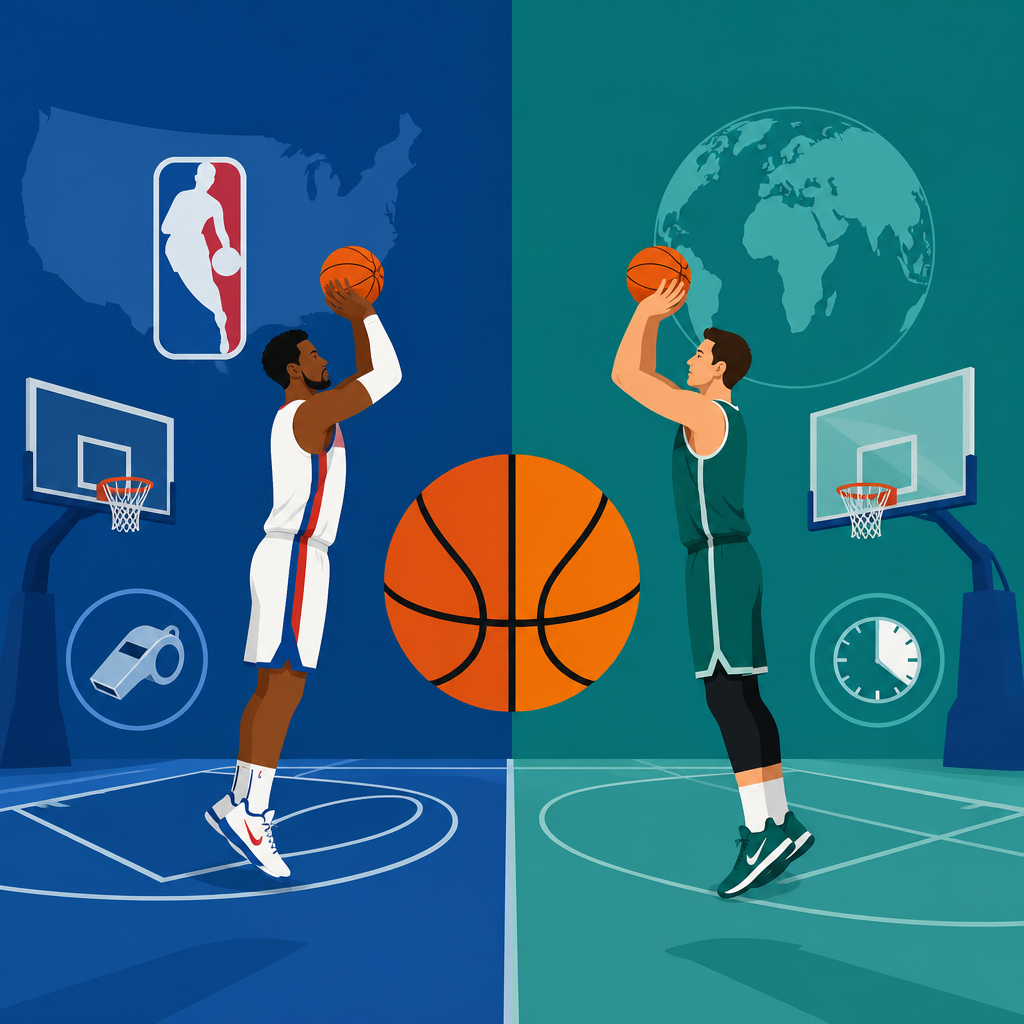
NBA vs FIBA rules shape everything from roster building to late-game strategy, and understanding those differences is essential if you watch the Olympics, the World Cup, EuroLeague talent, or the NBA itself. The NBA is the National Basketball Association, the top North American professional league, while FIBA is the International Basketball Federation, the global governing body that sets rules for most international competitions. Although both versions share basketball’s core structure, they differ in court dimensions, game length, fouls, timeouts, goaltending, replay, and season format. Those rule changes are not cosmetic. They affect spacing, pace, defensive schemes, player conditioning, officiating standards, and how stars perform when they move between systems.
I have covered this topic from the practical side because every summer tournament creates the same questions: Why can a defender knock the ball off the rim in FIBA? Why do NBA players foul out later? Why does the game feel more crowded internationally? The answer is that the rules create a different sport environment. A shorter three-point line changes shot distribution. A forty-minute game changes substitution patterns. Different timeout rules change coaching rhythm. Different basket interference rules can decide medal games. Even the season format matters, because FIBA competitions are tournament based, while the NBA season is a long league campaign with playoff seeding, travel management, and load balancing built into its design.
This article is the hub for the season format side of the broader NBA rules conversation, but it also explains every major rules difference so readers have the full context. If you are comparing NBA vs FIBA rules, start with one principle: the NBA is optimized for a long domestic league season and postseason entertainment, while FIBA rules are optimized for standardized international competition across national teams and leagues. Once you understand that design goal, the rest of the differences make sense. The league and the international game are not simply using alternate preferences. They are solving different competitive problems, and that is why the details matter.
Season Format: League Campaign vs Tournament Structure
The biggest structural difference is season format. The NBA runs an 82-game regular season followed by a multiround playoff bracket, with conferences, divisions, standings, tiebreakers, and a long calendar stretching from October to June. Teams play repeated opponents, manage back-to-backs, scout over months, and adjust rotations for an endurance season. FIBA does not run one equivalent global season. Instead, it governs international events such as the FIBA Basketball World Cup, Olympic qualifying tournaments, continental championships like EuroBasket, and windows for national-team qualification. Those competitions are shorter, more compressed, and built around group play and knockout rounds rather than one long table.
That difference changes strategy immediately. In the NBA, one bad shooting night rarely destroys a season, and coaches think in terms of cumulative wins, health preservation, and playoff matchup preparation. In FIBA competition, a single loss in group play can radically alter the bracket, and one elimination game ends the run. National teams often have limited practice time, so systems must be installed quickly. Coaches simplify terminology, lean on continuity, and prioritize lineup combinations that defend and rebound right away. A veteran international team like Spain has often outperformed more talented rosters because tournament structure rewards cohesion, not just star power.
Even player usage changes because of season format. In the NBA, coaches must distribute minutes with an eye on an 82-game grind and, ideally, a postseason that can add another 16 to 28 games. In FIBA tournaments, there is less long-term preservation and more emphasis on immediate survival, although condensed schedules still make recovery crucial. The shorter event means stars can play more aggressively in bursts, but foul trouble becomes more dangerous because there are only five personal fouls before disqualification under FIBA rules. As a hub for season format, the key point is simple: the calendar is not background information. It determines how every other rule feels in live competition.
Game Length, Court Size, and the Shape of Possessions
NBA games are 48 minutes long, divided into four 12-minute quarters. FIBA games are 40 minutes long, divided into four 10-minute quarters. That eight-minute gap is significant. It lowers total possessions, compresses comeback time, and raises the value of each empty trip in FIBA competition. Overtime periods are five minutes in both systems, but the baseline game is shorter internationally, so coaches have less room to absorb mistakes. This is one reason international upsets happen more often than fans expect. In a shorter game, variance matters more.
The court is different too. An NBA court is 94 by 50 feet. A FIBA court is 28 by 15 meters, which converts to roughly 91.9 by 49.2 feet. The difference sounds small, but it combines with the shorter three-point line and different lane markings to shrink space. FIBA’s three-point line is 6.75 meters from the basket at the top, compared with the NBA line at 23 feet 9 inches, or about 7.24 meters, with shorter corners in both systems. International offenses therefore generate more plausible catch-and-shoot threes from actions that would create long twos or tougher attempts in the NBA.
Spacing affects personnel value. A non-shooting big can survive more easily in FIBA settings because the floor is naturally tighter and help defenders recover over shorter distances. That is one reason some NBA perimeter stars see driving lanes disappear in international tournaments. The game is not necessarily more physical by rule alone; it is also more crowded by geometry. Coaches respond with more off-ball screening, early seals, and post touches. When readers ask why the same player can average 30 points in the NBA but look ordinary in the World Cup, the court and game-length context are often the first place to look.
Fouls, Defense, and Possession Rules
Personal foul limits are one of the clearest differences. NBA players foul out on their sixth personal foul. FIBA players foul out on their fifth. In a 40-minute game, that lower threshold changes defensive risk. Coaches are quicker to protect a star with early fouls, and defenders are less free to body up repeatedly on the perimeter. Team foul penalties differ as well. In FIBA, a team enters the penalty on the fifth team foul in each quarter. In the NBA, the penalty begins on the fifth team foul in a quarter as well, but timing exceptions and late-quarter rules create different outcomes in practice, especially in transition foul situations and take-foul enforcement.
Defensive three seconds is another major separator. The NBA prohibits defenders from standing in the lane for more than three seconds without actively guarding an opponent, which was designed to open driving space and support modern isolation and pick-and-roll offense. FIBA has no defensive three-second rule. That means a rim protector can camp nearer the basket, helping early and deterring drives before they fully develop. International teams exploit this by packing the paint and daring lineups without enough shooting to win from outside. It is one of the most visible reasons the international game can feel more congested.
Goaltending and basket interference are dramatically different around the rim. In the NBA, once the ball contacts the rim, players still cannot touch it if it has a chance to score. In FIBA, after the ball touches the rim, either team can legally play it. That single rule creates scramble situations unseen in the NBA and rewards quick, instinctive bigs. Rudy Gobert, for example, benefits from being able to tap live balls away from the cylinder in FIBA play. It also changes late-game rebounding positioning because players attack the rim itself, not just the space around it.
Timeouts, Replay, and Officiating Philosophy
Timeout structure influences rhythm more than casual viewers realize. NBA teams receive more timeouts overall, and coaches as well as players can affect stoppage flow differently. FIBA grants fewer timeouts, and, crucially, they can generally be called only by the coach, not by players on the floor. In international games, that limits bailout situations when a trapped ballhandler wants an emergency timeout. It rewards poise, sideline communication, and advance preparation. The shorter game plus fewer stoppages often produces a cleaner broadcast rhythm, but it also places more pressure on inbounds execution and late-clock composure.
Replay use is narrower and more standardized in FIBA competition, although both systems continue to evolve. The NBA has expanded replay over time to review out-of-bounds calls, flagrant fouls, goaltending, clock issues, and coach’s challenges. FIBA also uses instant replay for specific end-of-game and technical situations, but in practical terms the NBA environment tends to involve more procedural pauses and more public explanation around reviews. Some fans prefer FIBA’s relative simplicity. Others value the NBA’s attempt to maximize accuracy. The tradeoff is familiar across sports: more review can reduce clear errors, but it can also interrupt momentum and create officiating that feels overlawyered.
Officiating philosophy also differs even when written rules look similar. FIBA referees often allow more contact off the ball and in paint traffic, especially when both players are competing vertically or through strong chest contact. NBA officiating, particularly in regular season perimeter play, has historically been more protective of dribble freedom, although points of emphasis change from year to year. International veterans understand how to use angles, early help, and physical tags without crossing the line. That experience matters. A player who relies on foul drawing through abrupt stops or arm entanglement may get fewer whistles internationally and must adjust quickly.
Quick Reference: Core NBA vs FIBA Differences
| Rule Area | NBA | FIBA | Why It Matters |
|---|---|---|---|
| Season format | 82-game season plus playoffs | Tournaments, qualifiers, group play, knockouts | Changes urgency, scouting, and roster management |
| Game length | 48 minutes | 40 minutes | Each possession carries more weight in FIBA |
| Foul limit | 6 personals | 5 personals | Stars reach disqualification faster internationally |
| Defensive three seconds | Yes | No | FIBA allows more paint loading and rim protection |
| Goaltending on rim | Ball on rim cannot be touched | Ball on rim is live | Creates unique rebounding and save plays |
| Three-point line | Longer | Shorter | Improves spacing for many international lineups |
| Timeout control | More flexible | Coach-driven, fewer total | Reduces bailout stoppages in FIBA games |
How Rule Differences Change Players, Teams, and Results
Rules do not live on paper; they shape outcomes. The NBA rewards elite shot creation, deep spacing, and the ability to maintain efficiency across a long season where talent usually wins out over time. FIBA competition rewards connected defense, fast tactical learning, and lineups that can score without monopolizing the dribble. That is why some role players become more valuable internationally than their NBA status suggests. A smart screener, decisive ball mover, or rugged rebounder can swing a single-elimination game more than a volume scorer who needs NBA-style spacing to dominate.
Recent international tournaments show the pattern. Germany’s 2023 World Cup title was built on continuity, disciplined help defense, and guards making simple reads repeatedly. Spain’s best eras under Sergio Scariolo relied on timing, screening, and collective execution more than overwhelming athleticism. Team USA, despite superior individual talent, has repeatedly had to adjust to tighter paint coverage, fewer free throws, and opponents comfortable with FIBA geometry. This does not mean FIBA basketball is better or harder in absolute terms. It means the rules reward a different hierarchy of strengths, especially over short events where chemistry compounds quickly.
For readers using this page as a season format hub under NBA rules, the practical takeaway is to link every rule back to competition design. Longer seasons favor depth, health management, and star durability. Tournament basketball favors immediacy, precision, and adaptability. If you want to understand why offenses look different, why coaches shorten rotations, or why a single whistle causes so much debate, start with that structural divide. Then study the specific rule changes that flow from it. Watch one NBA game and one FIBA game back to back, focusing on the paint, timeout usage, and end-of-quarter possessions. The contrast becomes obvious fast. Keep this framework in mind as you explore the broader NBA rules topic, and you will read both games more accurately.
Frequently Asked Questions
What are the biggest rule differences between NBA and FIBA basketball?
The biggest differences between NBA and FIBA rules show up in game length, court dimensions, the three-point line, timeout structure, goaltending rules, foul limits, and how the ball can be advanced late in games. NBA games are 48 minutes long, divided into four 12-minute quarters, while FIBA games are 40 minutes long with four 10-minute quarters. That shorter FIBA format changes pacing, rotations, and end-of-game urgency. The NBA also uses a larger court and a longer three-point line, which creates more spacing and often encourages more one-on-one creation. FIBA courts are slightly smaller, and the shorter international three-point line can make help defense and floor balance look different.
Some of the most noticeable differences come around the basket. In FIBA play, once the ball hits the rim, players are allowed to touch it and contest it, which means there is no NBA-style offensive or defensive basket interference restriction after rim contact. In the NBA, players cannot touch the ball while it is on the rim or within the imaginary cylinder above it. Timeout rules also differ substantially. NBA teams have more timeouts overall and can advance the ball in certain late-game situations after a timeout, which directly shapes sideline out-of-bounds strategy. FIBA has a different timeout count and stricter rules on when coaches can call them. Put together, these differences do not just create cosmetic changes; they influence everything from roster construction and offensive spacing to how teams manage crunch-time possessions.
How do court size and three-point line differences affect strategy in NBA and FIBA games?
Court size and three-point line distance have a major effect on how the game is played. The NBA court is 94 by 50 feet, while a FIBA court is slightly smaller at 28 by 15 meters, which is roughly 91.9 by 49.2 feet. That may not sound like a dramatic change, but at the highest level, every inch matters. A slightly smaller court compresses driving lanes, shortens recovery distances for defenders, and can make team defensive schemes look tighter and more physical. Help defenders can rotate faster, closeouts arrive sooner, and offenses often have less room to isolate in pure space compared with NBA conditions.
The three-point line magnifies that effect. The NBA line is farther from the basket than the FIBA line, so players in the NBA must cover more ground to stay attached to shooters, and offenses can stretch defenses wider across the floor. That helps explain why NBA teams often emphasize high-volume spacing, drive-and-kick actions, and pick-and-rolls designed to force long rotations. In FIBA play, the shorter arc can make more players legitimate shooting threats, but it also allows defenders to recover more easily because the floor is not stretched quite as far. The result is a game that often looks more crowded in the paint and more dependent on quick ball movement, timing, and precision. For players moving between the two systems, shooting comfort, driving angles, and defensive positioning all need adjustment.
How do foul rules, physicality, and disqualification standards differ between the NBA and FIBA?
One of the clearest differences is player disqualification. In the NBA, a player fouls out after six personal fouls. Under FIBA rules, a player is disqualified after five fouls. Losing a foul to work with changes defensive aggression, especially for stars, centers protecting the rim, and perimeter defenders guarding elite scorers. Coaches in FIBA competition often have to think more carefully about early foul trouble because there is less game time overall and less flexibility once a key player reaches four fouls. That can alter substitution patterns and force teams to adjust their coverages earlier than they might in the NBA.
Physicality is also interpreted a bit differently in many NBA versus FIBA discussions, though some of that comes from officiating style as much as written rules. International games are often perceived as allowing more contact off the ball and in the lane, while the NBA has, at various points, emphasized freedom of movement and perimeter advantage more strongly. FIBA’s structure can produce games that feel more compact and contested, particularly because of the shorter court and different spacing. There are also differences in team foul penalty situations and how bonus free throws are triggered, which affects how often teams get to the line and how defenses behave late in quarters. In practical terms, players and fans notice that FIBA games can feel more possession-by-possession, with every whistle carrying extra weight, while NBA games allow a slightly longer runway for players managing foul trouble over 48 minutes.
What is the difference between NBA and FIBA goaltending and basket interference rules?
This is one of the most important differences for fans who switch between watching the NBA and international basketball. In the NBA, once a shot is on the rim, players are not allowed to touch the ball if it is still on or directly above the cylinder. That means both offensive and defensive players must leave the ball alone until it clearly comes off. Basket interference and goaltending in the NBA are tightly tied to protecting that imaginary vertical cylinder over the rim. The result is a rule set that often rewards touch around the basket but restricts second-effort plays once the ball makes rim contact.
Under FIBA rules, once the ball touches the rim, it is considered live and either team can legally play it. That means defenders can swat it away and offensive players can tap it in, even if the ball is still bouncing around the cylinder area. This creates a very different rebounding environment and adds value to timing, verticality, and awareness near the basket. It also changes end-of-possession tactics, because players are trained to react instantly after rim contact rather than waiting to avoid a violation. For fans, this can be one of the most jarring visual differences between the two systems. For coaches and front offices, it can slightly raise the importance of mobile big men and aggressive rebounders who can influence shots after they hit the rim in international competition.
Why do NBA and FIBA late-game situations feel so different?
Late-game possessions often feel very different because the rules governing timeouts, ball advancement, and overall game flow are not the same. In the NBA, teams have more structured options in the final minutes, including the ability in certain situations to call timeout and advance the ball to the frontcourt. That rule has a huge strategic impact. It allows coaches to draw up sideline or baseline plays without having to navigate a full-court press or waste valuable seconds bringing the ball up. The NBA’s longer game and larger floor also mean there is more time and space for two-for-one strategies, mismatch hunting, and specialized offense-defense substitutions.
FIBA late-game basketball tends to feel more compressed and more unforgiving. Coaches cannot always manipulate possessions the same way because timeout administration differs, and teams may have fewer opportunities to stop play and reset. Since the game is only 40 minutes long, every possession in the fourth quarter carries slightly more weight, and momentum swings can become decisive much faster. Add in the shorter three-point line and live-ball-on-the-rim rule, and final possessions can become especially chaotic. The overall effect is that NBA endings often showcase elaborate set design and matchup exploitation, while FIBA endings can emphasize execution under pressure, transition awareness, and immediate reactions. Neither format is inherently better; they simply reward different strategic strengths and create different kinds of drama.