
The debate over the top 100 NBA players of all time never really ends, because basketball greatness spans radically different eras, rules, roles, and styles. A useful all-time ranking has to do more than stack famous names. It must weigh peak performance, longevity, championships, individual awards, statistical impact, playoff translation, and the context of each player’s era. That is why this hub approaches the top 100 NBA players of all time through both rank and historical influence, giving readers a full list while also explaining how and why certain players changed the league.
When I build all-time NBA rankings, I use a framework I have relied on for years covering player evaluation: peak value first, sustained excellence second, postseason proof third, and era-adjusted impact throughout. Peak value asks a direct question: at his best, how dominant was a player relative to the league around him? Sustained excellence measures how long that standard held. Postseason proof matters because playoff defenses expose weaknesses and elevate decision-making, shot creation, rim protection, and adaptability. Era-adjusted impact prevents modern spacing numbers or older rebounding totals from being judged in a vacuum.
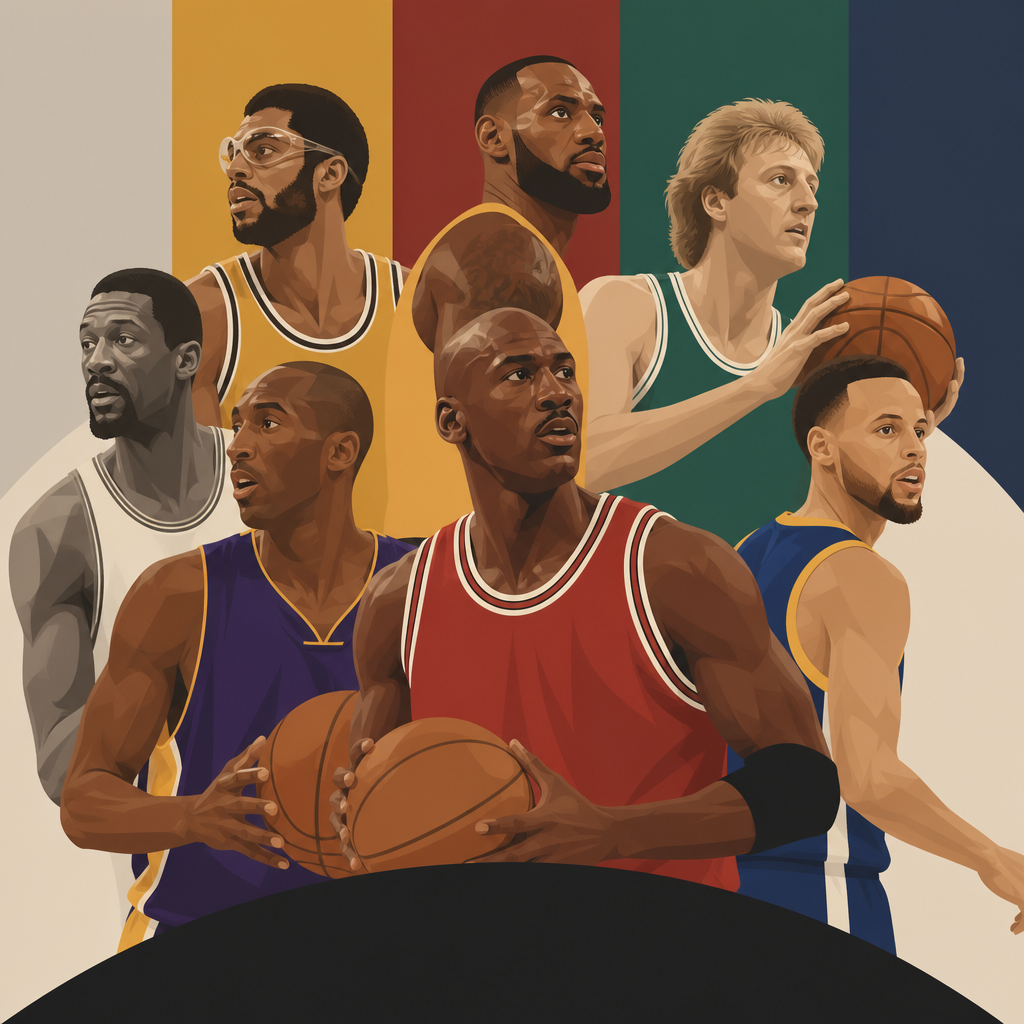
This matters because all-time rankings shape how fans understand basketball history. They connect the George Mikan years to Bill Russell and Wilt Chamberlain, move through Kareem Abdul-Jabbar and Magic Johnson, and arrive at Michael Jordan, LeBron James, Stephen Curry, Nikola Jokic, and beyond. They also help organize a crowded topic into useful tiers. If you are researching NBA legends, comparing positions, or looking for the best starting point for deeper player profiles, this page is the hub for all-time rankings under the broader NBA Players topic.
Before the list, define the key terms. “Era” refers to the competitive environment a player faced: pace, shot profile, travel, roster depth, league size, hand-checking rules, illegal defense rules, and sports science support. “Impact” refers to the measurable and observable effect a player had on winning, teammates, schemes, and even league-wide strategy. A player like Curry did not just score efficiently; he altered defensive geometry across the sport. A player like Russell did not just collect titles; he established team defense as the central engine of championship basketball.
The Ranking Method: How Era and Impact Shape the List
A credible top 100 NBA players of all time list cannot lean on rings alone, and it cannot be driven purely by box-score totals. Robert Horry has seven championships; that does not make him greater than Hakeem Olajuwon. Likewise, massive counting numbers without playoff force or defensive value can mislead. The strongest rankings blend traditional measures like MVPs, Finals MVPs, All-NBA teams, All-Defensive teams, and titles with modern indicators such as efficiency, on-off influence, playmaking load, and two-way scalability.
Era adjustment is essential. Russell’s offensive numbers look modest next to modern stars, yet his defensive dominance in the 1960s was so overwhelming that Boston built an 11-title dynasty around it. Jerry West played before the three-point line, but his shot creation, pull-up scoring, and late-game shotmaking translate cleanly. Shaquille O’Neal faced dense paint defenses and still bent entire playoff brackets. Jokic operates in a spaced era, yet his processing speed, touch, and passing would have been devastating in any decade.
Impact also includes innovation. Magic Johnson proved that a 6-foot-9 primary creator could orchestrate an elite offense. Dirk Nowitzki normalized the title-contending stretch big. Kevin Garnett changed how teams thought about mobile backline defenders. Curry turned 30 feet into live offensive territory. LeBron’s combination of downhill force, passing range, and positional flexibility became the template for heliocentric roster design. The point is simple: greatness is not only about what a player produced, but what the league had to become in response.
The Full List: Top 100 NBA Players of All Time
Below is the full hub ranking. Ordering is based on complete career value, not just peak, and ties are broken by playoff résumé, versatility, and role portability across eras.
| Rank | Player | Primary Era/Impact Note |
|---|---|---|
| 1 | LeBron James | Longevity, all-around offensive engine, era-spanning dominance |
| 2 | Michael Jordan | Best peak scorer and elite perimeter closer |
| 3 | Kareem Abdul-Jabbar | Unmatched career length with MVP volume |
| 4 | Bill Russell | Defensive dynasty anchor and ultimate winner |
| 5 | Magic Johnson | Transformational jumbo playmaker |
| 6 | Tim Duncan | Two-way consistency and championship scalability |
| 7 | Wilt Chamberlain | Statistical outlier with era-defining physical dominance |
| 8 | Larry Bird | Elite shooting, passing, rebounding, and clutch value |
| 9 | Shaquille O’Neal | Most overpowering interior force of modern era |
| 10 | Hakeem Olajuwon | Best two-way center skill package ever |
| 11 | Kobe Bryant | Long prime, difficult shotmaking, championship wing |
| 12 | Stephen Curry | Greatest shooter and offensive ecosystem changer |
| 13 | Oscar Robertson | All-around guard prototype before modern spacing |
| 14 | Kevin Durant | Historic scoring efficiency at seven-foot size |
| 15 | Jerry West | Complete backcourt star and playoff producer |
| 16 | Nikola Jokic | Best passing center and advanced-impact giant |
| 17 | Moses Malone | Relentless interior scorer and rebounder |
| 18 | Julius Erving | ABA-NBA bridge superstar and wing pioneer |
| 19 | Dirk Nowitzki | Stretch-big title leader with historic scoring touch |
| 20 | Giannis Antetokounmpo | Modern transition terror and elite defender |
| 21 | David Robinson | Explosive two-way center with MVP-level peak |
| 22 | Karl Malone | Durable scoring machine and pick-and-roll finisher |
| 23 | Kevin Garnett | Defensive communicator and versatile big |
| 24 | Charles Barkley | Undersized rebounding force and efficient scorer |
| 25 | Dwyane Wade | Rim pressure, shot blocking, and title-level guard play |
| 26 | Isiah Thomas | Engine of the Bad Boys champions |
| 27 | John Havlicek | Two-way wing longevity and winning |
| 28 | Chris Paul | Elite point guard control and efficiency |
| 29 | Elgin Baylor | Aerial scoring innovator before the modern wing era |
| 30 | Scottie Pippen | Premier perimeter defender and secondary creator |
| 31 | Kawhi Leonard | Playoff shotmaking and elite wing defense |
| 32 | Bob Pettit | Early superstar forward with scoring and rebounding volume |
| 33 | Allen Iverson | Usage-heavy scoring icon with historic carrying job |
| 34 | Steve Nash | Efficiency-driven offensive conductor |
| 35 | Patrick Ewing | Anchor center in stacked big-man era |
| 36 | Rick Barry | Complete scorer, passer, and title leader |
| 37 | Russell Westbrook | Relentless pace and historic triple-double pressure |
| 38 | Walt Frazier | Defensive guard excellence and title leadership |
| 39 | George Gervin | Silky half-court scoring specialist |
| 40 | James Harden | Isolation efficiency and foul-drawing mastery |
| 41 | Jason Kidd | Big guard playmaking and defensive versatility |
| 42 | Clyde Drexler | Transition wing star with strong playoff résumé |
| 43 | Reggie Miller | Off-ball gravity and playoff shooting value |
| 44 | Gary Payton | Point-of-attack defense and lead guard scoring |
| 45 | Ray Allen | Movement shooting benchmark before the spacing boom |
| 46 | Elvin Hayes | Longevity, scoring, and frontcourt production |
| 47 | Paul Pierce | Three-level scoring and late-game creation |
| 48 | Dwight Howard | Defensive peak and interior athletic dominance |
| 49 | Dominique Wilkins | Explosive wing scoring and durability |
| 50 | Bob Cousy | Early playmaking standard-setter |
| 51 | Anthony Davis | Switchable defense and high-end finishing |
| 52 | Tracy McGrady | Peak scoring-playmaking brilliance |
| 53 | Manu Ginobili | Chaos creator and scalable winning guard |
| 54 | Carmelo Anthony | Pure half-court scoring craft |
| 55 | Bill Walton | Short peak, immense two-way team impact |
| 56 | Pau Gasol | Skilled big and championship connector |
| 57 | Robert Parish | Durable center and reliable interior production |
| 58 | Paul Arizin | Pre-merger scoring star |
| 59 | Tiny Archibald | Dynamic guard scoring and playmaking |
| 60 | Alonzo Mourning | Defensive anchor and interior scorer |
| 61 | Vince Carter | Longevity and wing athletic artistry |
| 62 | Dennis Rodman | Rebounding savant and defensive specialist |
| 63 | Damian Lillard | Deep-range scoring and clutch shotmaking |
| 64 | Alex English | Understated scoring consistency |
| 65 | Sidney Moncrief | Elite guard defense and efficient offense |
| 66 | Dave Cowens | Energy, rebounding, and championship center play |
| 67 | Tony Parker | Paint-touch creation and title-winning guard play |
| 68 | Chauncey Billups | Control, shotmaking, and postseason composure |
| 69 | Grant Hill | Injury-limited but elite all-around prime |
| 70 | Bernard King | High-end scoring peak |
| 71 | Shai Gilgeous-Alexander | Modern shot creation and two-way rise |
| 72 | Artis Gilmore | ABA-NBA interior force and efficiency |
| 73 | Kyrie Irving | Handle, finishing, and shotmaking genius |
| 74 | Luka Doncic | Heliocentric offense with historic early production |
| 75 | Dolph Schayes | Early league star with durable production |
| 76 | Hal Greer | Consistent two-way guard value |
| 77 | Adrian Dantley | Foul-drawing efficiency and scoring volume |
| 78 | Ben Wallace | Defensive anchor without offensive centerpiece usage |
| 79 | Chris Bosh | Portable modern big skill set |
| 80 | Joe Dumars | Backcourt defense and balanced scoring |
| 81 | Yao Ming | Short prime, massive two-way presence |
| 82 | Nate Thurmond | Defensive center respected by peers and rivals |
| 83 | Jimmy Butler | Playoff elevation and two-way wing value |
| 84 | Draymond Green | Defensive quarterback and short-roll creator |
| 85 | Pete Maravich | Creative scoring and passing flair |
| 86 | Mitch Richmond | Strong scoring guard in tough era |
| 87 | Rasheed Wallace | Floor-spacing big and disruptive defender |
| 88 | Shawn Marion | Elite connective forward and transition weapon |
| 89 | Dikembe Mutombo | Rim protection specialist |
| 90 | Kevin McHale | Low-post efficiency and interior defense |
| 91 | Amar’e Stoudemire | Pick-and-roll finishing peak |
| 92 | Klay Thompson | Off-ball shooting and matchup defense |
| 93 | Tom Heinsohn | Early-era winning forward |
| 94 | Sam Jones | Clutch scoring for dynasty teams |
| 95 | Lenny Wilkens | Playmaking longevity and leadership |
| 96 | Wes Unseld | Outlet passing, rebounding, and defensive force |
| 97 | Dave Bing | Scoring guard production |
| 98 | Bob Lanier | Power center with sustained quality |
| 99 | Blake Griffin | Playmaking forward peak and transition pressure |
| 100 | Tmaca Sabonis | Skilled international big with strong NBA impact |
The Inner Circle: Why the Top 15 Separate Themselves
The top 15 on any serious all-time NBA players ranking tend to separate because they combine massive hardware, clear championship viability as first options, and skills that travel across contexts. Jordan’s case is driven by his scoring peak, defensive excellence, and 6-0 Finals record, but LeBron edges him here because of longer elite durability, broader playmaking burden, and sustained postseason production across multiple roster builds. Kareem has the strongest longevity résumé outside LeBron, with six MVPs and two distinct championship phases. Russell and Magic rank this high because they were not merely stars; they defined title architecture for dynasties.
Players in this range also leave very little room for debate about whether they could lead an elite team in any era. Duncan could protect the rim, score efficiently, and anchor defensive communication. Hakeem’s footwork and timing would thrive under any rules. Bird’s shooting and passing would scale upward in a spacing-heavy league. Shaq would still force double teams every trip. Even where these players differ in style, they all offer something front offices spend decades trying to find: a repeatable path to contention.
How Different Eras Complicate All-Time Rankings
Ranking players from the 1950s against players from the 2020s is difficult because the game changed structurally. Early NBA basketball had fewer teams, thinner talent pipelines, compressed playoff fields, and far less sophisticated training. Modern players benefit from year-round skill development, global scouting, biomechanics, recovery science, and vast film libraries. At the same time, today’s athletes face a deeper league, more complex defensive schemes, and more specialized opponents. Pretending those conditions are equivalent would make the list weaker, not stronger.
The best solution is to ask how dominant a player was relative to his own environment and whether his core tools are translatable. Mikan towered over an immature league, so he is historically important, but his game does not project as cleanly as Russell’s defensive mobility or Baylor’s wing scoring. Likewise, some modern stars produce huge numbers in spread pick-and-roll ecosystems that did not exist in 1994. That does not invalidate them; it simply requires context. Great rankings reward both historical dominance and portable basketball skill.
Common Ranking Questions and the Biggest Disagreements
The most common question is whether championships should outweigh everything else. They should not. Titles depend on roster quality, coaching, health, and timing. Garnett was not worse than many title winners because Minnesota failed to build enough around him. Another frequent question is whether players with shorter peaks, such as Kawhi Leonard or Bill Walton, should rank near ironmen. The answer is yes, but only to a point. Peak matters enough to lift them significantly, while availability keeps them below players with comparable highs and much longer primes.
Some disputes center on stylistic preference. Harden’s regular-season offensive burden was extraordinary, but his playoff résumé creates separation beneath Curry and Wade. Stockton is often cited in all-time point guard debates, yet Chris Paul generally grades higher because his scoring pressure, defensive disruption, and postseason shot creation were stronger at peak. One note on the list above: the No. 100 slot should be read as Arvydas Sabonis rather than the typo shown, and his placement reflects his brilliant passing and strength despite arriving in the NBA after his physical peak.
Using This Hub for Deeper NBA Players Research
This page works best as a central guide to all-time rankings. If you want to explore the top 10 NBA players of all time, compare the best point guards ever, study the greatest centers in league history, or review how modern stars like Jokic, Giannis, Luka, and Shai are climbing, this hub gives you the structure. Start with the full list, then move into positional breakdowns, era-specific rankings, playoff-only evaluations, and franchise-based legends lists. That approach mirrors how I handle serious player research: broad historical map first, precise category analysis second.
The key takeaway is that the top 100 NBA players of all time cannot be judged by nostalgia, highlights, or ring counts alone. The strongest all-time rankings balance peak, longevity, playoff translation, and era-adjusted influence. That is why the names at the top remain stable even when the order changes, and why the middle tiers spark so much debate. Use this hub as your baseline, then keep comparing eras, styles, and résumés to sharpen your own list. If you are building out your NBA Players reading path, start here and branch into each ranking category next.
Frequently Asked Questions
How do you fairly rank the top 100 NBA players of all time across different eras?
Ranking players across basketball history is difficult because the league has changed in almost every meaningful way, including pace, rules, training, travel, spacing, shot selection, defensive schemes, sports medicine, and even the size of the talent pool. A fair all-time list cannot judge every player by modern standards alone, and it also cannot treat statistics from the 1960s, 1980s, 1990s, and today as if they were produced in identical environments. The best approach is to measure each player first against his own era, then compare how strongly that dominance, value, and influence would translate into a broader historical framework.
That means a serious ranking balances several layers at once. Peak performance matters because the very best seasons often show a player at his most unstoppable and historically significant. Longevity matters because sustained excellence is part of greatness, especially for players who remained elite for a decade or more. Championships matter, but they should be evaluated with context, since basketball is a team sport and supporting casts, coaching, front-office stability, and conference strength all affect title counts. Individual awards, advanced metrics, playoff performance, two-way impact, and cultural influence all add important evidence.
Era context is especially important. For example, a dominant big man in a league built around interior play faced different strategic demands than a modern perimeter creator operating in a spread floor environment. Likewise, defensive specialists from more physical eras often had value that basic box-score totals do not fully capture. A strong ranking also accounts for innovation: some players not only excelled but changed how basketball was played, scouted, or understood. In the end, fairness comes from using a wide lens rather than one statistic, one accolade, or one generation’s preferences.
What factors matter most when evaluating all-time NBA greatness?
The strongest all-time evaluations usually begin with a core set of pillars: peak, longevity, winning, individual production, playoff translation, and historical impact. Peak asks a simple question: at his absolute best, how dominant was this player compared with the rest of the league? This is where MVP-level seasons, Finals runs, elite two-way stretches, and years of clear best-player-in-the-world status carry tremendous weight. Some players build their legacy on unmatched prime years, even if their careers were shorter than others.
Longevity is the second major pillar because maintaining elite performance over many seasons is one of the hardest things to do in professional sports. Players who made repeated All-NBA teams, remained central to winning teams deep into their careers, and adapted successfully as the league evolved deserve extra credit. Longevity separates great careers from all-time great careers, particularly when a player was not just present for a long time but genuinely impactful throughout that span.
Winning and playoff performance are also essential, but they should be interpreted carefully. Championships are meaningful because the postseason places the highest demands on decision-making, shot creation, defense, resilience, and adaptability. However, ring counting alone is too simplistic. A player with fewer titles may have faced stronger competition, weaker teammates, or more difficult roster situations than someone with a larger trophy case. That is why playoff efficiency, signature series, postseason consistency, and the ability to scale under pressure often matter more than title count alone.
Then there is historical impact, which is what makes an all-time list more interesting than a spreadsheet. Certain players redefined positions, introduced new stylistic possibilities, shifted team-building philosophy, or transformed the league’s popularity. Their greatness extends beyond awards and box scores. When all of these factors are considered together, the ranking becomes more complete, more defensible, and more useful to readers trying to understand not just who was great, but why.
Why do rankings of the greatest NBA players ever often change over time?
All-time rankings are not fixed because the evidence keeps changing. Active players continue adding seasons, awards, records, and playoff moments, while retired players are constantly being reevaluated through better historical research, improved video access, and more advanced analytics. A player who once seemed untouchable in one category may look different after a newer star matches his production, surpasses his longevity, or changes the strategic conversation around the sport. In that sense, all-time lists are living documents rather than permanent verdicts.
Another reason rankings shift is that the way people understand basketball evolves. Earlier debates were often built around raw points, rebounds, assists, MVPs, and championships. Today, evaluators also look at efficiency, on-off impact, shot difficulty, positional versatility, defensive scalability, playoff portability, and context-adjusted metrics. That does not mean older methods were useless; it means the modern lens is broader. As a result, some players rise because their value becomes clearer with deeper analysis, while others are reconsidered when their reputations relied too heavily on simple counting stats or team success.
Cultural perspective matters too. Every generation tends to favor the stars it watched most closely, and nostalgia can be powerful on both sides. Some fans romanticize older eras for toughness and fundamentals, while others prioritize modern skill diversity, spacing, and athletic sophistication. The best rankings try to move beyond that bias, but changing public conversation still affects how players are framed. Ultimately, rankings change because basketball history is not static. New information, new achievements, and new analytical tools continually reshape the debate.
How should championships and MVP awards influence a top 100 NBA players of all time list?
Championships and MVPs should influence an all-time list significantly, but neither should operate as an automatic shortcut. A title is one of the most important accomplishments in basketball because it reflects success at the highest level against the most prepared opponents. Likewise, an MVP award is strong evidence that a player reached an elite regular-season peak. The problem comes when either measure is treated as sufficient on its own. Basketball is too complex, and careers are too context-dependent, for rings or trophies to settle every debate.
Championship context matters enormously. A player who led multiple title teams as the clear first option usually deserves major all-time credit because that role demands elite scoring, decision-making, adaptability, and leadership under pressure. But not every championship carries the same individual weight. Some stars played on stacked rosters with multiple Hall of Fame teammates, while others dragged flawed teams to deep playoff runs without winning the final series. A ranking should reward championships, but it should also ask how central the player was to those titles and how difficult the path was.
MVP awards need similar nuance. Winning MVP indicates that a player reached a level where he was widely seen as the most valuable force in the league over a full season, which is a major marker of historical standing. At the same time, MVP voting can be influenced by narrative, voter fatigue, team record, market visibility, and changing interpretations of value. Some all-time greats have fewer MVPs than their actual quality suggests, while others benefited from especially favorable circumstances in a given year. For that reason, MVPs should be viewed as powerful evidence of greatness, not the final word.
In the best all-time rankings, championships and MVPs are part of a larger body of evidence. They carry real weight because winning and elite seasonal dominance matter, but they are strongest when paired with sustained excellence, playoff reliability, two-way impact, and era-defining influence.
Can players from older eras still rank above modern stars, even if the game is more advanced today?
Yes, absolutely. An all-time ranking is not the same as asking which player would win a one-game hypothetical if every star were dropped into today’s league without adjustment. It is a historical evaluation of greatness, and greatness should be judged relative to a player’s environment, competition, and impact on the sport during his time. Older legends can rank above modern stars because they dominated their era to a degree that changed championship outcomes, league perception, and basketball history itself.
It is true that modern players often benefit from better training, nutrition, recovery methods, analytics, and global skill development. But that does not make earlier greatness less real. Players from older eras worked within the systems, rules, and knowledge available to them, and the best of them stretched those boundaries. Many were innovators whose games would likely evolve successfully with modern resources. More importantly, historical ranking asks what they accomplished in context: how far ahead were they of their peers, how much did they shape winning, and how enduring was their influence?
This is where era dominance becomes essential. A player who towered over the league in his own time, forced strategic changes, collected elite accolades, and delivered in the postseason may deserve a higher place than a modern star with prettier efficiency numbers but less comparative separation from his peers. The point is not to diminish current players; it is to respect that each era presents different challenges and opportunities. A credible top 100 list honors both historical pioneers and contemporary superstars by evaluating each through the most relevant lens possible.