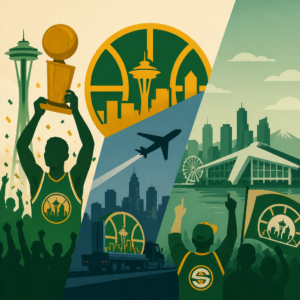

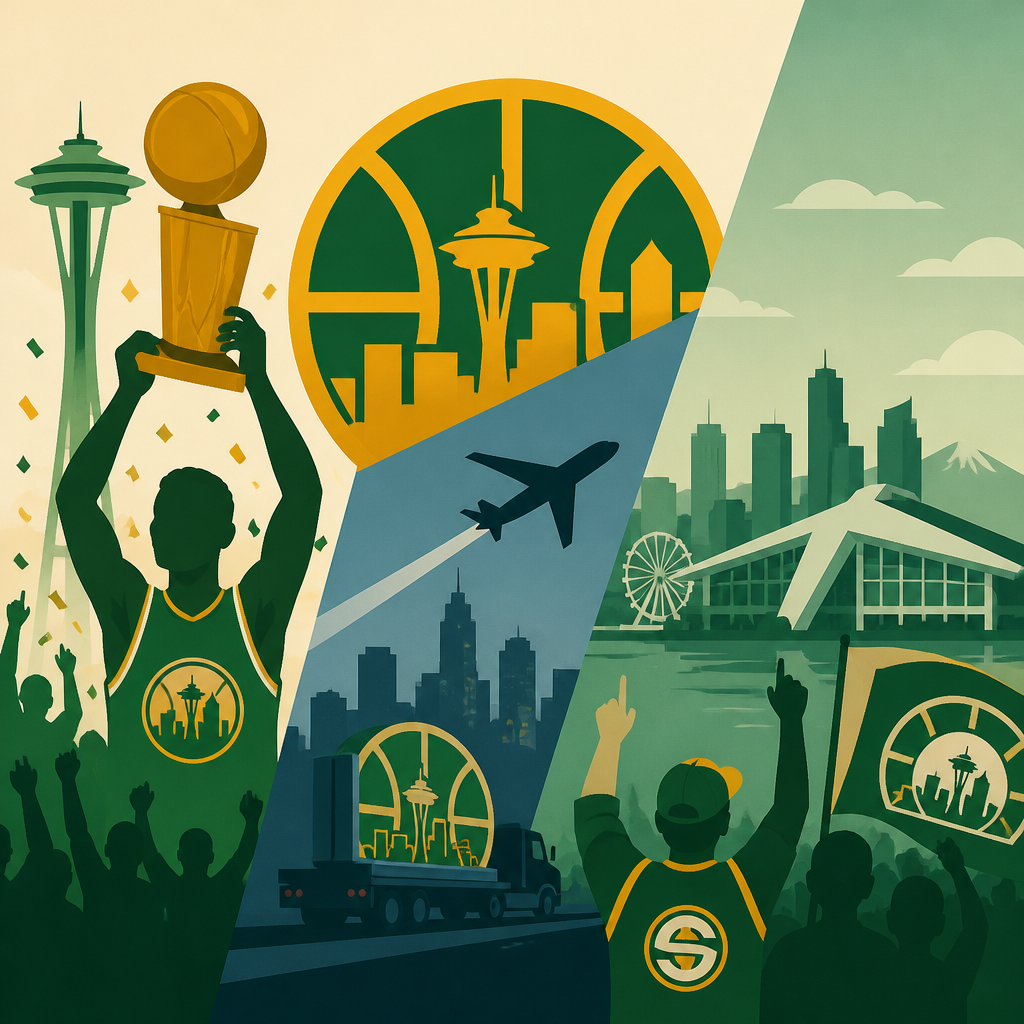
The Seattle SuperSonics occupy a singular place in NBA history because their story contains nearly every force that has shaped the league: expansion ambition, championship building, star power, civic identity, arena economics, franchise relocation, and the modern push for expansion. Founded in 1967, the SuperSonics were Seattle’s entry into a rapidly growing NBA, and over four decades they evolved from a new-market experiment into one of professional basketball’s most recognizable brands. Any serious overview of league history has to include the Sonics, not only for what they achieved on the court, but for what their departure revealed about how professional sports actually operate.
When people search Seattle SuperSonics history, they are usually asking several questions at once. When did the team begin? Who were the defining players and coaches? How did Seattle win its only NBA championship? Why did the franchise move to Oklahoma City? And will the NBA ever return to Seattle? Those questions are connected. The answers trace the league’s growth from a regional competition into a global entertainment business where television revenue, public financing, arena design, ownership strategy, and brand leverage matter almost as much as win-loss records. I have worked through this history from game archives, legal filings, arena debates, and league records, and the Sonics consistently stand at the intersection of basketball and business.
The term “league history” means more than a timeline of champions. It includes the NBA’s expansion patterns, labor and ownership dynamics, media eras, playoff structures, and relocation precedents. The SuperSonics help explain all of it. Their 1979 championship remains a landmark for small-market team building. Their rivalries with the Lakers, Trail Blazers, Suns, Bulls, and later the Nuggets and Jazz reflect changing conference power structures. Their move in 2008 exposed how vulnerable even established franchises can be when arena negotiations collapse. And the enduring campaign to bring the NBA back to Seattle shows how legacy markets retain strategic value for league growth.
As a hub article within NBA history, this guide covers the full arc: the expansion years, the Lenny Wilkens championship era, the Gary Payton and Shawn Kemp resurgence, the ownership battle that led to relocation, and the current case for a new Seattle franchise. The point is not nostalgia alone. The SuperSonics are a case study in how teams are built, how leagues make territorial decisions, and why some brands outlive the franchises that carried them.
Expansion Origins and Early Identity
The NBA awarded Seattle an expansion franchise for the 1967-68 season, part of a broader effort to place teams in rising West Coast markets. The choice made strategic sense. Seattle was a growing metropolitan area, a strong corporate center, and a city already proving it could support major sports. The club played at the Seattle Center Coliseum, later known as KeyArena, and adopted the SuperSonics name in reference to Boeing’s role in the city and the local fascination with aerospace innovation.
Like many expansion teams, the early Sonics struggled for consistency. Yet they did not stay irrelevant for long. Under owner Sam Schulman and later with important front-office work from people such as Zollie Volchok, the franchise became competitive faster than many peers. Spencer Haywood, one of the most consequential figures in basketball labor history, arrived in 1970 after leaving the ABA and challenging the NBA’s eligibility rules. His legal battle against the league helped weaken restrictions that had limited players from entering before their college class graduated. That case changed league history far beyond Seattle. On the court, Haywood was brilliant, averaging more than 24 points and 12 rebounds per game in his Sonics years and giving the franchise its first true superstar.
By the mid-1970s, Seattle had developed a hardened home-court identity. The crowd was loud, the building compact, and the team increasingly disciplined. That set the stage for the most important period in franchise history.
The 1978 and 1979 Finals Runs
The SuperSonics reached a new level after Lenny Wilkens took over as head coach during the 1977-78 season. Wilkens, a Hall of Fame guard and one of the most respected basketball minds in league history, stabilized the team immediately. Seattle started that season poorly, but Wilkens reorganized the rotation, simplified responsibilities, and built a defense-first approach around length, rebounding, and mistake-free execution.
The 1978 playoffs announced Seattle as a genuine contender. The Sonics defeated the Lakers and Trail Blazers to win the Western Conference, then faced the Washington Bullets in the NBA Finals. Seattle lost the series in seven games, but the matchup established the formula that would soon bring a title. Dennis Johnson emerged as a premier perimeter defender, Gus Williams added speed and shot creation, Jack Sikma became the cerebral center who anchored both ends, and role players such as Lonnie Shelton, Fred Brown, and John Johnson fit clearly defined jobs.
In 1979, Seattle returned with greater composure and balance. The Sonics again met the Bullets in the NBA Finals and this time won in five games to capture the franchise’s only championship. Dennis Johnson was named Finals MVP. What made that team special was not one overwhelming scorer but an ecosystem of complementary strengths. Sikma controlled space with positioning and touch. Williams pressured defenses in transition. Shelton and John Johnson supplied toughness and versatility. Wilkens demanded accountability on every possession. In historical terms, the 1979 title proved that elite defense, depth, and continuity could defeat more star-centric constructions.
That championship still matters in NBA history because it stands as one of the clearest examples of collective team building. Seattle was not a glamour franchise with endless financial advantages. It was a smart, connected group that maximized chemistry and coaching. For modern fans comparing title pathways, the 1979 Sonics belong in the same conversation as other balanced champions that won through structure rather than celebrity.
The 1980s Transition and the 1990s Revival
The post-title years brought respectability but not another Finals breakthrough. Seattle remained competitive in the early 1980s, yet roster changes and conference strength made sustained dominance difficult. Gus Williams missed the 1980-81 season in a contract dispute, and although the Sonics continued to produce quality teams, they gradually shifted from contender to dangerous middle seed. One bright point came in 1987, when a 39-win Seattle team coached by Bernie Bickerstaff made a surprising run to the Western Conference Finals behind Tom Chambers, Dale Ellis, and Xavier McDaniel. That run reinforced a pattern familiar in league history: the Sonics repeatedly outperformed outside expectations when their athletic wings and home environment aligned.
The franchise’s next great era began in the early 1990s under head coach George Karl. General manager Wally Walker and the front office assembled a roster with a clear identity: pressure defense, speed, and physicality. Gary Payton became the face of the team and one of the best guards in NBA history. Shawn Kemp supplied explosive finishing and emotional force. Detlef Schrempf added playmaking and shooting, while players such as Nate McMillan, Hersey Hawkins, Sam Perkins, and Ervin Johnson gave Seattle veteran intelligence and defensive flexibility.
These Sonics were not merely entertaining. They were strategically ahead of their time in several ways. Seattle switched aggressively, trapped ball handlers, and used Payton as a disruptive point-of-attack defender long before perimeter defense received its current level of analytical attention. Kemp, meanwhile, was a prototype for the modern rim-running power forward: dynamic in space, dangerous above the rim, and capable of altering transition games by himself.
| Era | Key Figures | League Significance | Best Result |
|---|---|---|---|
| Late 1970s | Lenny Wilkens, Dennis Johnson, Gus Williams, Jack Sikma | Defense-and-depth championship model | 1979 NBA title |
| Late 1980s | Tom Chambers, Dale Ellis, Xavier McDaniel | Underdog playoff overachievement | 1987 West finals |
| 1990s | Gary Payton, Shawn Kemp, George Karl, Detlef Schrempf | Elite pressure defense and transition basketball | 1996 NBA Finals |
| 2000s | Ray Allen, Rashard Lewis, Kevin Durant | Bridge from veteran scoring to future rebuild | 2005 West semifinals |
The peak came in 1995-96, when Seattle won 64 games, the best mark in franchise history. The Sonics reached the NBA Finals and faced Michael Jordan’s 72-win Chicago Bulls. Seattle lost in six games, but the series remains more competitive than casual memory suggests. After falling behind 3-0, the Sonics adjusted by assigning Payton more directly to Jordan and won Games 4 and 5. Chicago’s greatness ultimately prevailed, yet Seattle’s run confirmed the franchise as one of the defining powers of the decade.
Decline, Ownership Conflict, and the Move to Oklahoma City
After the 1996 Finals appearance, the Sonics stayed relevant but could not hold the same peak. Kemp was traded in 1997, the roster aged, and the Western Conference deepened. Payton remained elite, winning Defensive Player of the Year in 1996 and sustaining All-NBA production, but the title window narrowed. In the 2000s, Seattle pivoted again. Ray Allen and Rashard Lewis headlined a skilled offensive team that won 52 games in 2004-05 under Nate McMillan and reached the Western Conference semifinals. It was a strong season, though not the start of a stable contender.
The franchise’s existential crisis centered on the arena. By the 2000s, KeyArena, despite its atmosphere and history, was viewed by ownership and league decision-makers as financially outdated. Modern NBA economics increasingly depended on premium seating, club spaces, sponsorship inventory, and expanded back-of-house revenue opportunities. Howard Schultz, whose ownership group bought the team in 2001, pushed for a publicly supported arena solution but failed to secure one. In 2006, Schultz sold the Sonics and WNBA’s Storm to an ownership group led by Clay Bennett from Oklahoma City.
That sale changed everything. Seattle officials and many fans believed Bennett’s group was acting in bad faith, seeing relocation as a likely objective from the start. Bennett pursued a new arena in the Seattle area, but negotiations with state and local leaders stalled. In 2008, after failed efforts to secure public financing in Renton, the ownership group moved to relocate the franchise to Oklahoma City. The city of Seattle sued over the remaining lease at KeyArena, and the dispute ended in a settlement allowing the team to leave immediately after paying $45 million, with the possibility of an additional $30 million under certain conditions.
The basketball side of the story made the move even more painful. Seattle had drafted Kevin Durant in 2007, giving the franchise a transformational young star just before departure. Durant’s rookie season, along with Jeff Green’s arrival, suggested a meaningful rebuild. Instead, the Sonics played one final season in 2007-08, finished 20-62, and then became the Oklahoma City Thunder. Importantly, the settlement left Seattle with the SuperSonics name, logos, and historical records should a future NBA team return. That detail matters because it preserved continuity between the city’s past and any eventual franchise revival.
From a league-history perspective, the relocation remains one of the NBA’s most instructive episodes. It demonstrated that long tenure in a city does not guarantee security, that arena politics can override fan loyalty, and that ownership alignment with league priorities often determines outcomes more than public sentiment. It also fueled later skepticism whenever any franchise entered prolonged arena negotiations elsewhere.
The Lasting Legacy and the Case for an NBA Return
The push to bring the NBA back to Seattle has never faded because the market fundamentals are unusually strong. Seattle is a large media market, a wealthy corporate center, and a city with proven basketball culture from the Sonics era, strong college support, youth participation, and sustained fan activism. Climate Pledge Arena, the renovated successor to KeyArena, opened in 2021 as a state-of-the-art venue with the premium inventory and event infrastructure modern leagues require. In practical terms, the single biggest structural obstacle that defined the 2008 exit is no longer the same problem.
The argument for expansion or return also fits broader NBA strategy. The league has repeatedly signaled interest in eventual expansion once national media-rights priorities are settled. Seattle is almost always named first in serious discussions, often alongside Las Vegas. That is not sentimental charity. It is rational business. Seattle offers immediate brand recognition, an existing historical identity, strong sponsorship potential, and a ready-made rivalry map with Portland, Golden State, the Lakers, and any future Western Conference alignment.
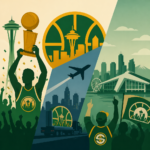
Legacy matters here. The SuperSonics were never just another relocated team. Their history includes Hall of Famers, a championship, multiple Finals runs, major labor-law significance through Spencer Haywood, and one of the league’s most passionate fan bases. The visual symbols alone remain powerful: green and gold uniforms, the skyline logo, and the acoustic intensity of the old arena. Few dormant brands in American sports retain that level of recognition.
The main uncertainty is timing, not viability. Expansion fees would be enormous, ownership groups must satisfy league governance standards, and conference realignment would require negotiation. But the foundation is unusually complete. Seattle has the arena, the corporate support, the historical claim, and the public appetite. If and when the NBA expands, the return of the SuperSonics is the most logical move available.
Seattle SuperSonics history matters because it explains the NBA in full: how expansion works, how championships are built, how stars define eras, how business pressures reshape geography, and how civic memory can outlast relocation. The Sonics won a title through depth and discipline in 1979, reemerged as a defensive powerhouse in the 1990s, and then became the cautionary example every fan base cites when arena politics turn tense. Their disappearance did not erase their significance. It sharpened it.
For readers exploring league history, the SuperSonics are not a side note between bigger-market dynasties. They are central to understanding the NBA’s western growth, competitive evolution, and modern economics. Spencer Haywood’s legal challenge changed player movement. Lenny Wilkens’ champion showed the value of complete roster construction. Gary Payton and Shawn Kemp embodied the athletic, defense-driven 1990s. The relocation to Oklahoma City reset how fans and cities evaluate franchise stability. And the continuing expansion discussion shows that historic brands can remain strategically important long after a team leaves town.
The clearest takeaway is simple: the Seattle SuperSonics are one of the NBA’s most important missing franchises, and their story is still unfinished. If you are building a serious understanding of NBA history, keep Seattle near the center of the map, then follow the linked team, Finals, relocation, and expansion stories that branch from it. That is where league history becomes real.
Frequently Asked Questions
When were the Seattle SuperSonics founded, and why were they important to the NBA’s growth?
The Seattle SuperSonics were founded in 1967 as part of the NBA’s expansion into new markets during a period when professional basketball was trying to establish a stronger national footprint. Seattle was seen as a promising city with a growing population, a strong regional identity, and the kind of civic ambition that made it attractive for a major sports franchise. The team’s arrival signaled that the NBA was no longer centered only on its traditional strongholds in the East and Midwest. It was beginning to think bigger, moving into emerging cities and testing how far the league’s appeal could reach.
The SuperSonics quickly became more than just an expansion team. Over time, they helped prove that a franchise outside the league’s oldest markets could build a passionate fan base, develop a recognizable identity, and matter on the national stage. Their history reflects several major themes in NBA evolution: how expansion reshaped the league, how star players elevated franchises, how local loyalty can define a team’s brand, and how ownership and arena politics can alter the future of even a successful organization. In that sense, the SuperSonics were not just a Seattle story. They were part of the broader story of how the NBA became a modern, coast-to-coast league.
What was the high point of SuperSonics history, and how did the team win its championship?
The high point of Seattle SuperSonics history came in 1979, when the franchise won its first and only NBA championship. That title team was defined by balance, toughness, and discipline rather than by a single overwhelming superstar carrying the entire roster. Under head coach Lenny Wilkens, the Sonics built a cohesive, defense-first identity that made them extremely difficult to play against. Their success was rooted in depth, unselfishness, and an ability to control the tempo of games, which gave them a reliable formula in the postseason.
Key players on that championship team included Dennis Johnson, Gus Williams, Jack Sikma, and Downtown Freddie Brown. Johnson brought elite perimeter defense and big-game intensity. Williams supplied speed, scoring, and shot creation. Sikma provided interior skill, rebounding, and one of the most distinctive all-around games of his era. Brown added offensive firepower and became one of the most beloved figures in franchise history. Together, they formed a roster that was greater than the sum of its parts.
Seattle reached the NBA Finals in 1978, losing to the Washington Bullets, then returned in 1979 for a rematch and won the series. That quick return and eventual victory reinforced the idea that the Sonics were not a one-year surprise but a legitimate contender built on structure and resilience. The 1979 championship remains a defining civic sports memory in Seattle. It gave the franchise permanent historical credibility and ensured that the SuperSonics would always be remembered as champions, not merely as a relocated team whose identity was lost to history.
Who were the most important players and eras in Seattle SuperSonics history after the championship?
After the 1979 title, the SuperSonics continued to produce notable teams, memorable stars, and important eras that kept the franchise nationally relevant. In the 1980s, Seattle remained competitive and featured standout players such as Jack Sikma, Tom Chambers, Dale Ellis, Xavier McDaniel, and others who helped sustain fan interest even as the NBA became increasingly star-driven. The 1987 team, for example, made a surprising run to the Western Conference Finals, showing that the Sonics could still command attention in a crowded and increasingly competitive league.
For many fans, though, the defining post-championship era came in the 1990s with Gary Payton and Shawn Kemp. Payton became the face of the franchise with his elite defense, relentless competitiveness, and unmistakable swagger. Nicknamed “The Glove,” he developed into one of the greatest point guards in NBA history and one of the rare guards capable of controlling a game on both ends of the floor. Kemp, meanwhile, brought explosive athleticism, highlight-reel dunks, and star power that made the Sonics one of the league’s most entertaining teams. Their chemistry, along with strong coaching from George Karl and support from key contributors like Detlef Schrempf, Sam Perkins, Hersey Hawkins, and Nate McMillan, made Seattle a perennial contender.
The peak of that era came in 1995-96, when the SuperSonics won 64 games and reached the NBA Finals. They ultimately lost to Michael Jordan’s Chicago Bulls, but that team remains one of the most respected in franchise history. It captured the intensity and personality of 1990s NBA basketball while strengthening Seattle’s image as a serious basketball city. Later, in the 2000s, stars such as Ray Allen and Rashard Lewis kept the team relevant, and Kevin Durant’s rookie season in Seattle gave fans one final glimpse of a possible future before relocation changed everything. Across decades, the SuperSonics consistently found ways to produce compelling teams and players, which is one reason the franchise still holds such a strong place in the memories of NBA fans.
Why did the Seattle SuperSonics leave for Oklahoma City?
The SuperSonics’ move to Oklahoma City after the 2007-08 season was the result of a complicated mix of ownership decisions, arena disputes, local politics, and broader changes in professional sports economics. While fans often remember the move as a simple case of a beloved team being taken away, the reality involved years of tension over the future of KeyArena and the franchise’s long-term financial model. By the 2000s, many NBA owners believed modern arenas needed to generate substantial revenue through luxury suites, premium seating, sponsorships, and other amenities that older buildings often lacked. KeyArena, despite its history and atmosphere, was increasingly viewed by ownership as financially outdated.
In 2006, a group led by Clay Bennett purchased the team from longtime owner Howard Schultz. Bennett’s ownership quickly became associated with efforts to secure a new or significantly upgraded arena solution. When those efforts failed in Seattle, relocation became the central issue. Many fans and local observers believed the new ownership had always been inclined toward moving the franchise, especially given Bennett’s ties to Oklahoma City, which had already demonstrated its enthusiasm for NBA basketball by temporarily hosting the New Orleans Hornets after Hurricane Katrina. The legal and political battles that followed were bitter and highly public, and they left lasting resentment in Seattle.
In 2008, a settlement allowed the franchise to relocate and become the Oklahoma City Thunder. As part of that agreement, Seattle retained the SuperSonics name, colors, and history for potential future use, an unusually important detail that preserved the possibility of a revived franchise identity someday. The move became one of the most discussed relocations in modern American sports because it touched so many sensitive issues at once: public funding, private ownership, civic loyalty, and the emotional bond between a city and its team. For Seattle fans, it was not just the loss of an NBA club. It was the loss of a cultural institution woven into the city’s sports identity.
Why is there still such a strong push to bring the NBA back to Seattle?
The push to bring the NBA back to Seattle remains strong because the city still checks nearly every box the league typically values: market size, corporate support, basketball history, media relevance, and a fan base with proven passion for the sport. Seattle is one of the largest metropolitan areas in the United States and has continued to grow economically and culturally since the SuperSonics left. It is home to major global companies, strong sponsorship potential, and a deep reservoir of nostalgia attached to the SuperSonics brand. From a business standpoint, it is easy to see why Seattle is constantly mentioned in conversations about future NBA expansion.
Just as important, Seattle’s basketball culture never disappeared. The Sonics’ history still resonates across generations, from fans who remember the 1979 championship to those who grew up watching Gary Payton and Shawn Kemp in the 1990s. The franchise’s visual identity, green-and-gold color scheme, and iconic name remain instantly recognizable. That kind of lingering brand power is rare, and it matters. It means an eventual return would not require building interest from scratch. Instead, the NBA would be reconnecting with a market that already sees itself as a natural basketball city.
The arena question, once the biggest obstacle, has also changed significantly. Climate Pledge Arena gives Seattle a modern venue capable of hosting an NBA team, removing a major hurdle that existed during the SuperSonics’ final years. Because of that, expansion rather than relocation is often framed as the most realistic path back. Seattle is frequently discussed alongside other cities whenever the league hints at growth. For many observers, the question is no longer whether Seattle deserves an NBA team, but when the league will decide the timing makes sense. That is why the campaign to bring back the SuperSonics has endured for so long: it is driven not only by nostalgia, but also by a credible belief that Seattle remains one of the best and most prepared markets for the NBA’s next chapter.