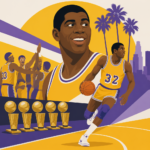

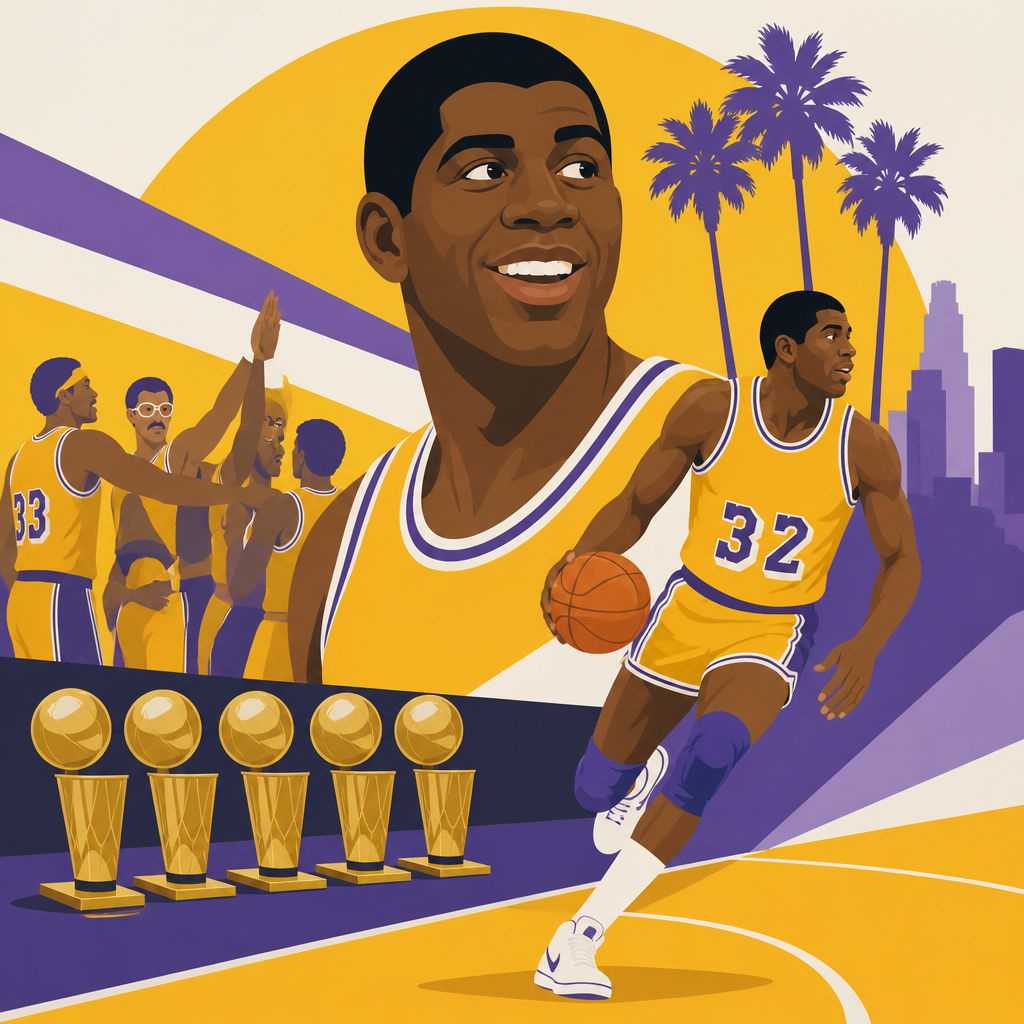
Magic Johnson changed what basketball fans expected from a point guard, from a franchise leader, and from the NBA itself. His career sits at the center of the league’s “Legends and Eras” conversation because it connects multiple defining themes at once: the rise of modern superstar marketing, the rebirth of the Los Angeles Lakers, the fierce Lakers-Celtics rivalry, and the transformation of playmaking into a full-court art form. Standing 6-foot-9, Earvin “Magic” Johnson became widely known as the tallest point guard ever, though later oversized creators would follow his blueprint. What made him singular was not only height, but the way he used it to see over defenses, ignite transition offense, and control pace without sacrificing flair or efficiency.
Any serious NBA History hub on legends has to place Johnson near the center. He won five NBA championships, three MVP awards, three Finals MVPs, and led one of the most entertaining dynasties the sport has produced. Yet his legacy goes beyond trophies. He helped turn nationally televised basketball into appointment viewing, gave the fast break a glamorous identity under the “Showtime” label, and provided a model for positionless offense decades before the term became common. I have worked through game film, box scores, and historical coverage of this era for years, and Johnson consistently stands out because his impact appears in every layer: team success, statistical production, cultural visibility, and strategic innovation.
This hub article covers the major dimensions of Magic Johnson’s career while also mapping the broader “Legends and Eras” landscape around him. To understand Johnson properly, you need to see where he came from, how Showtime worked, why the five titles mattered, how his rivalry with Larry Bird elevated the league, what his statistics really say, and how later generations borrowed from his style. You also need to recognize the limits of nostalgia. Johnson played in a different pace environment, under different defensive rules, and on rosters loaded with elite talent. Context does not diminish him; it sharpens the evaluation.
From Lansing to Los Angeles: how Magic Johnson became a franchise-changing star
Before he was the face of Showtime, Johnson was a basketball prodigy in Lansing, Michigan, where his size and ballhandling already made him unusual. At Everett High School, he drew attention for dazzling passing and all-around command, and at Michigan State he became a national star. The defining early moment came in the 1979 NCAA championship game, when Michigan State defeated Indiana State in the matchup that introduced a national audience to Johnson versus Larry Bird. That game remains one of the most important bridges between college popularity and the NBA’s coming boom.
The Lakers selected Johnson first overall in the 1979 NBA draft. He joined a team that already had Kareem Abdul-Jabbar, then the league’s most established superstar, but Johnson altered its identity almost immediately. As a rookie, he averaged 18.0 points, 7.7 rebounds, and 7.3 assists per game, numbers that reflected versatility rather than role limitation. His most famous early performance came in Game 6 of the 1980 NBA Finals, when Abdul-Jabbar was out with an ankle injury. Johnson started at center, effectively played every position, and produced 42 points, 15 rebounds, and 7 assists to clinch the title over Philadelphia. The moment became foundational mythology, but it also represented something concrete: he could bend structure without breaking winning basketball.
That rookie championship mattered because it accelerated the Lakers’ transition from strong contender to era-defining team. Johnson did not simply fit beside stars; he amplified them. Wing runners got easier baskets, big men received passes on time and on target, and the team’s tempo became a weapon. In historical terms, that is one reason his career belongs at the center of an NBA History hub. Great legends do more than compile honors. They shift the operating system of their teams and influence the league’s preferred style.
What Showtime really was: pace, spacing, and decision-making before modern analytics language
“Showtime” is often reduced to no-look passes and Hollywood glamour, but that shorthand misses the real mechanics. In basketball terms, Showtime was an elite transition system built on defensive rebounding, outlet precision, lane discipline, and rapid processing. Johnson pushed the ball relentlessly after misses, forcing defenses into impossible choices. If a big retreated too deep, he attacked the middle and delivered a lob or dump-off. If a wing pinched in, he hit the open lane runner. If nothing materialized, the Lakers flowed into half-court actions without looking rushed. The spectacle worked because the reads were correct.
Coach Pat Riley gave the Lakers structure, but Johnson was the engine. His height let him survey the floor over smaller guards, and his right-hand-dominant passing came with enough improvisation to punish late help. One common misconception is that Showtime was undisciplined creativity. In reality, it relied on repeatable habits: rebound, advance, fill lanes wide, run to the rim, and make the defense commit early. Today, coaches would describe many of these principles in terms of early offense, paint touches, and advantage creation. Johnson was executing them at championship level long before those phrases became standard front-office vocabulary.
The Lakers’ personnel made the system lethal. Abdul-Jabbar remained a dependable half-court anchor with the skyhook, James Worthy excelled as a finisher in space, Byron Scott ran lanes effectively, and Michael Cooper added defense and connective play. Johnson linked all of it. During the 1980s, the Lakers regularly ranked among the league leaders in offensive efficiency and pace-adjusted production, even if the era’s public discourse focused more on style than on possession-based metrics. Film and outcomes agree: Showtime was beautiful because it was brutally functional.
Five championships and the seasons that defined Magic Johnson’s peak
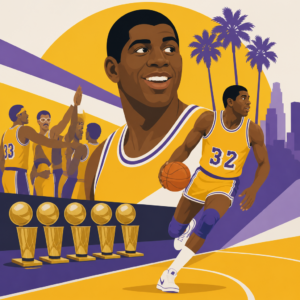
Johnson’s five NBA titles came in 1980, 1982, 1985, 1987, and 1988, and each one added something distinct to his legacy. The 1980 championship announced him. The 1982 title confirmed the Lakers’ staying power after a coaching change and increased expectations. The 1985 championship carried special historical weight because Los Angeles finally defeated Boston in the NBA Finals, something the franchise had failed to do repeatedly in prior decades. That result mattered far beyond a single ring; it changed the emotional balance of one of sports’ greatest rivalries.
The 1987 title is often the strongest case for Johnson at his absolute best. He won league MVP that season while averaging 23.9 points, 12.2 assists, and 6.3 rebounds per game, shooting an excellent percentage from the field and controlling the game’s rhythm with near-total authority. That postseason included the iconic “junior sky hook” in Game 4 of the Finals at Boston Garden, a shot that symbolized poise under maximum pressure. The 1988 title, secured against the Detroit Pistons, demonstrated resilience. Those Finals were physically punishing, and the Pistons were built to challenge every glamorous assumption about Lakers basketball. Johnson and Los Angeles still repeated, a difficult feat in any era.
For quick historical reference, the championship run looks like this:
| Season | Result | Key historical significance |
|---|---|---|
| 1979-80 | Championship | Rookie title; Game 6 Finals clincher without Kareem defined Johnson’s early legend |
| 1981-82 | Championship | Established the Lakers as the decade’s premier Western power |
| 1984-85 | Championship | First Lakers Finals win over the Celtics, a turning point in franchise history |
| 1986-87 | Championship | Johnson’s MVP peak; “junior sky hook” became an iconic Finals moment |
| 1987-88 | Championship | Back-to-back title confirmed endurance against the rising Bad Boy Pistons |
Championship counting alone can flatten history, so the better question is how Johnson drove winning. He was the offense’s organizer, transition accelerator, emotional thermostat, and late-game decision-maker. On teams with multiple Hall of Famers, that centrality matters. Plenty of great players have elite teammates; fewer are the obvious system-defining force on title teams. Johnson was.
The Lakers-Celtics rivalry and why Magic versus Bird saved the NBA’s national profile
When historians explain the NBA’s rise in the 1980s, Johnson and Bird are inseparable. The league already had extraordinary talent, including Abdul-Jabbar, Julius Erving, Moses Malone, and later Michael Jordan, but Johnson and Bird gave it a sustained storyline that networks, newspapers, and casual fans could follow. Their rivalry had geographic contrast, stylistic contrast, racial subtext in media framing, and above all competitive credibility. They met in the 1979 NCAA final, then repeatedly shaped the NBA’s biggest stages.
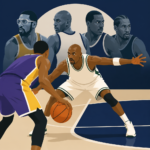
The Lakers and Celtics met in the NBA Finals in 1984, 1985, and 1987. Boston won the first meeting, while Los Angeles took the next two. Those series were not simply entertainment products; they were strategic contests between different basketball identities. Boston leaned into execution, physicality, and half-court precision behind Bird, Kevin McHale, Robert Parish, and Dennis Johnson. Los Angeles preferred pace, pressure in transition, and Johnson’s orchestration. The contrast made each Finals feel like a referendum on how championship basketball should look.
From a league-business perspective, the effect was enormous. Television interest increased, marquee games became cultural events, and star branding matured. Johnson’s charisma was central to that expansion. He smiled, talked, competed, and embraced visibility in a way that made the NBA more marketable without diluting the seriousness of the sport. Bird’s colder intensity gave the rivalry balance. Together they helped turn the league from a product with uneven national traction into a major entertainment and sports property. Any broad “Legends and Eras” hub should treat this rivalry as a foundational chapter, not a side note.
The tallest point guard ever? Evaluating Magic Johnson’s position, skills, and statistical profile
The phrase “tallest point guard ever” is useful but requires precision. Johnson is the most famous oversized primary ballhandler in NBA history, listed at 6-foot-9 and playing the point by function rather than by traditional body type. Later players such as Ben Simmons, Luka Doncic, and LeBron James have handled similar creation burdens in larger frames, but Johnson normalized the concept at championship scale. He proved that a lead guard could dominate without relying on jitterbug dribbling or high-volume outside shooting.
His career averages of 19.5 points, 7.2 rebounds, and 11.2 assists per game still read like an all-purpose offensive engine. He led the league in assists four times and retired as the all-time leader in assists per game. The number that best captures his style may be his assist percentage, which remained among the highest ever recorded for a superstar. He created layups, dunks, free throws, and deep post catches for teammates constantly. Unlike some pass-first guards, he also pressured the rim, posted smaller defenders, and drew fouls. By the late 1980s he had developed a reliable set shot from distance, including 38.4 percent from three in his 1989-90 MVP season, a reminder that his game evolved.
There were limitations. Johnson was never an elite isolation defender against the quickest guards, and his free-throw line push shot or runner was more functional than aesthetically pure. He also benefited from elite finishers and one of the decade’s best supporting casts. Those are fair caveats, but they do not undermine the main conclusion. His size expanded the geometry of offense. Rebounding initiated breaks. Post entries came from unusual angles. Cross-court passes that smaller guards could not see or deliver became routine. That combination remains rare even in today’s larger, more flexible lineups.
Legacy, influence, and the place of Magic Johnson in NBA history
Johnson’s career changed course in November 1991 when he announced that he had tested positive for HIV. The shock was enormous, and the announcement transformed public understanding of the virus at a time when misinformation was widespread. He retired immediately, returned memorably for the 1992 All-Star Game, played on the Dream Team at the 1992 Olympics, and later made a brief NBA comeback in 1996. These chapters matter because legacy is not only about peak seasons. Johnson became part of a public health conversation that extended far beyond basketball, handling scrutiny with unusual openness and changing perceptions for millions of people.
Within the game, his influence is visible everywhere. Modern offenses prize grab-and-go rebounds, tall initiators, quick hit-ahead passing, and lineups that blur positions. Johnson did all of that decades earlier. Players as different as Penny Hardaway, Jason Kidd, LeBron James, and Doncic reflect pieces of his template. Front offices now actively seek size at every decision-making spot because larger creators can see over coverage and survive switching. Johnson was the original proof of concept at the highest level.
Where does he rank among the greatest players ever? Reasonable lists vary, but he belongs firmly in the inner circle. The argument rests on peak value, postseason success, offensive control, and historical influence. If this “NBA History” hub is guiding readers through legends and eras, Johnson is one of the clearest entry points because his story touches every major theme: dynasty building, rivalry, innovation, celebrity, adversity, and lasting tactical impact. To understand the 1980s, the Lakers, or the evolution of the point guard, you start with Magic Johnson. From there, explore the connected stories around Bird, Kareem, Riley, the Celtics, and the broader transformation of the league. That network of legends is how NBA history becomes coherent, and Johnson is one of its brightest centers.
Frequently Asked Questions
Why was Magic Johnson considered such a revolutionary point guard?
Magic Johnson was revolutionary because he expanded the definition of what a point guard could be. At 6-foot-9, he had the size of a forward but the vision, ball-handling, and decision-making of an elite floor general. Before Magic, most point guards were expected to be smaller players who initiated the offense, protected the ball, and set up teammates in more traditional ways. Magic changed that expectation by turning the position into a dynamic, full-court force. He pushed tempo relentlessly, threw creative passes others would not even attempt, and made transition offense feel like a form of basketball theater.
What made him truly different was that his size was not just a novelty. It gave him real advantages. He could see over defenses, post up smaller guards, rebound like a frontcourt player, and defend multiple positions when needed. That versatility allowed the Lakers to play faster, bigger, and more unpredictably than most opponents were prepared for. He was not simply a tall player handling the ball; he was an offensive system unto himself.
Magic also reshaped how fans understood playmaking. He was not just collecting assists. He controlled rhythm, generated confidence in teammates, and made everyone around him more dangerous. His passes were not random flashes of flair. They were precise reads delivered at top speed, often before a defender realized the opening existed. That blend of imagination and control is a major reason he remains one of the most influential players in NBA history and why the phrase “tallest point guard ever” still carries such meaning in discussions about positionless basketball.
What was “Showtime,” and how did Magic Johnson make it work?
“Showtime” was the identity of the Los Angeles Lakers during the 1980s, a fast, glamorous, highly entertaining style built on pace, movement, confidence, and devastating transition offense. It was basketball played with speed and flair, but it was also highly disciplined beneath the surface. The Lakers did not just run for the sake of running. They attacked before the defense could get organized, turned rebounds into instant scoring opportunities, and forced opponents into a style they often could not sustain. Magic Johnson was the engine that made all of it possible.
His rebounding, outlet passing, and open-floor decision-making were central to the system. The moment the Lakers gained possession, Magic could ignite the break. He could take the rebound himself or receive the ball and immediately assess every lane, angle, and mismatch. Few players in league history have ever been better at converting chaos into clean offense. His ability to deliver no-look passes, hit streaking wings in stride, or find big men near the rim made the Lakers lethal in transition and captivating to watch.
Just as importantly, Magic’s personality matched the era. He played with joy, confidence, and charisma, which made Showtime bigger than strategy alone. It became a brand for the Lakers and, in many ways, for the NBA’s growth as a national and global entertainment product. Yet the style worked because it was backed by elite execution. With Kareem Abdul-Jabbar, James Worthy, Byron Scott, and other talented teammates, Magic orchestrated an attack that combined star power with structure. Showtime was not just flashy basketball. It was one of the most effective dynastic formulas the league has ever seen, and Magic was its unmistakable centerpiece.
How many championships did Magic Johnson win, and what made those title teams so important?
Magic Johnson won five NBA championships with the Los Angeles Lakers, capturing titles in 1980, 1982, 1985, 1987, and 1988. Those championships mattered for more than just the trophy count. They defined an era, restored the Lakers as a dominant force, and helped transform the NBA into a bigger television and cultural phenomenon. Magic entered the league in 1979 and made an immediate impact, leading Los Angeles to a championship as a rookie. That alone was extraordinary, but the sustained success that followed is what cemented his legacy.
Each championship added to the story in a different way. The 1980 title announced Magic as a star capable of thriving on the biggest stage. The later titles showed that he was not merely a gifted newcomer playing on a talented roster, but the long-term leader of a dynasty. The 1985 championship was especially significant because the Lakers defeated the Boston Celtics in the Finals, a breakthrough that carried historical and emotional weight for the franchise. The 1987 and 1988 titles then reinforced the Lakers’ place as the league’s dominant team, with Magic at the height of his powers as a scorer, passer, and leader.
These title teams were important because they shaped the image of 1980s basketball. They represented excellence, star-driven entertainment, and the power of chemistry built around elite talent. Magic’s Lakers were not just winning championships; they were creating moments, rivalries, and storylines that brought new fans into the sport. Their success also elevated the standard for point guard leadership. Magic was expected to produce highlights, but also to organize teammates, close games, and carry championship expectations year after year. Winning five titles in that environment is one of the clearest indicators of how great he truly was.
How important was the Lakers-Celtics rivalry to Magic Johnson’s career and the NBA’s growth?
The Lakers-Celtics rivalry was absolutely central to Magic Johnson’s career and to the modern rise of the NBA. It provided the league with a dramatic, easy-to-understand storyline built around two iconic franchises, contrasting styles, and two generational leaders in Magic Johnson and Larry Bird. Their competition began before the NBA, most notably in the 1979 NCAA championship game, and then expanded onto the professional stage in a way that gave the league a recurring centerpiece. When the Lakers and Celtics met, it felt larger than a normal Finals matchup. It felt like a clash of basketball cultures, coastlines, personalities, and philosophies.
For Magic personally, the rivalry sharpened his legacy. Great players are often remembered not only for what they won, but for whom they had to overcome. Boston was the benchmark, and the Celtics’ physicality, discipline, and championship pedigree forced Magic and the Lakers to reach an even higher level. The 1984 Finals loss was painful and defining, while the 1985 Finals victory over Boston was historic because it gave the Lakers a long-sought breakthrough against their biggest rival on the sport’s largest stage. Those battles made Magic’s championships feel more meaningful and his leadership more tested.
For the NBA, the rivalry was transformative. It boosted television ratings, increased national attention, and helped frame the league around star power and recurring narratives that casual fans could follow. Magic’s charisma and style in Los Angeles contrasted perfectly with Bird’s toughness and precision in Boston, and that tension helped turn the NBA into a must-watch product. The rivalry did not grow the league by itself, but it gave the NBA an emotional core at a pivotal moment. Magic’s place within that story is one reason his career remains so important to any discussion of the game’s most influential eras.
What is Magic Johnson’s lasting legacy in basketball history?
Magic Johnson’s lasting legacy is that he changed the way basketball could be played, marketed, and understood. On the court, he proved that positions could be more fluid than traditional thinking allowed. A player his height was not supposed to be the primary ball-handler, tempo setter, and creative hub of an offense, yet he turned those responsibilities into his greatest strengths. In many ways, he anticipated the modern game, where versatility, size, and playmaking across positions are prized more than ever. His career helped open the door for future oversized creators who would be judged not by old positional limits but by what they could actually do.
His legacy also includes winning at the highest level. Five championships, three MVP awards, and a long run as the face of one of the sport’s signature dynasties place him securely among the greatest players ever. But statistics and trophies only tell part of the story. Magic made basketball feel expansive. He gave the game pace, imagination, joy, and visibility. He could dominate without scoring 40 points because his impact touched every possession. He elevated teammates, energized crowds, and made the sport more inviting to a broader audience.
Beyond his playing style, Magic’s career sits at the intersection of major NBA themes: the emergence of the superstar as a cultural force, the rebirth of a flagship franchise, the power of historic rivalries, and the transformation of entertainment value into league-wide momentum. That is why he remains so central to “Legends and Eras” conversations. He was not just one great player among many. He was a defining figure in the NBA’s evolution. When people remember Magic Johnson, they remember the smile, the speed, the passes, the championships, and the sense that basketball became bigger when he was at the center of it.