
NBA team names are more than branding. They capture geography, economics, civic identity, and the shifting business of professional basketball. In league history, franchise rebrands often happened when ownership changed, teams relocated, markets expanded, or a nickname no longer fit the city. When fans search for NBA teams that changed their names, they usually want a clean record of who changed, when it happened, and why the new identity stuck.
That wider history matters because the NBA has never been static. Since the league’s early decades, franchises have folded, moved, merged, and reinvented themselves to match new arenas, new regions, and new audiences. A team name can preserve local heritage, like the New York Knicks, or become a mismatch after relocation, like the Lakers keeping a Minnesota-born nickname in Los Angeles. Other clubs made sharper pivots, dropping one identity completely for another.
I have worked through old media guides, relocation timelines, and franchise records enough times to know that naming history gets confused fast. Fans mix up relocations with expansion teams, or assume every move produced a new name. That is not true. Some franchises moved and kept the same identity. Others stayed put and rebranded. This hub explains the full picture of league history by focusing on every NBA franchise identity change from the Rockets era forward, while also showing how those changes fit the NBA’s broader development.
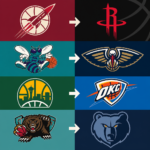
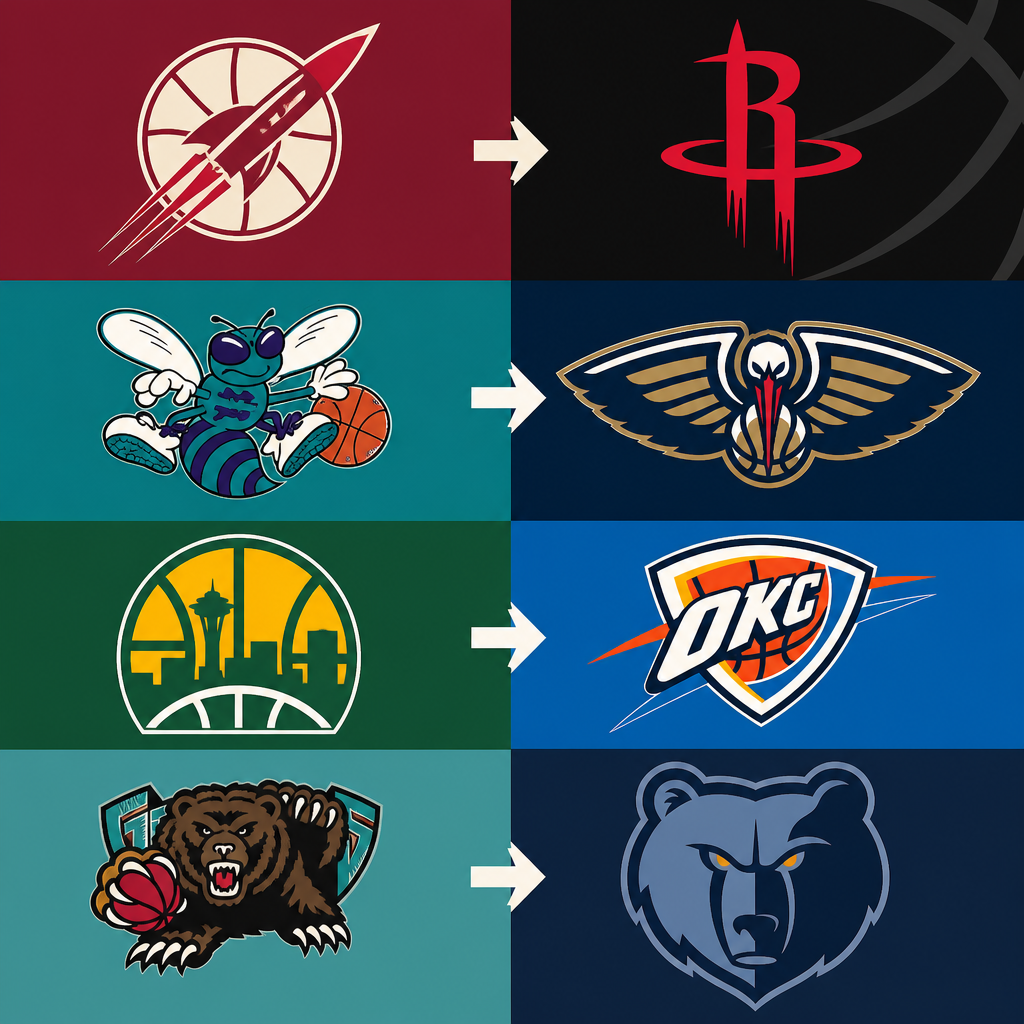
In practical terms, a rebrand means the franchise adopted a different primary name, not just a new logo, color palette, or uniform set. The Seattle SuperSonics becoming the Oklahoma City Thunder counts. The Denver Rockets becoming the Denver Nuggets counts. The Toronto Raptors changing jerseys does not. Understanding that distinction helps when tracing official records, retired numbers, and franchise continuity across decades.
How NBA name changes happen in league history
NBA name changes usually come from four causes: relocation, legal conflict, local relevance, or ownership strategy. Relocation is the clearest. When a franchise leaves one city for another, management must decide whether the old nickname still fits. Sometimes it does. The Jazz stayed the Jazz after leaving New Orleans, even though the cultural connection weakened. Sometimes it does not, as when Charlotte’s original Hornets moved to New Orleans and later became the Pelicans to reflect Louisiana’s state symbol.
Legal and commercial pressures also matter. The Washington Bullets became the Wizards partly because owner Abe Pollin wanted to move away from violent associations during a period of high crime in the nation’s capital. In other cases, preexisting sports teams create trademark or market complications. New owners often use a rebrand to reset the business, especially after poor attendance, arena disputes, or years of losing.
League history shows another pattern: timing matters. Rebrands tend to align with larger structural moments such as the ABA-NBA merger, expansion waves, or civic redevelopment around new arenas. A name change is rarely cosmetic on its own. It usually arrives with new uniforms, new broadcast packaging, revised community outreach, and a sales push around tickets and merchandise. In other words, a franchise renames itself when it wants fans and sponsors to treat the team as meaningfully new.
Every major NBA franchise rebrand from the Rockets to the Pelicans
The modern run of notable name changes begins with the Rockets lineage only indirectly, because Houston kept the Rockets name after moving from San Diego in 1971. That fact is useful: not every relocation created a rebrand. Still, the Rockets period marks the league’s more mobile era, when several franchises reconsidered whether their inherited identities still worked in new markets.
| Franchise timeline | Name change | Effective year | Main reason |
|---|---|---|---|
| Denver Rockets to Denver Nuggets | Rockets → Nuggets | 1974 | Avoid overlap with Houston and revive local mining history |
| Buffalo Braves to San Diego Clippers | Braves → Clippers | 1978 | Relocation and coastal identity fit |
| Kansas City-Omaha Kings to Sacramento Kings | No nickname change | 1985 | Relocation without rebrand |
| Capital Bullets to Washington Bullets | Capital → Washington | 1974 | Regional simplification |
| Washington Bullets to Washington Wizards | Bullets → Wizards | 1997 | Image reset and social concerns |
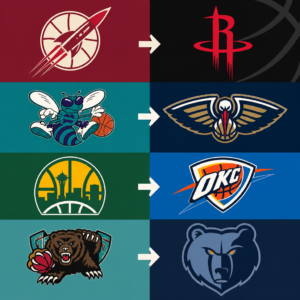
| Seattle SuperSonics to Oklahoma City Thunder | SuperSonics → Thunder | 2008 | Relocation and fresh regional identity |
| New Jersey Nets to Brooklyn Nets | New Jersey → Brooklyn | 2012 | Borough-based branding after relocation |
| New Orleans Hornets to New Orleans Pelicans | Hornets → Pelicans | 2013 | State-symbol identity and local differentiation |
| Charlotte Bobcats to Charlotte Hornets | Bobcats → Hornets | 2014 | Restoration of historic local brand |
The Denver Nuggets are an instructive first case. The franchise played as the Denver Rockets in the ABA, but changed to Nuggets in 1974 before entering the NBA through the 1976 merger. The reason was practical and historical. Houston already had the Rockets, and duplicate names in the merged landscape would have been clumsy. “Nuggets” also revived an earlier Denver basketball name and connected neatly to Colorado’s mining legacy. This was a smart rebrand before the term became standard sports business language.
The Buffalo Braves becoming the San Diego Clippers in 1978 is another classic example. Owner Irv Levin wanted to move the franchise to Southern California, and “Clippers” referenced the swift sailing ships associated with San Diego’s maritime image. The old Braves identity belonged to Buffalo; the new market needed a new story. When the club later moved to Los Angeles in 1984, it kept Clippers, proving that some rebrands are designed to survive future moves.
Washington’s franchise made two identity shifts. It started as the Chicago Packers, then Chicago Zephyrs, moved to Baltimore as the Bullets, became the Capital Bullets in 1973, and then the Washington Bullets in 1974. The most consequential change came in 1997, when the team became the Washington Wizards. Pollin publicly argued that “Bullets” was no longer appropriate in Washington. Fans debated the decision heavily, but it remains one of the clearest examples of a franchise changing its name for social and political context rather than relocation.
The Seattle SuperSonics becoming the Oklahoma City Thunder in 2008 is among the most significant rebrands in NBA history. “SuperSonics” tied directly to Seattle’s aerospace industry and the Boeing-driven civic identity of the 1960s. Oklahoma City needed a different concept. “Thunder” leaned into regional weather imagery and broad marketability. The break was controversial because Seattle lost not just a team but one of the league’s most distinctive names, colors, and symbols.
The New Jersey Nets rebranding as the Brooklyn Nets in 2012 was less dramatic in nickname terms but highly important as a league history moment. By retaining “Nets,” the franchise kept continuity from its ABA origins while attaching itself to Brooklyn’s long basketball tradition. The black-and-white visual system, the move to Barclays Center, and Jay-Z’s involvement gave the rebrand unusual cultural reach. It showed how a relocation can modernize a club without discarding its core nickname.
New Orleans changed from the Hornets to the Pelicans in 2013, and that move solved several problems at once. “Hornets” came from Charlotte’s Revolutionary War history and never felt fully rooted in Louisiana. “Pelicans” referenced the brown pelican, the state bird, and gave the franchise a distinctly local identity. The change also opened the door for Charlotte to reclaim Hornets, which it did when the Bobcats became the Hornets in 2014. Few NBA rebrands have restored historical order so cleanly.
Older changes that shaped the league before the modern era
To cover league history comprehensively, this hub also needs the earlier, messier years. The NBA and its predecessor environment included franchises that changed names repeatedly while trying to find stable markets. The most famous early example is the Philadelphia Warriors becoming the San Francisco Warriors in 1962 and later the Golden State Warriors in 1971. That final shift was more than geographic. It signaled an ambition to represent the broader Bay Area and California audience rather than one city alone. Today it is one of the strongest brands in sports.
The Kings franchise also had a winding path: Rochester Royals, Cincinnati Royals, Kansas City-Omaha Kings, Kansas City Kings, and finally Sacramento Kings. The key naming change was Royals to Kings in 1972, largely because the team moved into a market with the Kansas City Royals in Major League Baseball. Avoiding confusion was essential. This is a textbook case of market competition shaping basketball identity.
The Wizards franchise, as noted, may be the most renamed in league history. Chicago Packers lasted one year, Zephyrs one year, then the move to Baltimore produced the Bullets identity that endured longest. Researchers often separate city moves from nickname shifts, but in historical analysis the sequence matters because it shows how unstable some early franchises were before television revenue and modern arenas created permanence.
Another important example is the Tri-Cities Blackhawks becoming the Milwaukee Hawks, then St. Louis Hawks, then Atlanta Hawks. The nickname survived multiple relocations, so this lineage demonstrates the opposite principle: a name can become portable if it is broad enough. By contrast, “SuperSonics” was so place-specific that portability was unrealistic. League history is full of these contrasts, and they explain why some brands survive moves while others are retired immediately.
Why some names survive relocation while others disappear
From experience studying franchise branding, three tests usually decide whether a team keeps its name after moving. First is geographic specificity. “Lakers” references Minnesota’s lakes, but by the time the club was established in Los Angeles, the brand had already accumulated championship value under George Mikan and later under Jerry West, Magic Johnson, Kobe Bryant, and LeBron James. Winning can overpower literal mismatch. “Jazz” followed a similar path in Utah.
Second is trademark strength. If merchandise sales, historical footage, and national recognition are tied tightly to a nickname, owners are reluctant to start over. Third is local credibility. If a name feels alien or borrowed, the new market may never embrace it fully. That is what happened with New Orleans Hornets. The Pelicans identity had clearer local logic, and that matters for youth programs, civic partnerships, and long-term fan attachment.
There is also a league governance angle. The NBA must approve relocations and often coordinates timing, intellectual property, and archival treatment. Charlotte’s recovery of the Hornets name illustrates this. The league later recognized the current Hornets as inheriting the history and records of the original Charlotte Hornets for the years before the New Orleans relocation. That administrative choice helped align the historical record with fan intuition.
What these rebrands reveal about NBA history as a whole
Name changes are a shortcut to the league’s larger evolution. In the early decades, teams chased viable markets. In the cable era, they chased regional scale. In the modern era, they chase globally legible brands that still feel locally authentic. Every rebrand sits at the intersection of those pressures. Denver Nuggets tied past and place together. Washington Wizards reflected civic sensitivity. Oklahoma City Thunder represented relocation-era reset economics. Brooklyn Nets showed the power of urban lifestyle positioning. New Orleans Pelicans and Charlotte Hornets demonstrated how historical continuity can be repaired.
For anyone building deeper knowledge of NBA history, team names are not trivia. They connect to expansion policy, arena finance, ownership politics, media strategy, and fan culture. If you understand why a franchise changed its name, you usually understand what problem the organization was trying to solve. That makes this topic an effective hub for broader league history research.
The clearest takeaway is simple: NBA rebrands happen when business reality and civic identity stop matching. Some changes improve local connection immediately, as with the Pelicans. Some remain debated decades later, as with the Wizards and the loss of the SuperSonics. All of them tell you something concrete about the era in which they happened.
Use this hub as your starting point for league history. Follow each franchise timeline, compare relocations with true rebrands, and you will see the NBA not as a fixed set of logos, but as a living map of American sports culture still changing today.
Frequently Asked Questions
Which NBA teams have changed their names, and what are the most notable examples?
Several NBA franchises have changed their names over the course of league history, usually because of relocation, ownership changes, or a push to better match a city’s identity. Some of the clearest examples include the Rochester Royals becoming the Cincinnati Royals, then the Kansas City-Omaha Kings, then the Kansas City Kings, and finally the Sacramento Kings. The Tri-Cities Blackhawks became the Milwaukee Hawks, then the St. Louis Hawks, and eventually the Atlanta Hawks. The New Orleans Jazz moved to Utah but kept the Jazz name, creating one of the league’s most famous branding mismatches. The New Orleans Hornets later rebranded as the New Orleans Pelicans, while the Charlotte Bobcats reclaimed the Hornets identity after New Orleans gave it up. The Washington Wizards were previously the Washington Bullets, and the Golden State Warriors began as the Philadelphia Warriors before becoming the San Francisco Warriors and then adopting the broader Golden State identity. The Houston Rockets also fit this conversation because they started as the San Diego Rockets before relocating to Houston, where the name suddenly made even more sense because of the city’s connection to NASA and the space industry.
What makes these cases especially notable is that NBA name changes are rarely just cosmetic. They usually reflect something bigger about the franchise and the market around it. A new city can make an old nickname feel disconnected, as happened with the Jazz in Utah, or make an existing one feel newly perfect, as happened with the Rockets in Houston. In other cases, the rebrand is about moving away from imagery that no longer fits public values or local culture, which was a major factor when the Bullets became the Wizards. Taken together, these examples show that NBA team names often evolve alongside business realities, civic identity, and fan expectations.
Why do NBA teams change their names in the first place?
NBA teams usually change their names for four main reasons: relocation, market repositioning, ownership strategy, and civic or cultural relevance. Relocation is the most common trigger. When a franchise moves, the old name may not fit the new city at all, or the team may decide to keep it if the brand already has national recognition. That is why some names survive a move, like the Lakers and Jazz, while others are replaced to better match the new home. A team’s name is also a business asset, so owners often use a rebrand to mark a new era, sell merchandise, reset public perception, or connect more directly with local history and symbols.
Cultural and political considerations matter too. The Bullets becoming the Wizards is one of the best examples because the change was tied to concern over the violent connotations of the old nickname. In other cases, a city may want a stronger local connection than the existing identity provides. The Pelicans name gave New Orleans a symbol rooted in Louisiana itself, while Charlotte’s return to Hornets restored a brand many fans felt represented the city more authentically than Bobcats ever did. In short, NBA name changes happen when the league’s business goals and a city’s sense of self no longer line up with the old identity.
How did the Rockets and Pelicans become two of the best examples of NBA rebranding history?
The Rockets and Pelicans are often discussed together because they show two very different but equally revealing kinds of NBA rebrand. The Rockets began as the San Diego Rockets in 1967. When the franchise moved to Houston in 1971, it kept the Rockets name. That decision turned out to be a branding win because Houston’s close ties to NASA, Mission Control, and the American space program made “Rockets” feel more natural there than it had in California. It is a great example of a nickname becoming stronger after relocation, even though the franchise did not technically invent a new name in the process.
The Pelicans story is different because it involved a full identity reset. The franchise had been the New Orleans Hornets after relocating from Charlotte, but the Hornets name still carried strong emotional ties to North Carolina. In 2013, New Orleans adopted the Pelicans name, drawing from Louisiana’s state bird and giving the team a more regionally authentic identity. That move also opened the door for Charlotte to reclaim the Hornets name, which it did after the Bobcats era. As a result, the Pelicans rebrand is one of the most important in modern NBA history because it resolved a branding mismatch for two cities at once. The Rockets show how a move can make an existing name stronger, while the Pelicans show how a thoughtful new identity can better align a franchise with local culture and restore historical continuity elsewhere.
What is the difference between a team relocation and a true name change in NBA history?
A relocation happens when a franchise moves from one city to another, while a true name change happens when the nickname or core identity changes. Sometimes these happen together, and sometimes they do not. For example, the San Diego Rockets becoming the Houston Rockets was a relocation without a nickname change. The same basic brand survived, but the city changed. The New Orleans Hornets becoming the New Orleans Pelicans was a true name change without leaving the market. Then there are cases like the Seattle SuperSonics becoming the Oklahoma City Thunder, where relocation and rebranding happened at the same time.
This distinction matters because fans searching for “NBA teams that changed their names” often want a clean historical record, but the history is not always simple. Some franchises changed cities multiple times before settling into a final identity, like the Kings and Hawks. Others kept names that no longer fit geographically, like the Lakers and Jazz. From a historical and SEO perspective, it helps to separate three categories: teams that relocated but kept their names, teams that stayed put but rebranded, and teams that did both. That framework makes NBA franchise history much easier to understand and explains why conversations about rebrands often overlap with conversations about moves.
Which NBA name changes had the biggest impact on fans, branding, and league history?
The most impactful NBA name changes are usually the ones that reshaped how fans saw a franchise or how a city connected to it. The Washington Bullets becoming the Wizards was hugely significant because it remains one of the league’s most discussed image-driven rebrands. The New Orleans Hornets becoming the Pelicans, followed by Charlotte reclaiming the Hornets name, had an unusually deep effect because it restored a beloved identity to one market while giving another a name more rooted in local heritage. The Seattle SuperSonics becoming the Oklahoma City Thunder also had a major impact, though in that case the emotional reaction was tied as much to the loss of the Seattle franchise identity as to the new name itself.
Historically, some of the biggest changes were less controversial and more evolutionary. The Warriors’ shift from Philadelphia to San Francisco and then to Golden State expanded the franchise from a city-specific brand into a statewide one. The Kings and Hawks also demonstrate how repeated moves can produce layered identities that connect different eras and regions. Ultimately, the biggest NBA rebrands are the ones that do more than alter logos and uniforms. They change the story a franchise tells about where it belongs, who it represents, and why the name still matters to fans decades later.