
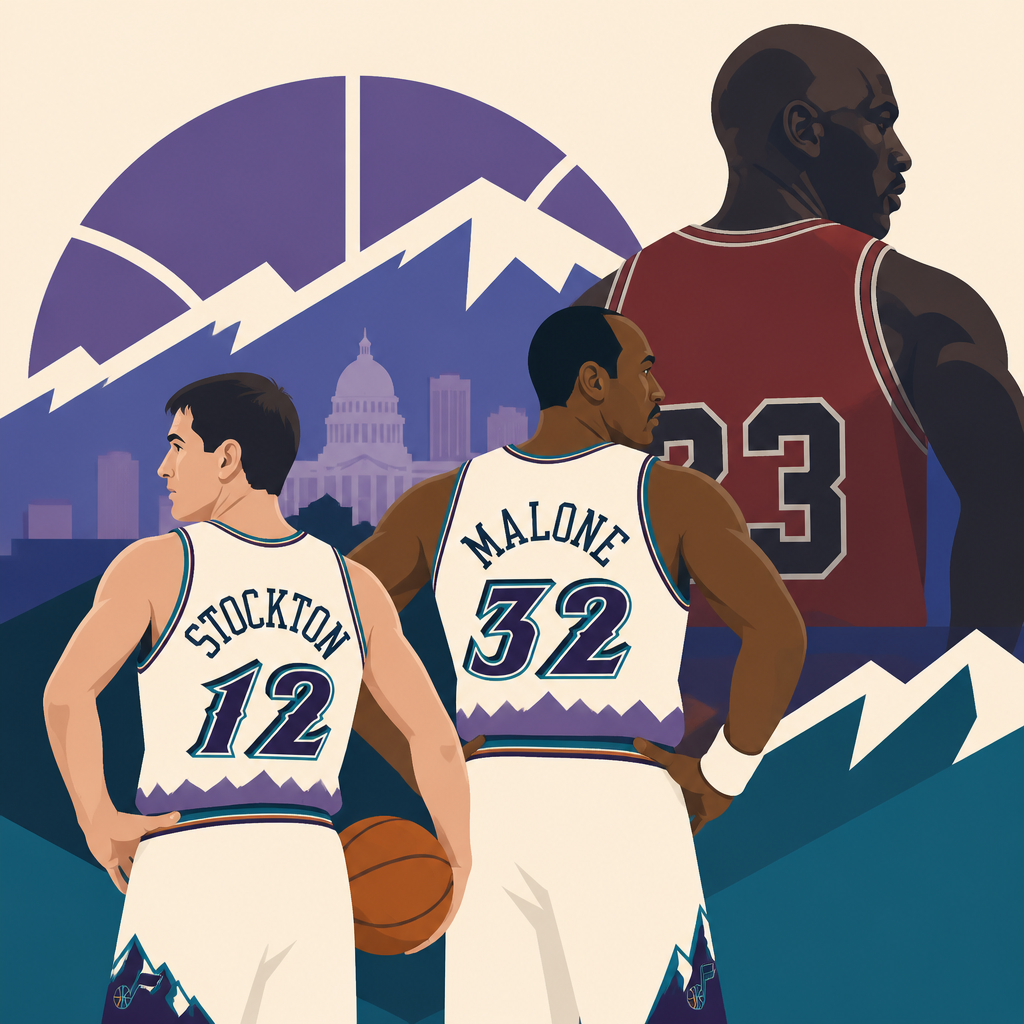
The Utah Jazz history is one of the NBA’s clearest examples of sustained excellence without a championship, built on continuity, discipline, and two Hall of Fame careers that shaped an era. When people search for Utah Jazz history, they usually want three things explained plainly: how the franchise began, why John Stockton and Karl Malone mattered so much, and what really happened in the Finals runs against Michael Jordan’s Chicago Bulls. Those questions are central, but the full story is broader. The Jazz became a model small-market franchise by drafting well, committing to a defined system, and maintaining long-term leadership through ownership, coaching, and player development.
The franchise started in New Orleans in 1974 before moving to Salt Lake City in 1979, keeping the “Jazz” name despite the obvious mismatch with Utah’s cultural identity. That unusual origin matters because it frames the team’s early instability. The New Orleans years were marked by financial strain, uneven attendance, and roster turnover. The move to Utah gave the club a more stable home, but it did not immediately create a winner. Like many relocated teams, the Jazz needed years to establish an identity, earn fan trust, and build a basketball infrastructure that could compete with larger markets.
In practical basketball terms, the defining phase of Utah Jazz history began when the franchise paired elite decision-making with patience. Drafting John Stockton in 1984 and Karl Malone in 1985 gave the organization two foundational players whose skills fit each other perfectly. Stockton was an elite point guard, known for pace control, passing precision, half-court orchestration, and defensive positioning. Malone was a dominant power forward, combining strength, mid-range touch, transition finishing, and durability at a historic level. Together, they made the pick-and-roll one of the league’s most feared actions and turned consistency into a competitive advantage.
This history matters because the Jazz proved that a team outside Los Angeles, New York, or Chicago could become a perennial contender through structure rather than glamour. Their rise also explains a larger NBA truth: championship windows are not only about talent, but also timing. Utah’s best teams reached peak form in the 1990s, exactly when Jordan’s Bulls controlled the league. That overlap turned the Jazz into a measuring stick. They were not merely good enough to win the West; they were good enough to force one of basketball’s greatest dynasties to execute at its highest level. For anyone exploring NBA team histories, Utah is essential because it shows how greatness can be undeniable even when the final trophy remains out of reach.
From New Orleans to Salt Lake City: How the Franchise Took Shape
The Jazz entered the NBA as an expansion team in 1974. In New Orleans, the club struggled with arena issues, ownership problems, and the basic challenges that expansion franchises usually face: shallow depth, limited continuity, and a weak defensive identity. Pete Maravich gave the early Jazz star power, but his brilliance could not overcome the team’s structural weaknesses. By 1979, ownership moved the franchise to Utah. That relocation is one of the most significant turning points in Utah Jazz history because it reset the business side of the organization and created a long-term connection with a market that embraced pro basketball intensely.
In Salt Lake City, the franchise gradually became stable under owner Larry H. Miller, whose influence on the team and local sports culture was enormous. Miller treated the Jazz less as a vanity asset and more as a civic institution. The team improved its arena experience, organizational discipline, and long-range planning. Frank Layden, first as coach and later as an executive, helped guide that transition. He brought personality and credibility, but more importantly, he helped establish a talent-evaluation pipeline that would matter when the draft became Utah’s lifeline. Small-market teams rarely survive on free agency; they survive by finding value before everyone else sees it clearly.
The selection of Stockton and Malone did exactly that. Stockton was taken 16th overall from Gonzaga in 1984, a pick many casual observers underestimated. Malone arrived a year later as the 13th overall pick from Louisiana Tech. Neither entered the league with the hype of a first-overall selection, yet together they became arguably the best draft-to-development success story in league history. Their rise also reflected a key organizational trait: Utah identified players whose intelligence, toughness, and availability would age well. In a league where injuries and ego often disrupt contenders, the Jazz built around reliability.
Stockton and Malone: Why Their Partnership Worked
I have always thought the easiest way to understand the Stockton-Malone era is to start with geometry. Utah’s offense created angles, timing windows, and repeated decisions for defenders. Stockton manipulated defenders with footwork, hesitations, and exact passing delivery. Malone set crushing screens, rolled hard, popped into space, ran the floor, and punished switches on the block. Because both players mastered details, the same action could produce multiple outcomes: a layup, a foul, a kick-out, or a mid-range jumper. Defenses knew what was coming and still struggled to stop it, which is usually the clearest sign of elite execution rather than gimmickry.
Stockton remains the NBA’s all-time leader in assists and steals, records that are not just impressive but monumental. His assist total of 15,806 and steals total of 3,265 reflect both longevity and decision-making quality. Malone ranks among the greatest scorers in league history, finishing his career with 36,928 points. He won MVP awards in 1997 and 1999, evidence that his impact was recognized beyond Utah’s system. It is important to note that this was not a case of one player being carried by another. Stockton elevated everyone through control and accuracy, while Malone gave the offense force, volume scoring, and physical pressure every night.
Jerry Sloan, who became head coach in 1988, transformed their talents into a culture. Sloan’s teams valued defensive accountability, low-turnover offense, conditioning, and role clarity. That matters in any team history because stars alone do not create annual 50-win seasons. Utah routinely received meaningful contributions from players such as Jeff Hornacek, Bryon Russell, Antoine Carr, Greg Ostertag, and later Shandon Anderson and Howard Eisley. They understood spacing, screening angles, weak-side reads, and transition responsibilities. Sloan demanded that everyone play correctly, and because Stockton and Malone embodied those standards, the message carried unusual authority.
| Figure | Primary role | Why it mattered in Utah Jazz history |
|---|---|---|
| John Stockton | Point guard and offensive organizer | Set NBA records for assists and steals; controlled tempo and maximized every possession |
| Karl Malone | Power forward and lead scorer | Provided elite scoring, rebounding, durability, and physical pressure in half-court and transition play |
| Jerry Sloan | Head coach | Built a disciplined identity based on execution, defense, and role definition over decades |
| Larry H. Miller | Owner | Stabilized the franchise and reinforced long-term competitiveness in a small market |
The Road to Contention in the Western Conference
Before the Finals appearances, the Jazz spent years proving they could survive deep playoff competition in the West. They were not a one-season surprise. From the late 1980s through the 1990s, Utah regularly won 50 or more games, qualified for the postseason, and advanced against high-level opponents. The Western Conference during this period was physically demanding and tactically varied. The Jazz had to navigate teams built around Magic Johnson’s Lakers in the late 1980s, Clyde Drexler’s Trail Blazers, Hakeem Olajuwon’s Rockets, Charles Barkley’s Suns, and later the Spurs and Sonics. Their consistency gains meaning only when placed against that level of opposition.
The 1996-97 season finally delivered Utah’s first NBA Finals berth. The team went 64-18, then beat the Clippers, Lakers, and Rockets in the playoffs. The Western Conference Finals against Houston were especially symbolic because the Rockets were defending conference powers with Olajuwon and Charles Barkley. Stockton’s series-winning three-pointer in Game 6 remains one of the most important shots in franchise history. It sent Utah to the Finals and validated years of near-misses. The following season, the Jazz were even better in the regular season at 62-20 and returned to the Finals after defeating Houston, San Antonio, and the Lakers.
What separated those Utah teams from earlier versions was not just experience. They had offensive balance around the stars, cleaner late-game execution, and a deeper understanding of how to win ugly. Hornacek added shooting and secondary playmaking. Russell handled difficult wing assignments. Ostertag gave them size in the middle. The team also embraced pace control, which mattered in playoff basketball, where possessions shrink and mistakes are magnified. Utah rarely beat itself. Against most opponents, that was enough.
The 1997 NBA Finals: Utah Meets Jordan’s Bulls
The 1997 NBA Finals placed the Jazz against a 69-win Chicago Bulls team led by Michael Jordan and Scottie Pippen. On paper, Chicago had more top-end wing talent and superior defensive versatility. Utah, however, had the best interior scoring threat in Malone and the best pure table-setter in Stockton. The series was competitive because the styles contrasted sharply. Chicago thrived on ball pressure, transition creation, and Jordan’s late-game shotmaking. Utah relied on half-court precision, interior force, and minimizing errors.
Chicago won the series in six games, but the margin was thinner than casual memory suggests. Game 1 ended with Jordan’s buzzer-beating jumper after Malone missed a crucial late free throw sequence. Utah responded by winning Game 4 in Chicago, showing that the Bulls could be solved when the Jazz dictated tempo and forced Chicago into tougher half-court possessions. Game 5 became legendary because of Jordan’s 38-point performance while ill, often called the “Flu Game,” though later reporting complicated the original framing. Even so, what mattered competitively was that Utah had positioned itself to pressure the Bulls deep into the series.
The biggest lesson from 1997 was that championship basketball often turns on possession-level details. Chicago’s perimeter defense slightly disrupted Stockton’s rhythm. Dennis Rodman’s rebounding reduced Utah’s second-chance opportunities. Jordan created a margin in the final minutes that no scheme could fully erase. The Jazz were not exposed as frauds; they were beaten by a historically superior closer on a historically elite team. That distinction is important when evaluating legacy.
The 1998 NBA Finals: The Last Shot and the Lasting Image
The 1998 rematch gave Utah another real opportunity to win a title. The Bulls were older, less explosive, and dealing with the internal instability documented throughout “The Last Dance” era. Utah held home-court advantage and had reason to believe the matchup could swing. The series again went six games, and again small moments decided everything. Utah won Game 3 decisively and took Game 5 in Chicago behind a composed team performance, putting genuine pressure on the Bulls as the series returned to Salt Lake City.
Game 6 remains one of the defining endings in NBA history. With under a minute left, Utah led 86-83. Jordan drove for a quick score, cutting the lead to one. On the next possession, he stripped Malone in the post, then brought the ball up and hit the famous pull-up over Bryon Russell for an 87-86 lead with 5.2 seconds remaining. Stockton’s last-second three-point attempt missed, ending the series and the Bulls’ second three-peat. For Utah, the pain came from how close the title was. They were not overwhelmed. They were one late stop, one secure catch, or one made final shot from changing league history.
The lasting image of Jordan’s jumper can overshadow how well Utah played in those Finals. The Jazz defended with discipline, executed under pressure, and consistently forced Chicago into contested possessions. They lost to a dynasty at the exact moment that dynasty produced its most iconic closing sequence. In historical terms, that should elevate rather than diminish the Jazz. Very few teams pushed Jordan’s championship Bulls with that level of control and resilience.
Legacy, Modern Relevance, and Why This Team History Still Matters
The Stockton-Malone era ended without a title, but it established the standard every later Jazz team has chased. It also influenced how front offices think about continuity. Utah showed that elite partnership chemistry, institutional patience, and schematic clarity can keep a team relevant for more than a decade. Later Jazz groups, including the Deron Williams-Carlos Boozer teams and the Donovan Mitchell-Rudy Gobert era, inherited expectations formed during the 1990s: win consistently, compete seriously, and build around a recognizable identity.
There are, of course, complexities in assessing this history. Malone’s basketball greatness exists alongside serious off-court issues that should not be ignored when discussing legacy. Stockton’s public profile after retirement also became more controversial than many expected. A credible account of Utah Jazz history should acknowledge both the excellence on the floor and the fact that legacies are rarely neat. That honesty does not erase the team’s achievements; it places them in a fuller human context.
For readers exploring NBA team histories, the main takeaway is straightforward. The Utah Jazz became one of the league’s signature franchises by pairing outstanding drafting with disciplined coaching and long-term organizational stability. Stockton and Malone formed one of basketball’s greatest partnerships. Jerry Sloan built one of the sport’s most reliable systems. And the Finals runs against Jordan’s Bulls remain essential viewing because they capture how narrow the distance can be between all-time greatness and a championship parade. If you are building out your understanding of NBA teams, start with Utah’s model of continuity, then follow that thread into the league’s broader history of contenders, dynasties, and the fine margins that separate them.
Frequently Asked Questions
How did the Utah Jazz franchise begin, and how did it become one of the NBA’s most consistently successful teams?
The Utah Jazz did not begin in Utah at all. The franchise entered the NBA in 1974 as the New Orleans Jazz, a name chosen to reflect the city’s musical identity. Financial problems, arena issues, and uneven early results made those first years unstable, and in 1979 the team relocated to Salt Lake City. The “Jazz” name stayed, even though it fit New Orleans more naturally than Utah, and over time it became one of the most recognizable identities in professional basketball.
The franchise’s rise to relevance was gradual rather than sudden. In the early Utah years, the team worked to establish a fan base and a basketball culture in a smaller market that did not have the glamour or commercial advantages of larger NBA cities. What changed the trajectory of the organization was smart drafting, patience, and long-term continuity. The Jazz selected John Stockton in 1984 and Karl Malone in 1985, two decisions that would define the next two decades of team history. Around them, the organization built a reputation for discipline, player development, and a very clear basketball identity.
Another major turning point came with the arrival of head coach Jerry Sloan, who became the face of stability on the sideline. Sloan emphasized execution, toughness, accountability, and team-first basketball. Under his leadership, the Jazz were rarely flashy in the Hollywood sense, but they were relentlessly efficient and difficult to beat. Year after year, they won regular-season games, made playoff appearances, and forced opponents to deal with one of the league’s most polished half-court offenses.
That sustained success is what makes Utah Jazz history stand out. Many franchises have brief peaks, but the Jazz built a model of competitiveness that lasted for years. They became known as a team that could be trusted to contend, even if they never captured the final prize. In that sense, the franchise’s story is not just about winning titles. It is about how a small-market organization created a lasting standard through consistency, smart leadership, and two all-time great players at the center of everything.
Why were John Stockton and Karl Malone so important to Utah Jazz history and to NBA history overall?
John Stockton and Karl Malone are the defining duo in Utah Jazz history, and their importance goes far beyond franchise records. Together, they formed one of the most productive and durable partnerships the NBA has ever seen. Stockton, a point guard with elite vision, precision, and decision-making, became the league’s all-time leader in assists and steals. Malone, a physically dominant power forward with a polished scoring game and tremendous durability, became one of the highest scorers in NBA history. Their careers were not simply impressive on paper; they embodied a style of basketball built on timing, trust, and repetition.
Their signature action was the pick-and-roll, and few combinations in league history have run it better. Stockton understood angles, pace, and spacing at an almost surgical level. Malone combined strength, footwork, touch, and conditioning to punish defenders in multiple ways. Defenses knew what was coming, but stopping it was another matter. That is a huge part of why the Jazz remained contenders for so long. Their best play was simple enough to repeat endlessly but difficult enough to disrupt, especially when surrounded by role players who understood their assignments.
Stockton and Malone also mattered because they represented continuity in an era that increasingly highlighted star movement and dramatic roster changes. They spent the bulk of their legendary careers together in Utah, developed under the same organizational culture, and played for the same head coach for years. That stability gave the Jazz a clear identity. Fans did not have to guess what the team would be. It would be disciplined, physical, unselfish, and mentally tough.
At the same time, their legacy is nuanced. They are celebrated for consistency, longevity, and historic production, but they are also often discussed in the context of what they did not win: an NBA championship. That absence does not erase their greatness, but it does shape how their era is remembered. In NBA history, Stockton and Malone are often used as examples of how difficult it is to break through even when a team does nearly everything right. Their careers prove that all-time excellence does not always end with a title, especially when it collides with another dynasty at its peak.
What happened in the Utah Jazz’s NBA Finals runs against Michael Jordan and the Chicago Bulls?
The Utah Jazz reached the NBA Finals in back-to-back seasons, 1997 and 1998, and both times they ran into Michael Jordan’s Chicago Bulls, one of the greatest dynasties in sports history. Those Finals are central to the Jazz story because they represent both the franchise’s highest achievement and its most painful what-if. Utah had earned those appearances through years of elite regular-season play, playoff resilience, and a roster built around Stockton, Malone, and Sloan’s system. But in the Finals, they faced a team with unmatched championship experience, defensive versatility, and the closing brilliance of Jordan.
In the 1997 Finals, the Bulls won the series in six games. The Jazz competed hard and had moments where they looked capable of taking control, but Chicago repeatedly proved more composed in the biggest possessions. One of the defining games was Game 5, often remembered as Jordan’s “Flu Game,” when he delivered a legendary performance despite being visibly ill. That game has become one of the iconic moments in NBA history, and because it came against Utah, it also became part of the Jazz narrative. Instead of being remembered primarily for pushing a great team to the edge, the Jazz are often remembered as the opponent in one of Jordan’s most famous triumphs.
The 1998 Finals were even more heartbreaking for Utah because the margins felt thinner. Again, the Bulls won in six games, and again the Jazz were close enough to believe the outcome could have changed with just a few plays. Game 6 remains one of the most analyzed endings in league history. Utah held a late lead, Malone was stripped by Jordan on a crucial possession, and then Jordan hit the go-ahead jumper over Bryon Russell with seconds remaining. Whether people remember it as an iconic championship shot or debate the physicality of the push-off, it became the lasting image of the series and of the Bulls’ dynasty.
For the Jazz, those Finals losses can be frustratingly reductive if viewed too simply. They were not merely overmatched underdogs. They were an outstanding team that came within reach of a championship at a time when the NBA’s biggest star was still controlling the sport’s biggest stage. That is why the Finals against Jordan remain so central to Utah Jazz history. They symbolize both the greatness of the Jazz and the cruel reality of timing in sports: sometimes a championship-caliber team reaches its peak at the exact same moment as an all-time dynasty.
Why didn’t the Stockton-and-Malone era result in an NBA championship?
The simplest answer is that winning an NBA championship is extraordinarily difficult, and the Jazz played in an era full of elite competition. That may sound obvious, but it matters. The Jazz were not a flawed team that lucked into contention. They were excellent for a long time. However, being excellent for a long time does not guarantee a title. In the Western Conference alone, they had to battle through strong, physical, deeply talented opponents year after year. By the time they finally reached the Finals, they encountered Michael Jordan’s Bulls, a team with championship pedigree, star power, defense, and unmatched confidence in late-game situations.
There were also basketball reasons. Utah’s offense was brilliantly structured, but in certain playoff environments, teams could load up on Malone, pressure passing lanes, and force other Jazz players to make enough shots to swing a series. Stockton and Malone were historically productive, yet championship teams often need perfect timing, ideal health, and breakout support performances at exactly the right moment. The Jazz had strong role players over the years, but their margin for error against the very best teams could be thin.
Another factor is timing within the players’ own career arc. The Jazz were a perennial contender in multiple phases, but their Finals breakthrough came when Stockton and Malone were already veterans rather than rising young stars. They were still elite, but championship windows are fragile. Sometimes a team peaks before the supporting cast is ready; sometimes it peaks just as another dynasty is peaking too. Utah’s best shot at a title happened during the same period when Chicago was finishing one of the most dominant runs in NBA history.
It is also worth saying that the lack of a championship can distort public memory. People sometimes treat title count as the only measure of success, but that overlooks how rare and meaningful sustained contention really is. The Jazz made the playoffs year after year, won consistently, developed one of the most recognizable systems in the league, and built a franchise identity that lasted generations. Not winning a title is the defining gap in the Stockton-and-Malone era, but it should not obscure how extraordinary that era was. Their legacy is not one of failure; it is one of greatness that happened to exist in one of the toughest championship environments imaginable.
What is the lasting legacy of the Utah Jazz, especially from the Stockton, Malone, and Jerry Sloan era?
The lasting legacy of the Utah Jazz is that of sustained excellence, organizational discipline, and a basketball identity strong enough to